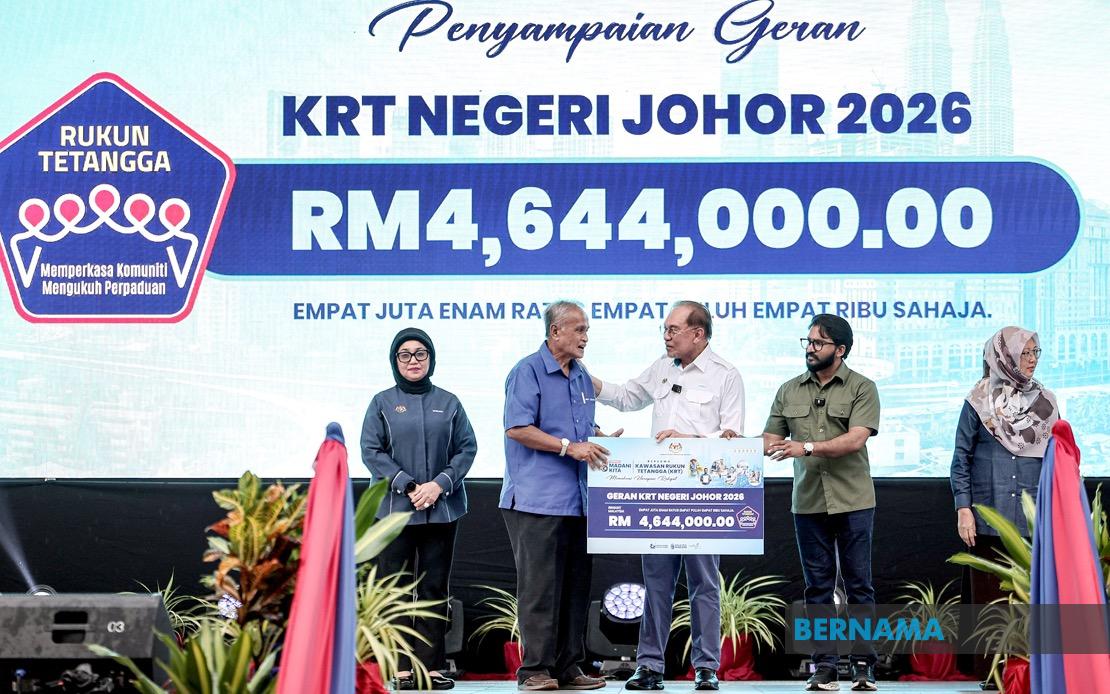
The Malaysian government has moved to enhance its grassroots security and community cohesion framework by substantially raising financial support for Neighbourhood Watch Areas across the nation. Prime Minister Datuk Seri Anwar Ibrahim announced the decision during a MADANI KITA Programme event at Dataran Segamat, directing that the annual grant for KRT units nationwide be increased to RM10,000, up from the previous RM6,000. The enhanced allocation will commence on January 1, 2027, marking a significant commitment to strengthen community-based policing mechanisms that have operated without a funding adjustment for an entire decade.
The rationale behind this budgetary decision centres on recognising the extended period during which KRT funding remained static despite evolving operational demands and the critical role these neighbourhood associations play in Malaysia's social fabric. According to the Prime Minister, the RM6,000 annual allocation had persisted unchanged for ten years, a timeline during which inflation and operational costs have substantially increased. By approving this 67 per cent increase in funding, the government signals acknowledgement that these community organisations deserve resources proportionate to their responsibilities and the contemporary challenges they address at the grassroots level.
Anwar emphasised that the funding increase targets KRT units that maintain transparent reporting standards regarding their development initiatives and community activities. This conditionality reflects a governance approach focused on accountability and performance metrics, ensuring that the enhanced grants are distributed to organisations demonstrating active engagement in their respective neighbourhoods. The emphasis on reporting requirements suggests the government views this investment not merely as financial support but as an incentive structure to encourage stronger organisational discipline and community-oriented outputs.
Beyond the financial dimensions, the Prime Minister articulated a strategic perspective on KRT's broader significance within Malaysia's national framework. He characterised these neighbourhood watch associations as instrumental in revitalising communal consensus, strengthening democratic participation at the grassroots, and fostering unity across diverse communities. In this framing, KRT entities represent frontline institutions where the government's development agenda intersects with citizen engagement, and where security personnel and various government departments collaborate with residents to address localised welfare and security concerns.
The announcement also reflected contemporary thinking about Malaysia's multicultural stability and social cohesion. Anwar stressed that the nation's enduring strength since independence has derived from its capacity to maintain harmony among ethnically, culturally, and religiously diverse populations. He cautioned that differences in racial, cultural, and religious identities should never serve as instruments for social fragmentation; instead, these distinctions should be celebrated and leveraged as markers of national strength. This ideological positioning frames KRT funding not as mere operational expenditure but as an investment in the institutional scaffolding supporting pluralistic coexistence.
The announcement was contextualised within a broader package of developmental commitments unveiled during the Segamat event. Alongside the KRT grant increase, the Prime Minister authorised RM3.205 million in immediate allocation for infrastructure rehabilitation projects targeting Islamic educational facilities throughout Johor. These funds are designated for upgrading and repair works across religious schools, madrasahs, study centres, and tahfiz institutions located in several districts including Batu Pahat, Muar, and Segamat. This parallel investment underscores the government's multifaceted approach to strengthening foundational community institutions.
The government's stated commitment to upgrading facilities at Islamic educational institutions is framed around pedagogical considerations and student welfare. Officials indicated that enhanced infrastructure and improved learning environments at these religious institutions constitute essential components of a broader educational strategy. The allocation reflects recognition that quality learning spaces are fundamental to effective religious education and the formation of students within Islamic institutional settings.
Additionally, the Prime Minister approved RM1.0 million in immediate funding for urgent and critical repair work at Royal Malaysian Police quarters across Johor. This allocation addresses the welfare and living conditions of uniformed personnel, reflecting the government's stated position that maintaining adequate facilities for security forces is integral to sustaining national peace and stability. The rationale articulated links personnel welfare directly to operational effectiveness, suggesting that investments in police housing quality represent investments in broader national security capacity.
These three funding announcements—the KRT grant increase, Islamic education infrastructure support, and police quarters improvements—collectively illustrate a governance approach centred on institutional strengthening at multiple societal levels. The KRT funding targets community-level security and cohesion, Islamic educational facilities address religious institutional capacity, and police infrastructure supports law enforcement personnel welfare. Together, they reflect an integrated vision of social stability and institutional effectiveness extending from the grassroots through security and education systems.
For Malaysian communities, particularly those in smaller towns and rural areas where KRT organisations constitute significant governance structures, the RM10,000 annual allocation represents material recognition of local institutional importance. The funding increase may enable KRT units to undertake more ambitious community projects, enhance their organisational capacity, and strengthen their operational linkages with formal security and government agencies. However, the conditionality attached to reporting requirements also signifies that enhanced resources come coupled with expectations for greater transparency and documented community engagement.
The timing of implementation—with disbursements commencing in January 2027—allows for administrative preparation and baseline adjustments across the KRT network nationwide. This extended timeline also permits the government to refine distribution mechanisms and establish clearer performance benchmarks against which funding will be allocated. For Southeast Asian observers, Malaysia's approach to funding grassroots security organisations reflects broader regional patterns whereby governments invest in community-based policing and neighbourhood associations as alternatives or complements to centralised law enforcement models.
The announcements carry implications for how Malaysian communities engage with both security frameworks and development initiatives in coming years. By materially investing in KRT capacity, the government signals that grassroots institutions will play expanding roles in addressing community welfare and security challenges. The funding increase, coupled with emphasis on reporting and performance standards, suggests an evolving relationship between state agencies and neighbourhood organisations, one characterised by closer partnership but also greater accountability expectations from community-level institutions.

