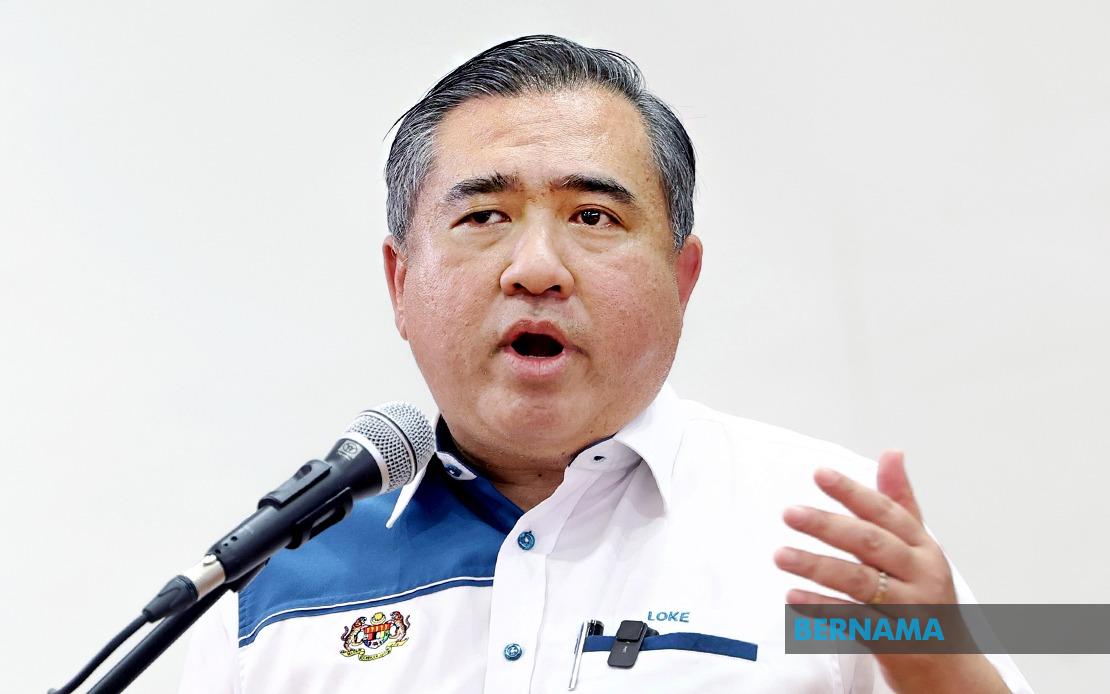
Transport Minister Anthony Loke has defended the deployment of diesel trains on the Southern Shuttle service, characterizing the measure as essential to avoid prolonged disruption for Johor residents and commuters who would otherwise face a wait of two to three years for new Electric Multiple Unit trains to enter service. Speaking on social media, Loke outlined the Ministry of Transport's pragmatic calculus: maintaining service continuity through existing locomotive stock rather than suspending operations entirely while the newer fleet undergoes completion and delivery. The decision reflects a tension between operational necessity and longer-term infrastructure modernization that increasingly defines transport planning across Malaysia.
The ministry has committed an annual subsidy ranging from RM11 million to RM15 million to expand access to rail-based public transport in the region, signaling renewed government investment in Johor's connectivity. This financial commitment underpins the decision to activate the Southern Shuttle service with available rolling stock, ensuring that residents and workers in the state can access an alternative to road-based commuting without delay. The subsidy structure suggests the ministry views the service as a strategic asset worthy of continuous financial support, even as it transitions toward newer technology.
Under current timelines, the Southern Shuttle will cease operating diesel locomotives once the Gemas–Johor Bahru electrified double-tracking project reaches completion. At that point, the route will transition to Electric Train Service operations, eliminating the interim diesel phase entirely. This staged approach effectively uses diesel trains as a bridging solution during the critical infrastructure upgrade period, allowing the corridor to serve passengers continuously rather than remaining dormant. The strategy presupposes that the electrification project will proceed on schedule, though Malaysian rail infrastructure has historically encountered delays that merit cautious optimism rather than certainty.
The Southern Shuttle currently links three strategic locations: Kulai, JB Sentral, and Pasir Gudang, offering commuters substantially faster journeys than alternatives. The Kulai to JB Sentral corridor takes approximately 40 minutes, while the Kempas Baru to Pasir Gudang leg requires 40 to 45 minutes, positioning the service as a competitive option for time-conscious travelers. Journey times of this order of magnitude make the service viable for daily commuting patterns, particularly for workers traveling between industrial zones and urban centers. The emphasis on speed and convenience suggests that frequency and reliability will determine whether the service achieves meaningful modal shift away from private vehicle usage.
A notable feature of the expanded service is the reopening of the Kempas Baru–Pasir Gudang route to passenger traffic, a corridor previously dedicated to freight operations. This transition represents intelligent infrastructure utilization, converting underutilized freight capacity into revenue-generating passenger service. The move also reflects evolving logistics patterns where rail freight may increasingly concentrate on longer-haul, bulk-movement operations while shorter regional routes accommodate mixed-use services. For Pasir Gudang residents and workers, the inclusion on the Southern Shuttle map provides long-overdue connectivity to broader regional transport networks.
Criticism of the service has centered on fare structures, with observers noting that Southern Shuttle fares are approximately three times higher than comparable rail services operating in the Klang Valley and the Seremban corridor. This disparity raises important questions about pricing consistency across Malaysia's rail network and whether rates accurately reflect cost recovery, operational subsidies, or strategic market positioning. Higher fares in Johor could reflect genuine cost differences in operating the newer service, or they might indicate that the ministry is testing price sensitivity in a regional market with less developed public transport alternatives. The discrepancy merits closer examination, particularly if fare levels inadvertently suppress demand among price-sensitive commuters who might otherwise adopt rail travel.
The deployment of temporary diesel technology also carries environmental implications for Johor, a state increasingly conscious of air quality and emissions management. While the interim period is explicitly time-bound, the extended use of diesel locomotives during the electrification transition period will generate localized emissions along the service corridor. This tradeoff between immediate service delivery and environmental performance reflects broader tensions in transport planning where speed of deployment sometimes conflicts with sustainability objectives. The ministry's commitment to eventual full electrification demonstrates recognition of these environmental concerns, though the interim phase represents a pragmatic compromise between competing priorities.
For Malaysian transport planners, the Southern Shuttle model offers instructive lessons in managing infrastructure transitions. Rather than attempting simultaneous service launch and technology upgrade—an approach that typically triggers project delays and cost overruns—the phased strategy accepts temporary sub-optimal operating conditions to maintain continuity and generate early revenue. This approach may become increasingly relevant as Malaysia seeks to modernize aging transport infrastructure while maintaining uninterrupted service for dependent populations. The willingness to operate transitional technology demonstrates that perfection in infrastructure systems often yields to functionality in practice.
The broader context for the Southern Shuttle includes Malaysia's ambition to increase rail's modal share in passenger transport across the peninsula. Johor, as Malaysia's second-largest state by population, represents a critical market for achieving these objectives. The service expansion signals that the ministry recognizes underserved demand in the southern corridor and is prepared to allocate resources toward activation. If the Southern Shuttle achieves reasonable ridership during its diesel phase, the success case could justify investment in similar services elsewhere in Johor and potentially inspire comparable schemes in other states with comparable geography and population distribution.
The 10 new Electric Multiple Unit train sets referenced by Loke represent a substantial capital investment, likely requiring extended procurement and manufacturing lead times with overseas suppliers. These trains will define long-term service characteristics, including capacity, comfort standards, and operating costs once the electrification project concludes. The quality and reliability of these newcomer trains will substantially influence whether the Southern Shuttle evolves into a foundational regional transport asset or remains peripheral to most commuters' travel patterns. The ministry's confidence in ordering this quantum of new rolling stock suggests institutional conviction that demand exists to justify the expenditure, even accounting for current fare criticism.
Stakeholder reactions will ultimately determine whether the diesel interim period succeeds as a transitional tool or becomes perceived as a false promise of imminent improvement. If service reliability and schedule adherence prove consistent, ridership may gradually build confidence in rail alternatives despite technological limitations. Conversely, if operational disruptions plague the early service period, skepticism about rail viability in the region could harden among potential users. The ministry therefore faces an implicit deadline not merely to complete the EMU procurement but to demonstrate that the interim service provides sufficient value to sustain user commitment through the transition period. The stakes extend beyond Johor to broader national transport strategy, where regional success stories increasingly shape policy confidence.

