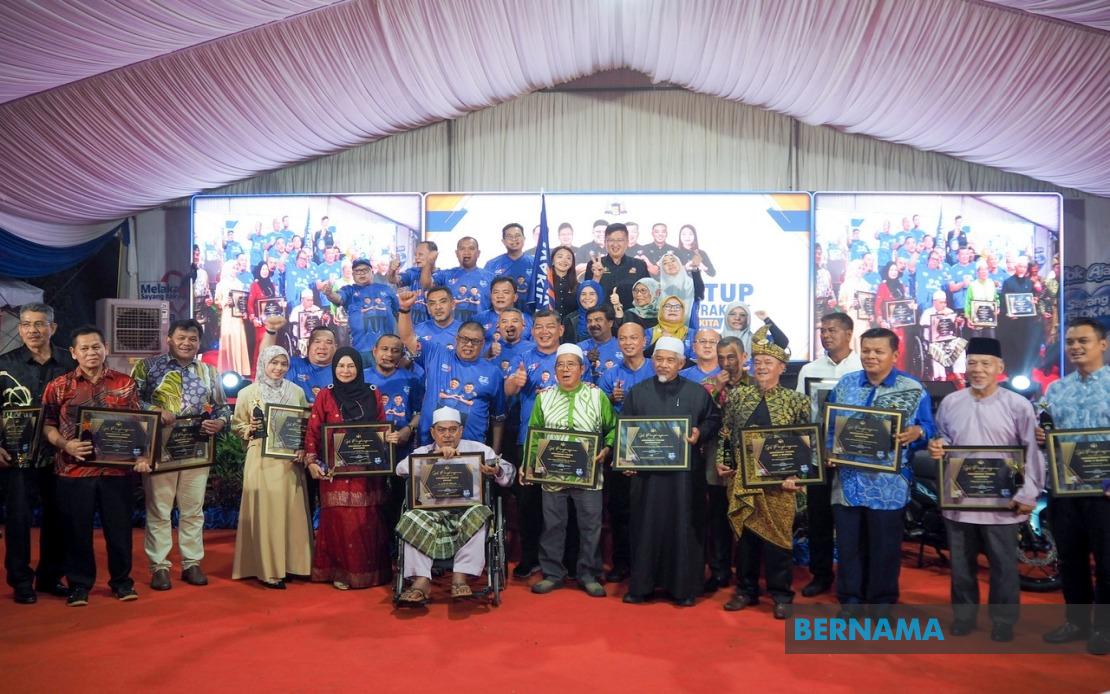
Melaka Chief Minister Datuk Seri Ab Rauf Yusoh has reframed how the state government evaluates the effectiveness of its flagship Wakil Rakyat Untuk Rakyat (WRUR) programme, arguing that meaningful governance cannot be reduced to mere metrics of programme volume. Speaking at the conclusion of WRUR's rollout in the Kota Melaka parliamentary constituency, Ab Rauf contended that true performance lies in the ability to identify, document and resolve grievances that affect ordinary households, irrespective of their political affiliation or geographic location.
The chief minister's emphasis on outcome over output reflects an increasingly pragmatic approach to public service delivery in Malaysia's political landscape. Rather than trumpeting the number of activities organised, his administration is positioning itself as being fundamentally responsive to ground-level concerns. This shift in narrative carries implications for how state governments across Southeast Asia might be judged by constituents, particularly in contexts where competing parties vie to demonstrate competence and accessibility.
According to Ab Rauf, the WRUR initiative operating across 19 state constituencies within Melaka has generated 4,027 complaints from residents since its inception. Significantly, 2,633 of these grievances—representing just over 65 per cent—have been successfully resolved. The remaining cases remain under active review, with the chief minister pledging that processing will continue beyond the formal programme period. This commitment to follow-through addresses a common frustration in Malaysian governance: complaints registered but subsequently abandoned once political campaigns conclude.
Kota Melaka represents the third parliamentary constituency to implement the WRUR framework, following earlier deployments in Alor Gajah and Hang Tuah Jaya. During its four-week implementation window, the programme marshalled over 500 separate initiatives across five state constituencies, extending benefits to more than 200,000 residents. In Kota Melaka specifically, 470 complaints were lodged, with 31 resolved during the active period and the remainder classified according to priority for continued handling.
The WRUR approach fundamentally centres on decentralisation of problem-solving. Rather than channelling all grievances through bureaucratic hierarchies, the programme empowers elected representatives to engage directly with constituents, document their concerns, and coordinate agency responses at the source of the problem. For Malaysian readers familiar with the frustrations of navigating government departments, this methodology represents a potential corrective to siloed administration and bureaucratic delay.
Datuk Abdul Razak Abdul Rahman, chairman of the State Tourism, Heritage, Arts, and Culture Committee, highlighted complementary development initiatives in the Telok Mas state constituency, where 328 local projects valued at RM68 million have been implemented over five years. These initiatives span conventional infrastructure rehabilitation—road upgrades, drainage systems, sewerage repairs—alongside social housing programmes and community facility improvements. The breadth suggests that responsive governance operates across multiple registers simultaneously, addressing both immediate grievances and longer-term development aspirations.
Welfare provision has also constituted a substantial focus. Over the same five-year window, Telok Mas residents received food assistance, welfare payments, and health support totalling RM1.2 million, alongside distribution of 213 medical beds to qualifying households. The Jualan Rahmah and Jualan Murah subsidised retail programmes have been conducted 70 times since 2022, directly targeting household consumption pressures. Additionally, the Free Petrol Programme has extended fuel subsidies worth RM177,000 to approximately 15,000 residents, illustrating how state governments grapple with cost-of-living volatility through targeted assistance.
Educational investment has received particular attention, with 1,694 secondary candidates supported through examination preparation schemes and 255 high-performing Form Five and tertiary students receiving educational incentives totalling RM244,200. Such programmes reflect recognition that mobility through education remains contested terrain in Malaysian society, where household income significantly influences access to supplementary tutoring and university progression.
Looking forward, Telok Mas faces tourism-oriented development aimed at regional differentiation and economic diversification. The Ministry of Tourism, Arts and Culture has allocated RM2.4 million toward upgrading tourism facilities in Sungai Punggor and Alai, with completion targeted for 2027. A further RM300,000 investment will establish Dataran Telok Mas as a consolidated centre for tourism promotion and local traditional product marketing. Most ambitiously, the Bukit Larang geosite has been designated for assessment as a National Geopark site under the emerging Melaka Geopark initiative, with evaluation scheduled for October.
These layered interventions—spanning immediate grievance resolution, welfare provision, infrastructure rehabilitation, educational support, and long-term economic positioning—suggest that contemporary Malaysian governance increasingly operates as a portfolio of competing priorities rather than a coherent strategy. The WRUR programme attempts to unify this dispersed activity through centralised complaint processing and commitment to systematic follow-through, potentially offering a model for other states confronting fragmentation in service delivery.
For ordinary Malaysians accustomed to bureaucratic opacity and unresolved grievances, Ab Rauf's insistence that impact—not output—defines success represents a modest but significant repositioning of political accountability. The measure of this claim will ultimately rest on whether the 2,633 resolved complaints reflect substantive improvement in residents' circumstances or merely administrative closure of case files. The chief minister's explicit instruction to agencies to continue monitoring issues beyond the formal programme window suggests awareness of this distinction, yet implementation fidelity across multiple jurisdictions and timescales remains a persistent challenge in Malaysian governance.

