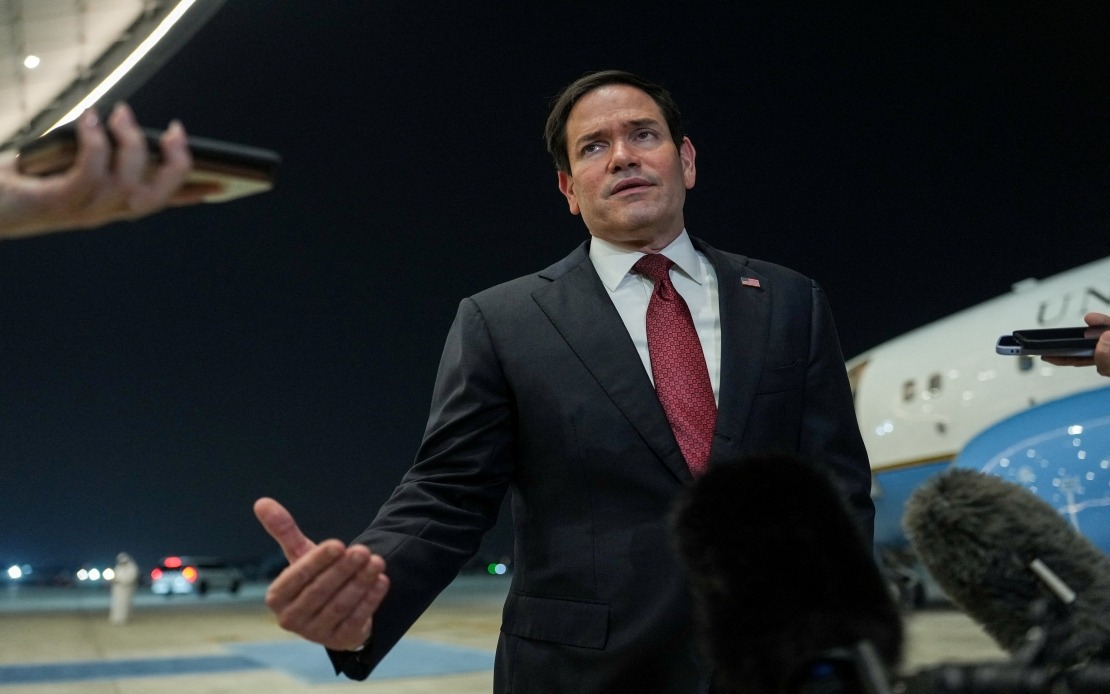
The United States will not commit government funds toward any reconstruction initiative for Iran, according to Secretary of State Marco Rubio, who addressed swirling speculation about a potential regional financing arrangement. Speaking to reporters on Tuesday, Rubio emphasized that while discussions about such economic mechanisms may form part of broader negotiations, direct American government participation is not on the table. His remarks clarify the Trump administration's position as diplomatic engagement with Tehran continues at a delicate stage, with multiple parties exploring pathways to regional stability.
Rubio's statement appears designed to manage expectations around a $300 billion reconstruction fund that President Trump dismissed last week as speculative reporting. The secretary of state suggested that any meaningful economic cooperation would depend less on financial commitments and more on Iran's willingness to create conditions for legitimate economic opportunity. This framing shifts the onus onto Tehran to demonstrate behavioral change across multiple security dimensions before economic incentives become relevant. The distinction is crucial: Washington is signaling openness to economic normalization as a downstream consequence of progress, not as an immediate inducement.
The clarification becomes significant given the involvement of Gulf Cooperation Council states in preliminary discussions. Rubio noted that if contributions were to materialize, they would come from regional actors like Saudi Arabia, the United Arab Emirates, and other Gulf partners rather than the US government. This arrangement would align with the administration's broader strategy of encouraging regional powers to assume greater responsibility for Middle Eastern security architecture while the US steps back from direct financial commitments. For Malaysia and Southeast Asia, this approach signals American willingness to create space for other nations to shape regional outcomes through economic engagement.
Recent diplomatic momentum has accelerated following last week's signing of a memorandum between Iran and the United States that formally ended military hostilities beginning February 28. The agreement, signed remotely, established specific timelines for American naval blockade removal and Iranian restoration of shipping through the Strait of Hormuz—a critical waterway affecting global maritime commerce and Malaysian trade routes. The structure demonstrates how security arrangements are being compartmentalized, with military issues addressed separately from broader normalization discussions. This modular approach may offer templates for resolving other regional conflicts where security, economic, and political concerns require phased resolution.
Direct talks between Iranian and American delegations took place in Burgenstock, Switzerland, on Sunday, mediated by Qatar and Pakistan. The US delegation was led by Vance, while Iran's parliamentary speaker Mohammad Bagher Ghalibaf headed the Iranian contingent. Both sides subsequently reported progress, signaling that despite decades of acrimony, negotiators are finding common ground on specific issues. The involvement of Qatar and Pakistan as mediators reflects how smaller nations can leverage geographic position and diplomatic relationships to influence major power negotiations—a dynamic relevant for Southeast Asian states navigating between competing powers.
A separate nuclear agreement remains under negotiation, with parties committing to resolve Iran's weapons program through dedicated discussions within a 60-day timeframe. This timeline suggests negotiators view nuclear issues as distinct from military ceasefire and economic arrangement discussions, allowing for parallel but sequenced diplomatic tracks. Iran has committed not to pursue nuclear weapons acquisition as part of the overall framework, though the detailed verification mechanisms and sanctions relief arrangements still require resolution. For regional players monitoring Iranian nuclear development, these talks represent a critical moment when the trajectory could shift significantly.
Rubio's emphasis on conditions and security progress rather than unconditional funding reflects a transactional approach characteristic of the Trump administration's foreign policy. The message conveyed to Iran is that economic normalization flows from demonstrated compliance with security commitments, not the reverse. This sequencing creates incentive structures where early steps toward military de-escalation and shipping corridor restoration become prerequisites for broader economic engagement. However, it also risks appearing punitive if Gulf states refuse to participate or if verification mechanisms prove contentious.
The potential involvement of Gulf reconstruction financing deserves scrutiny given the geopolitical complexities involved. Saudi Arabia and the UAE maintain their own tensions with Iran over Yemen, Syria, and regional influence spheres. Any reconstruction fund would implicitly acknowledge Iranian economic distress while potentially being contingent on Iranian behavioral change across multiple theaters beyond the central US-Iran bilateral relationship. This could create friction within Gulf Cooperation Council ranks if states disagree about Iran's compliance with unstated expectations.
For Southeast Asian observers, these developments carry implications for regional security architecture and maritime freedom. The Strait of Hormuz restoration clause directly affects shipping insurance, route planning, and energy security calculations for nations dependent on Gulf oil and gas. Malaysia's position as a major trading nation with significant commerce passing through these waters means that any improvement in Iranian-American military relations directly reduces risks to Malaysian vessels and commerce. Conversely, if negotiations collapse, the region faces renewed uncertainty about chokepoint security.
The broader pattern of American diplomacy reflected in Rubio's comments suggests the Trump administration is attempting to engineer Iranian behavioral compliance through a combination of military deterrence, blockade enforcement, and conditional economic reopening. By explicitly ruling out direct US government funding while leaving space for regional partners to contribute, Washington preserves leverage while distributing financial burden. This approach assumes sustained negotiating capacity and credible follow-through on blockade removal, which remain uncertain given historical US-Iran relations and domestic American political pressures.

