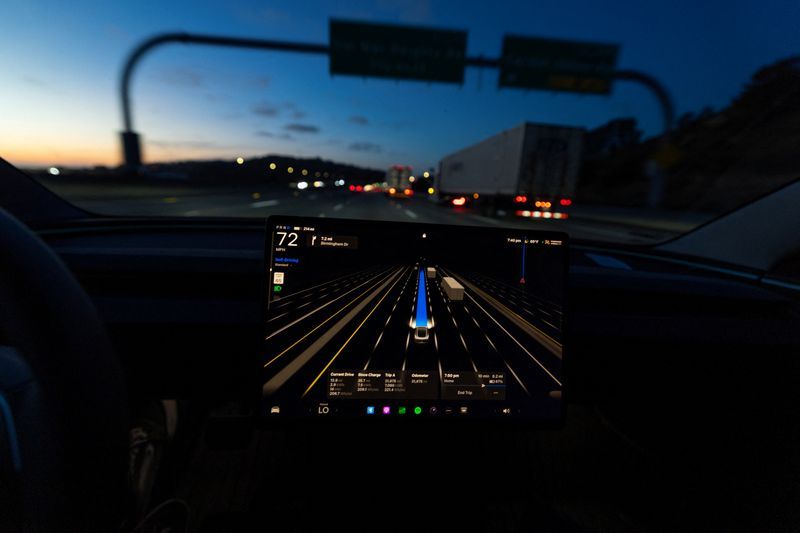
Pressure is mounting on Tesla over the integrity of its safety data for the Full Self-Driving driver-assistance system, with two prominent US senators formally demanding that federal regulators scrutinise the company's publicly released crash statistics. Democratic senators Edward Markey of Massachusetts and Richard Blumenthal of Connecticut have written to the National Highway Traffic Safety Administration (NHTSA) requesting an urgent examination of Tesla's methodology, following a Reuters investigation that revealed significant inconsistencies in how the electric vehicle manufacturer presents its safety record to the public and policymakers.
The senators' letter, sent to NHTSA on Monday, characterises Tesla's analytical framework underlying the FSD safety claims as fundamentally unreliable. They argue that the company's approach creates "an urgent safety problem" by presenting statistics to consumers and regulators that may not accurately reflect real-world safety performance. The correspondence asks NHTSA to provide detailed responses by July 7, with senators seeking clarity on whether the agency has independently evaluated Tesla's FSD safety assertions or requested access to the underlying crash data that supports those claims.
At the heart of the controversy is a methodological flaw that Reuters identified in Tesla's safety comparisons. The company, led by CEO Elon Musk, has repeatedly claimed that FSD technology is up to 10 times safer than human drivers, a dramatic assertion that dominates Tesla's marketing and public communications strategy. However, researchers interviewed by Reuters discovered that Tesla achieves this comparison through a carefully constructed but fundamentally misleading analytical approach. The company measures crashes in FSD-piloted Teslas that triggered airbag deployments—a threshold that captures only the most severe incidents—and compares this rate against the US national crash rate for all vehicles, which includes far less serious accidents like minor fender-benders.
This comparison methodology creates a statistical illusion that exaggerates FSD's safety advantages. By selecting a high-severity threshold for its own vehicles while using a comprehensive denominator for comparative data, Tesla essentially compares its most serious crashes against average American crashes of all severity levels. The effect is profound: the resulting statistics appear far more favourable to Tesla than a properly calibrated analysis would show. This selective framing has become central to Tesla's public messaging and investor relations narrative regarding autonomous driving technology.
Another critical distortion in Tesla's safety analysis involves the reference vehicles used for comparison. Tesla benchmarks its modern vehicles against the average age of vehicles on US roads, which is considerably older and equipped with fewer contemporary safety features. As major automotive manufacturers have progressively integrated advanced safety systems over the past decade—from collision avoidance to automatic emergency braking—these technologies have systematically reduced crash rates across the industry. By comparing newer Teslas to an older, less safety-equipped vehicle fleet average, Tesla inflates the apparent safety advantage of its own technology relative to what a contemporaneous comparison would reveal.
The implications of these methodological problems extend beyond the US market. Reuters reported earlier this week that Tesla has presented this same inflated safety data to European Union regulators as part of its push to secure regulatory approval for deploying FSD across EU member states. This globalisation of potentially misleading safety claims raises significant concerns about whether European policymakers, who maintain notably stringent safety standards, have been provided with accurate information for their decision-making processes. For Southeast Asian markets considering autonomous driving regulations, the Tesla case demonstrates the critical importance of establishing independent verification requirements before accepting manufacturer-supplied safety claims.
The senators' letter represents an escalation in official scrutiny of Tesla's autonomous driving claims, signalling that congressional bodies are now taking seriously the gap between the company's public messaging and actual safety performance verification. Markey and Blumenthal go beyond merely requesting an investigation into Tesla's existing claims; they explicitly urge NHTSA to strengthen overall reporting requirements for companies developing and deploying self-driving and advanced driver-assistance technologies. The senators contend that NHTSA currently lacks mechanisms to determine whether public safety claims from companies like Tesla bear any meaningful relationship to empirical reality.
This regulatory gap is particularly acute in the context of rapidly evolving autonomous vehicle technologies that operate in a space between fully manual and fully autonomous driving. The FSD system sits precisely in this grey zone, where regulatory oversight has lagged behind technological capability. The senators are essentially arguing that the current framework allows manufacturers to make essentially unverified claims to consumers without independent scrutiny, creating potential dangers as these systems become more prevalent on public roads.
Neither Tesla nor NHTSA has responded to requests for comment regarding the senators' letter, leaving the company's formal position on the safety methodology critique unstated. Tesla has historically resisted external scrutiny of its autonomous driving technology claims, preferring to position itself as the arbiter of its own safety standards. The company's reluctance to engage with these criticisms publicly may reflect concern about the legal and commercial implications of acknowledging the methodological flaws that Reuters identified.
The timing of this regulatory intervention is significant, as Tesla faces growing competition in the autonomous vehicle space from established automotive manufacturers and specialised autonomous vehicle companies that are developing alternative approaches. If NHTSA determines that Tesla's safety claims are indeed misleading, the regulatory consequences could include mandatory revisions to how the company markets FSD, potential fines, and requirements for more robust independent testing and verification. Such outcomes would establish important precedents for how US regulators treat manufacturer claims about emerging technologies.
For Malaysian and Southeast Asian readers, the Tesla case illustrates broader challenges in regulating autonomous vehicle technologies in markets where regulatory infrastructure may be less developed than in the US. As autonomous driving technology inevitably spreads to regional markets, policymakers in Southeast Asia should note that manufacturer self-regulation and self-published safety data have proven inadequate safeguards even in highly developed regulatory environments. Building independent testing and verification capacity early, before these technologies achieve significant market penetration, will be essential for protecting public safety while enabling innovation.