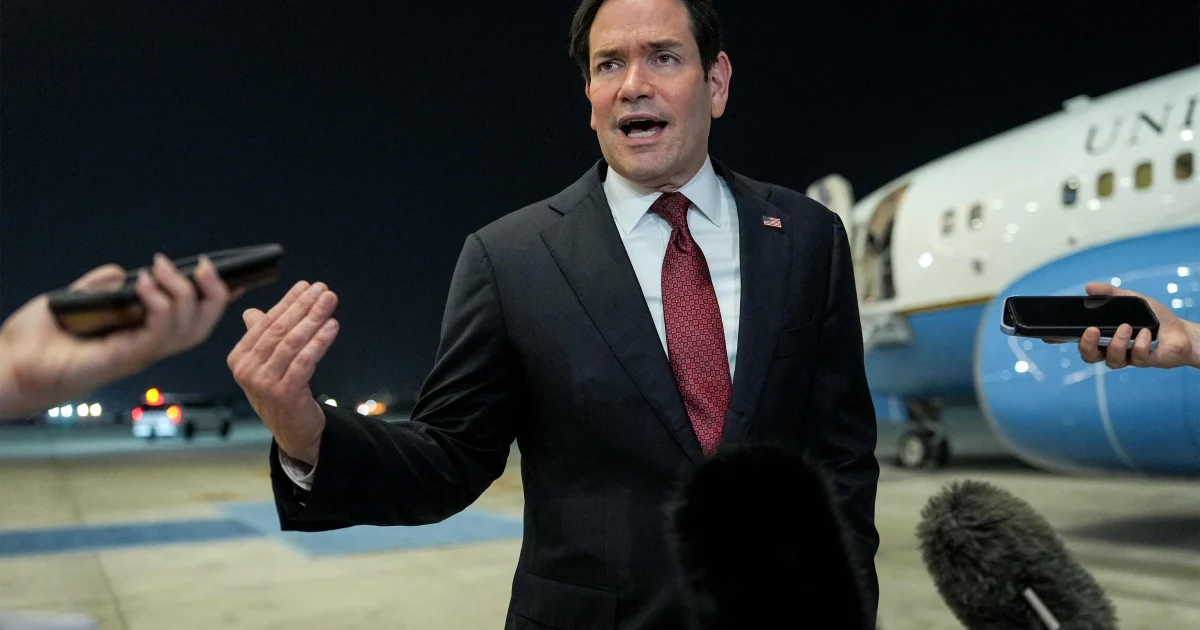
The United States has firmly rejected proposals from Iran to levy tolls or fees on commercial traffic transiting the Strait of Hormuz, according to remarks made by US Secretary of State Marco Rubio on Tuesday, marking a significant early flashpoint in delicate negotiations aimed at halting regional conflict. The rejection underscores mounting tensions over sovereignty claims on one of the world's most critical maritime chokepoints, through which roughly a third of global seaborne oil passes annually.
Rubio's statement reflects Washington's position that any toll system imposed by Tehran would constitute an illegitimate restriction on international commerce and freedom of navigation. The Strait of Hormuz, separating Iran from Oman, has long been a flashpoint between Western powers and Iran over questions of maritime rights and regional control. For decades, the United States has maintained that the waterway should remain open for unimpeded international shipping, a principle undergirded by international maritime law and UN conventions governing straits used for global commerce.
The significance of this dispute extends far beyond abstract principles of international law. For Malaysia and other Southeast Asian economies heavily dependent on Middle Eastern oil imports and reliant on stable maritime trade routes, any disruption to Hormuz shipping would carry profound economic consequences. Malaysian refineries and petrochemical industries depend substantially on crude oil flowing through the strait, making the region's stability directly relevant to Malaysia's energy security and economic interests.
The disagreement over Hormuz tolls represents merely one of several complications hampering broader efforts to establish a lasting ceasefire in the Middle East. Negotiations have simultaneously encountered friction over Iran's nuclear programme, particularly regarding the scope and intrusiveness of international inspections that the International Atomic Energy Agency would be permitted to conduct. Iran has sought to limit the extent of intrusive monitoring, viewing extensive inspections as violations of national sovereignty, while Western parties have insisted on comprehensive verification mechanisms to ensure compliance with any nuclear agreement.
Missile capabilities form another contentious negotiating point, with the United States and its regional allies demanding constraints on Iran's ballistic and cruise missile arsenals, while Tehran characterises its missile programme as a legitimate defence necessity. These weapons have become increasingly sophisticated in recent years and remain a primary source of concern for Gulf states and Israel, yet Iran views restrictions on its military capabilities as disproportionately disadvantageous.
The accumulation of these disagreements signals that achieving a comprehensive settlement will require sustained diplomatic effort and difficult compromises from all parties involved. Each issue carries domestic political weight—Iranian leaders face pressure from hardliners opposing any concessions, while American officials must satisfy Congressional skeptics and regional allies concerned about Iranian military capabilities and regional influence. Malaysian policymakers monitoring these developments must consider how any agreement or failure to reach agreement would affect regional stability, shipping security, and energy market dynamics affecting Malaysian import costs and economic growth.
Historically, disputes over the Strait of Hormuz have occasionally escalated into military posturing, with Iran previously threatening to close the waterway during periods of heightened tension with Western powers. While such closures remain unlikely in practice due to international legal protections and the prohibitive costs to Iran's own economy, the threat itself influences oil markets and regional security calculations. The current negotiations represent an opportunity to establish clearer frameworks governing the strait's use, though disagreements over tolls suggest this opportunity remains contested.
The timing of Rubio's remarks reflects the early stage of negotiations, where positions remain relatively rigid and posturing still predominates over substantive compromise-seeking. In such early phases, dramatic public rejections serve both symbolic and tactical purposes—signalling resolve to domestic audiences while potentially laying down markers for later negotiation. However, the breadth of disagreement spanning maritime access, nuclear inspections, and weaponry suggests negotiators face a complex puzzle requiring creative solutions to bridge fundamental differences.
For regional observers including Malaysia, these negotiation dynamics matter considerably. A successful agreement could stabilise Middle Eastern energy markets, reduce insurance premiums and shipping costs on Hormuz-transiting vessels, and diminish the risk of military confrontation that could disrupt energy supplies. Conversely, negotiation failure could prolong regional tensions, perpetuate military buildups, and maintain elevated shipping costs and insurance premiums that filter through to Malaysian consumers and businesses dependent on energy imports.
The rejection of Iranian toll proposals should not be interpreted as an absolute negotiating endpoint, despite Rubio's firm language. International negotiations typically involve extensive discussion of initially rejected proposals, with creative reformulation and face-saving mechanisms eventually enabling agreement on contested issues. Whether this particular dispute ultimately proves negotiable or becomes a genuine dealbreaker remains unclear, depending on how much flexibility Iran demonstrates regarding its toll aspirations and how creative negotiators become in finding alternative formulations acceptable to both sides.
Moving forward, success in these talks will likely hinge on whether negotiators can compartmentalise disputes—reaching agreement on some issues while suspending others or linking concessions across domains. The apparent determination of the United States to reject Iranian toll schemes wholesale suggests Washington considers this a core interest protecting broader principle, yet history demonstrates that such declared red lines sometimes prove more flexible when broader diplomatic settlements emerge on the horizon.

