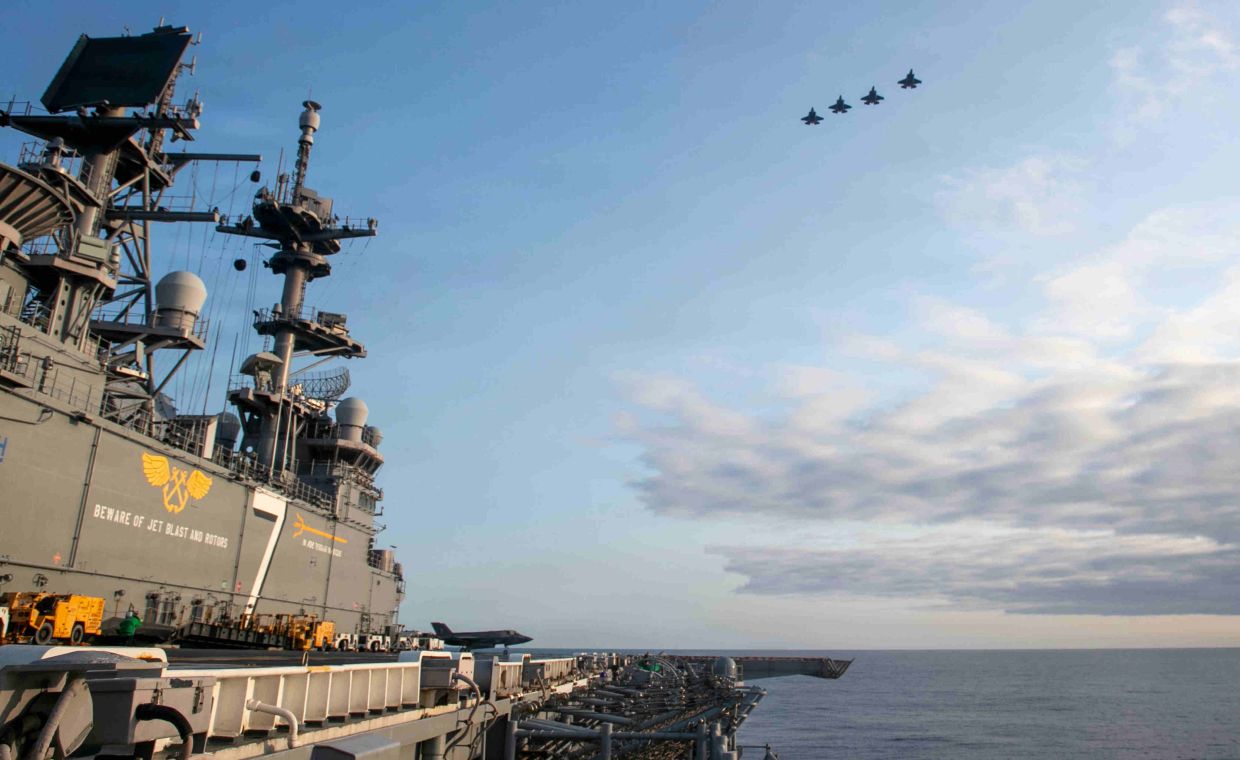
After months of concentrated military engagement in the Middle East, the United States appears to be recalibrating its global naval presence, with significant warship movements indicating a return of strategic focus to the Asia-Pacific region. The USS Boxer, a heavily-armed amphibious assault ship that was originally tasked for duty in the Middle East, has now been redirected to join the Seventh Fleet in the South China Sea from early June, accompanied by the amphibious transport dock USS Portland. The redeployment marks a visible shift in Washington's military priorities as the acute phase of confrontation with Iran begins to wind down, following an agreement announced by the United States and Pakistan for renewed negotiations with Tehran over the Strait of Hormuz and an end to the naval blockade.
The timing of these movements reflects broader shifts in US strategic calculations. Earlier in the year, the Pentagon had aggressively repositioned military assets from across the Indo-Pacific toward the Middle East, alarming several American allies who depend on forward-deployed naval power for security guarantees. The absence of the USS Tripoli amphibious strike group from the region raised questions among countries like Japan, South Korea, and Australia about Washington's sustained commitment to their security and regional stability. This concern was not merely political; the Seventh Fleet, headquartered in Yokosuka and responsible for the vast western Pacific theatre, is considered foundational to American deterrence of Chinese military expansion and the maintenance of rules-based maritime order across one of the world's most economically vital regions.
The USS Boxer brings substantial combat capability to the Pacific. The vessel carries a mix of advanced aircraft, including F-35B stealth fighters and MV-22B Osprey helicopters, along with the 11th Marine Expeditionary Unit—a force typically comprising more than 2,000 marines and sailors trained for rapid-response operations. According to the Seventh Fleet's assessment, this unit functions as "a persistent, combat credible force contributing to deterrence and crisis response" within the fleet's operational area. The specificity of this deployment, tracked through both US Navy statements and commercial satellite imagery, underscores the deliberate nature of the repositioning and suggests sustained American determination to maintain visible military presence in contested waters.
The broader geopolitical implications of this shift cannot be overstated for regional actors, particularly those in Southeast Asia who occupy the critical maritime corridors through which the Boxer now operates. Collin Koh, a senior fellow at the S. Rajaratnam School of International Studies in Singapore, characterizes naval presence as the foundation of American military power projection in the region. "The linchpin of US military force projection and presence has always been, mainly, the US Navy," Koh observed. "So that has often been a source of assurance and a deterrence signal." When these assets shifted westward in recent months to support operations against Iran, allied governments in Asia registered quiet but genuine anxiety about the durability of American commitment to their waters. The redeployment of the Boxer therefore functions simultaneously as military repositioning and diplomatic messaging—a signal that American strategic interests in the Pacific remain paramount.
Congress itself had expressed concerns about the sustainability of the Middle Eastern focus. During an April Senate hearing, Admiral Samuel Paparo, when pressed on how long munitions expenditure could continue in the Iran theatre without degrading US Indo-Pacific capabilities, acknowledged that "there are finite limits to the magazine" and that munitions were being deployed "judiciously." His careful phrasing reflected a genuine operational constraint: the US military's capacity for simultaneous major operations across two theatres is not unlimited. The congressional anxiety mirrored strategic anxieties held by allies who questioned whether the Middle Eastern adventure might come at the expense of Pacific readiness at a moment when Chinese military modernization and assertiveness in the South China Sea continue on an accelerating trajectory.
Analysts have emphasized that US strategic calculations remain fundamentally oriented toward China as the primary long-term adversary. Ni Lexiong, a Shanghai-based military analyst, notes that both major American political parties view China as Washington's most consequential rival. The redeployment of assets from the Middle East to the Pacific thus reflects deeper strategic consensus. "Other than military functions, pulling military assets is also a diplomatic stance that signals where its priority is," Ni observed. This positioning demonstrates that despite pressing near-term crises, the American strategic establishment remains committed to what has been termed the "Indo-Pacific" framework—viewing the region as the central arena of great-power competition in the coming decades.
The Pentagon has further underscored this strategic orientation through an institutional change: the renaming of the Indo-Pacific Command back to the United States Pacific Command. While the Department of Defence stated that the command's operational area remains unchanged—spanning from the western coasts of North America to the western border of India—the nomenclature shift signals a recalibration of institutional focus and priorities. The name change removes the geographic qualifier that emphasizes India's inclusion, reverting to simpler but historically-loaded terminology that prioritises the Pacific theatre proper. Whether this nomenclatural adjustment will accompany substantive changes in deployment patterns or strategic doctrine remains unclear, but the timing alongside the Boxer's redirection suggests symbolic and operational coherence in messaging.
For Malaysia and other Southeast Asian nations, the repositioning of American naval forces carries material significance. The South China Sea, through which the USS Boxer now operates, remains contested territory where multiple claimants advance overlapping territorial demands, and where freedom of navigation remains a contentious issue between Washington and Beijing. The presence of advanced American naval forces, coupled with aircraft like the F-35B fighter, affects the military balance and shapes calculations about risk and reward for various regional actors. The stability that comes from American naval presence—however contested by some—has provided a counterweight to unilateral assertions of control and has underpinned the maritime order that allows for the passage of enormous volumes of commerce through these waters.
The broader narrative arc of American military prioritization also carries implications for regional security architecture. If the pivot from the Middle East to the Pacific represents a genuine recalibration rather than temporary repositioning, it suggests that Washington is moving toward a more sustainable, long-term strategy focused on its declared core challenge: managing Chinese power and maintaining the legal and operational frameworks that define the Indo-Pacific system. This recalibration comes as several Southeast Asian nations balance diplomatic relationships with both superpowers, seeking security cooperation with the United States while maintaining economic and political ties with China. The clarity of American commitment, signalled through visible naval deployments and institutional reorganization, therefore carries weight in regional calculations about alignment and hedging strategies.
The Iran agreement that enabled this pivot, by reducing the military necessity of sustained American focus on the Middle East, has inadvertently created space for renewed American attention to the region that has become strategically central to global affairs. The relatively rapid de-escalation between Washington and Tehran—moving from confrontation toward negotiated settlement—demonstrates that crisis management can succeed when diplomatic off-ramps exist. For the Asia-Pacific, this success in de-escalating one theatre provides assurance that American security commitments are not permanently captured by Middle Eastern conflicts. Yet the episode also revealed the finite nature of American military capacity and the costs to allied relationships of major strategic pivots. Going forward, the sustainability of this renewed Pacific focus will depend on whether the Middle East remains genuinely stabilized or whether new crises might again draw American attention westward.

