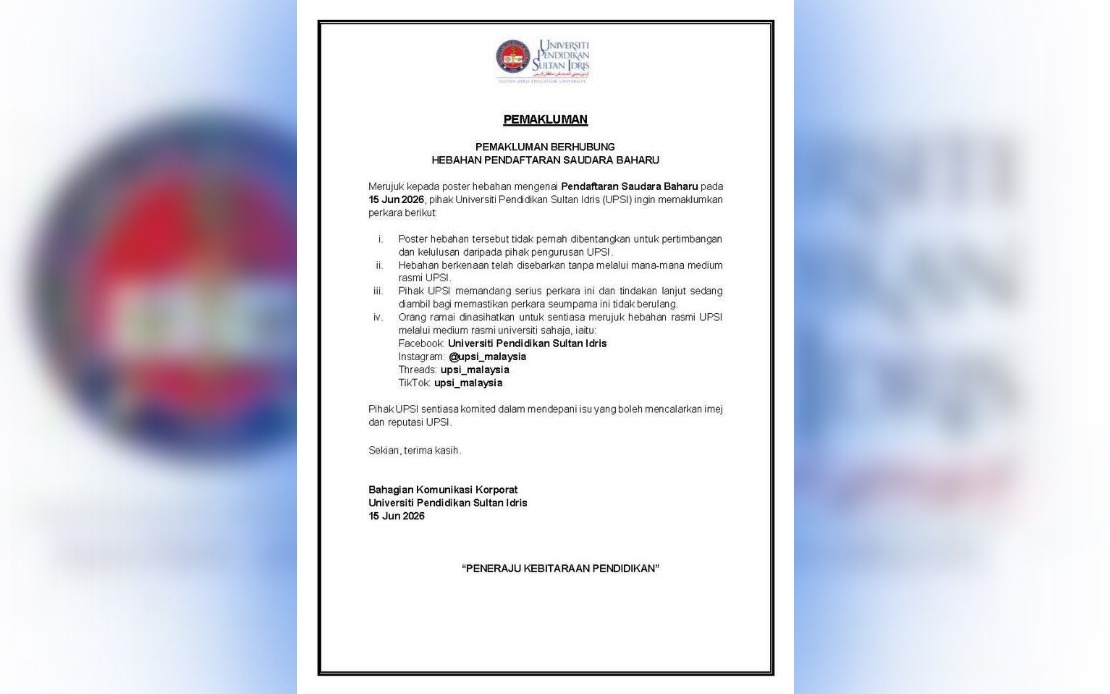
Universiti Pendidikan Sultan Idris (UPSI) moved swiftly to distance itself from an unauthorized poster promoting registration of 'saudara baharu' or newly converted Muslims that gained traction across social media platforms in mid-June. The institution's leadership denied any institutional involvement in the June 15-dated material and emphasized through official channels that neither the content nor its distribution received administrative approval or authorization from university leadership.
The poster's rapid spread without sanctioning from UPSI's central administration underscores growing concerns about misinformation and unauthorized communications attributed to established institutions. In the digital age, where content travels instantaneously across social networks, the ability to establish clear institutional boundaries between official and unofficial messaging has become critical for reputation management. UPSI's swift public response demonstrates awareness of how unauthorized content can quickly undermine institutional credibility if left unaddressed.
The university's statement, released through its verified social media accounts, stressed that the poster had never progressed through proper institutional channels for consideration or formal approval. This distinction matters considerably—it signals that the material originated outside the university's governance structures and communication protocols. For a public institution like UPSI, maintaining clarity about what represents official university positions versus external actors claiming association is fundamental to transparent institutional communication.
UPSI indicated that the matter receives serious institutional attention and that follow-up measures would be implemented to prevent similar unauthorized circulation in future. The university's commitment to investigating the poster's origin and distribution mechanisms reflects broader anxieties within Malaysian public institutions about protecting their names and reputations from unauthorized use. Such vigilance has become necessary as social media enables rapid amplification of content that may misrepresent organizational positions or create false associations with official bodies.
The university explicitly advised the public to rely exclusively on announcements disseminated through UPSI's recognized official platforms when seeking authentic institutional information. This guidance carries particular weight in an information landscape where distinguishing between authorized and unauthorized communications has grown increasingly difficult for average users. By directing stakeholders toward verified channels, UPSI attempts to create a protective barrier around its authentic communications and reduce susceptibility to misinformation bearing its name.
The incident reflects broader challenges facing Malaysian educational and public institutions as they navigate social media environments where content attribution and source verification remain problematic. Posters and announcements can be quickly reproduced, modified, and shared with institutional logos and references intact, creating ambiguity about authenticity. Universities and government bodies must continuously educate their constituencies about verification procedures and the importance of consulting official sources rather than accepting social media content at face value.
Reputational protection emerges as a central concern in UPSI's response. The university articulated commitment to addressing any matters potentially damaging to institutional image or credibility. For educational institutions, reputation rests substantially on public trust in institutional integrity, clarity of communication, and adherence to professional standards. Unauthorized content circulating under an institution's name, regardless of accuracy, creates confusion and potentially erodes stakeholder confidence in the university's ability to manage its communications effectively.
The broader context of this incident includes Malaysia's diverse religious landscape and increased public attention to matters involving Muslim conversion and religious identity. Content addressing these sensitive topics, when attributed to public institutions without authorization, can provoke significant public discussion and concern. UPSI's clear denial signals institutional awareness that allowing such attributions to stand unchallenged could be misinterpreted as institutional positioning on contentious matters.
For Malaysian readers and stakeholders, the incident offers practical lessons about verification practices in digital environments. Educational institutions, government agencies, and public bodies regularly issue information through official websites, verified social media accounts, and press releases distributed through established media channels. Posters and announcements circulating on unverified social media channels, even if bearing institutional logos or references, warrant skepticism until confirmed through official sources.
The university's statement underscores commitment to institutional governance and transparency. By publicly acknowledging that unauthorized content was circulating and clarifying the lack of institutional involvement, UPSI demonstrates responsiveness to public concern and willingness to clarify institutional positions. This approach contrasts with institutional silence, which might allow misinformation to persist unchallenged or create impressions of institutional complicity through inaction.
Moving forward, UPSI's investigation into the poster's origin will likely examine how unauthorized content came to bear the university's identity and which mechanisms enabled its social media distribution. Such investigations typically reveal vulnerabilities in content control, unauthorized use of institutional branding, or individuals claiming false associations with institutions. Understanding these pathways helps universities strengthen institutional communication protocols and reduce future incidents of unauthorized attribution.
For Malaysian higher education institutions and public bodies generally, this incident reinforces the importance of proactive communication strategies, clear institutional policies regarding official communications, and rapid response protocols when unauthorized content appears. In an environment where institutional reputation can be affected rapidly through social media, maintaining robust systems for distinguishing authentic from fraudulent communications represents a significant institutional responsibility. UPSI's response demonstrates growing institutional awareness of these imperatives within Malaysia's digital communication landscape.