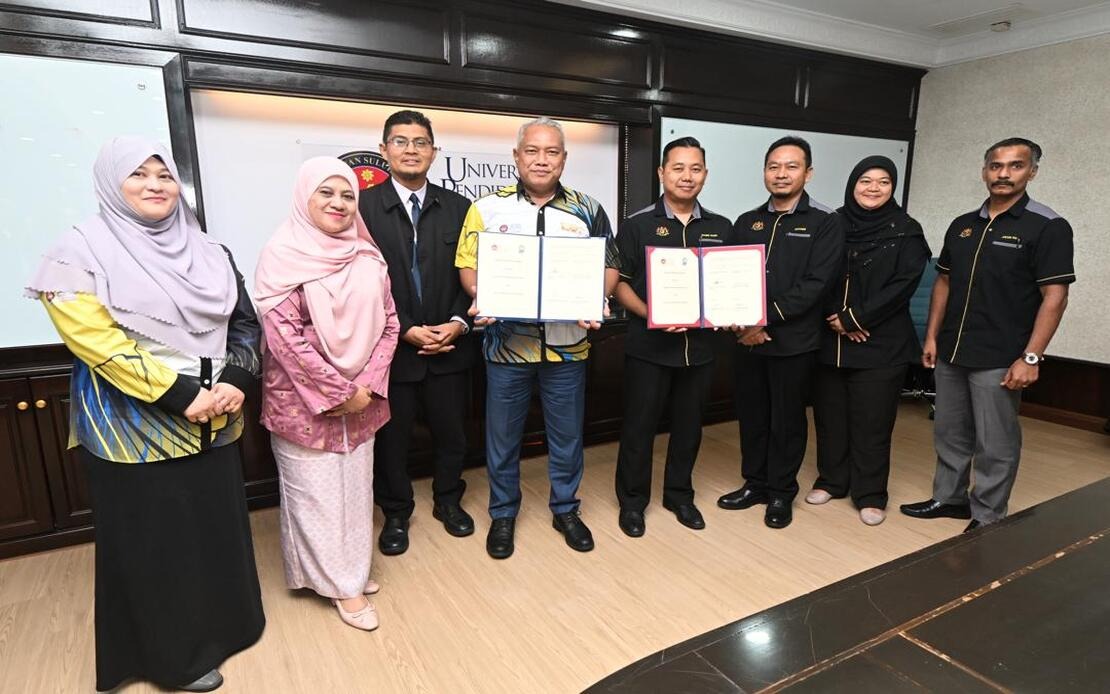
Universiti Pendidikan Sultan Idris (UPSI) and the National Institute of Land and Survey (INSTUN) have formally committed to collaboration through a memorandum of understanding designed to advance drone applications across campus facilities. The agreement, finalised at UPSI's Sultan Abdul Jalil Shah Campus in Ipoh on June 19, represents a strategic move by the education sector to embrace emerging technologies in institutional management and workforce development.
According to UPSI vice-chancellor Prof Datuk Dr Md Amin Md Taff, the partnership strengthens the university's commitment to operational excellence by systematically incorporating unmanned aerial systems into day-to-day campus oversight. Beyond immediate operational gains, the initiative positions UPSI to cultivate geospatial competencies among its institutional community, preparing both staff and students for careers in a technology-dependent landscape. This dual focus—practical implementation alongside capacity-building—signals recognition that technological adoption requires parallel investment in human capability.
The collaboration capitalises on INSTUN's specialisation in surveying, mapping, and geospatial technologies. By accessing this expertise, UPSI gains structured pathways to deploy drones across multiple campus functions, from infrastructure assessment to security surveillance and environmental monitoring. The expertise-sharing arrangement formalises what would otherwise be ad-hoc knowledge transfer, creating reproducible systems that other institutions might eventually adopt.
Drone deployment across a sprawling campus addresses a longstanding operational challenge: comprehensive monitoring of expansive grounds without proportional increases in personnel. Traditional security patrols are labour-intensive and coverage inherently remains incomplete, particularly at night or in hazardous terrain. Aerial platforms capture high-resolution imagery and spatial data far more efficiently, enabling faster response to facility issues, improved safety assessments, and data-driven decision-making regarding campus infrastructure maintenance and resource allocation.
The partnership explicitly encompasses training and exposure programmes, recognising that technology transfer requires institutional knowledge-building. Staff and student participation in drone operations and geospatial analysis creates a pipeline of skilled professionals equipped to support Malaysia's broader economy-wide shift toward advanced technologies. This human capital dimension proves particularly significant for Southeast Asia, where competition for technology workers intensifies and educational institutions must bridge the gap between academic training and industry-ready competencies.
Geographic information systems and digital mapping—core elements of the collaboration—extend beyond campus boundaries. Students and researchers engaged through this partnership gain practical experience in tools increasingly essential across urban planning, environmental management, agricultural development, and disaster response. For Malaysia specifically, where rapid urbanisation and climate-related challenges demand sophisticated spatial analysis capabilities, building this expertise within the education system generates spillover benefits across multiple sectors.
INSTUN director Khairin Nazry Karim framed the agreement as mutual commitment to advancing national capabilities in emerging spatial technologies. His emphasis on professional training and workforce development reflects understanding that Malaysia's competitive position depends on developing domestic expertise rather than remaining reliant on external contractors for geospatial services. Educational partnerships like this one distribute technical knowledge throughout the institutional fabric, creating resilience and accessibility.
The collaboration also positions UPSI as a potential hub for geospatial research and innovation within the education sector. By combining institutional resources with INSTUN's technical specialisation, the partnership creates conditions for applied research that addresses real campus management challenges while simultaneously advancing methodology. Research outputs could inform best practices for drone deployment in other educational institutions across Malaysia and the region.
Expanded cooperation in land management and digital mapping within an educational context creates opportunities for interdisciplinary engagement. Engineering students gain exposure to practical surveying challenges, geography and environmental science students access advanced analytical tools, and business students observe how emerging technologies reshape operational economics. This curricular integration strengthens educational outcomes across multiple disciplines.
The timing of this partnership reflects broader recognition within Malaysian institutional leadership that technological modernisation requires coordinated effort. Rather than universities operating independently, formal arrangements between educational institutions and specialised agencies like INSTUN create leverage, enabling smaller institutions to access capabilities that would otherwise require substantial independent investment. This collaborative model potentially offers replicable benefits across Malaysia's higher education sector.
For regional context, Southeast Asian universities increasingly recognise competitive necessity to integrate advanced technologies into campus operations and academic programmes. UPSI's initiative positions the institution competitively within this landscape while contributing to Malaysia's efforts to develop regional technological leadership. The partnership demonstrates how public institutions can collaborate to build national capacity in strategically important fields without requiring dramatic budget increases.
As drone technology becomes increasingly routine across civilian applications—from infrastructure inspection to environmental monitoring—institutions that developed expertise and comfortable regulatory frameworks during early adoption phases gain significant advantages. UPSI's proactive engagement through formal partnership with INSTUN places the university ahead of institutional peers, potentially attracting students and research funding while contributing credibly to Malaysia's technological advancement narrative.

