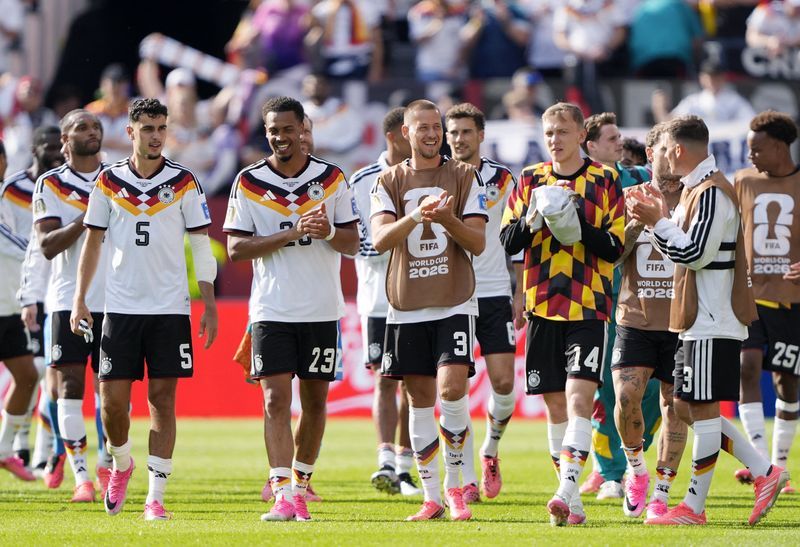
Germany bounced back from a frustrating first half to claim a 2-1 victory over Ivory Coast in Toronto on Saturday, securing their passage to the knockout stage with a dramatic turnaround ignited by substitute striker Deniz Undav's clinical finishing. The match showcased contrasting footballing philosophies—Germany's methodical build-up play clashing with the Ivorians' more direct, dynamic attacking approach—in what turned into one of Group E's most compelling encounters. The venue itself added an intriguing dimension, with over 100,000 residents of German descent in Toronto providing vocal support that tilted the atmosphere decidedly in favour of the European side.
The opening period proved deeply frustrating for Julian Nagelsmann's team, who created eight scoring opportunities yet found themselves trailing at the interval. Aleksandar Pavlovic appeared to have given Germany the lead when he rose unmarked to meet a short corner in the 25th minute, but the referee adjudged the midfielder to have fouled goalkeeper Yahia Fofana during the play. The decision, which left Pavlovic in visible disbelief with his hands clasped to his head, drew audible disapproval from the German contingent in the crowd. Shortly thereafter, Jamal Musiala found the net following a period of sustained pressure, only for that goal too to be ruled out for a foul in the build-up against Odilon Kossounou.
Ivory Coast's breakthrough came through an opportunistic finish by Franck Kessie, who pounced on a rebound after Amad Diallo's shot following a left-flank incursion by Yan Diomande. That goal gave the West Africans something tangible to show for their own spirited attacking play, and marked a continuation of an impressive scoring run—the Ivorians have now netted in seven consecutive World Cup matches, representing their longest such sequence in the tournament's history. The first-half narrative seemed set: a German side dominant in possession and territorial control but ineffective in the final third, facing an Ivorian outfit making the most of limited opportunities through shrewd, direct play.
However, the second half witnessed a dramatic reversal of fortunes. Undav, introduced from the bench, immediately changed the dynamic of the contest with his intelligent movement and composure in front of goal. The 26-year-old levelled proceedings in the 68th minute with a controlled volley that demonstrated technical precision, before doubling his tally shortly afterwards when he received the ball on the turn, swivelled smoothly, and dispatched a low finish past Fofana. The substitute's performance added another impressive chapter to an remarkable recent run of form—Undav has now accumulated nine goals across his last eight appearances, a return that underscores his growing importance to German attacking plans.
Ivory Coast mounted a late push for parity when Simon Adingra fashioned a presentable opportunity in the closing stages, but failed to execute cleanly in the penalty area. Germany's defensive resolve held firm, and they subsequently broke forward with Nathaniel Brown forcing another save from Fofana, effectively sealing the outcome. The back-and-forth nature of the final stages reflected the intensity that characterised this Group E encounter, a match that never settled into a predictable pattern and consistently produced moments of quality from both sides.
For Malaysian and Southeast Asian observers, the result carries particular significance given the regional interest in World Cup competitions. Germany's advancement underscores the enduring class of the four-time world champions, even when operating with a transitional squad following their early elimination in Qatar. Undav's emergence as a match-winner offers a compelling narrative of impact from an unexpected quarter—a reminder that tournament football frequently hinges on tactical adjustments and the introduction of fresh legs at critical junctures. The manner of Germany's comeback, recovering from early setbacks and officiating decisions that could have derailed their tournament, speaks to the psychological resilience required at the highest level of international football.
With six points from two matches, Germany now sits atop Group E and has already secured their place in the last 32. Their upcoming fixture against Ecuador in New Jersey on Thursday will essentially be a formality in terms of advancement, allowing Nagelsmann potential opportunity to rotate his squad. Ivory Coast, conversely, remain on three points after two matches and must face Curacao in Philadelphia while harbouring hopes that results elsewhere in the group might still provide a pathway forward. Ecuador and Curacao are scheduled to meet in Kansas City later on Saturday, a match whose outcome could considerably reshape the permutations in what has become an unpredictable group.
The contrast in recent trajectories between these two nations warrants examination. Ivory Coast arrived in Canada with realistic aspirations of mounting a serious tournament challenge, buoyed by their scoring consistency and the attacking talents at their disposal. Yet they find themselves in a precarious position after two matches, dependent on events beyond their control. Germany, meanwhile, despite early-tournament uncertainty and individual match frustrations, have demonstrated the capacity to grind out results and respond when circumstances demand it—a quality that has historically characterised their most successful tournament campaigns. As the group stage enters its final round, these differing narratives will likely prove decisive in determining which nations progress and which return home disappointed.

