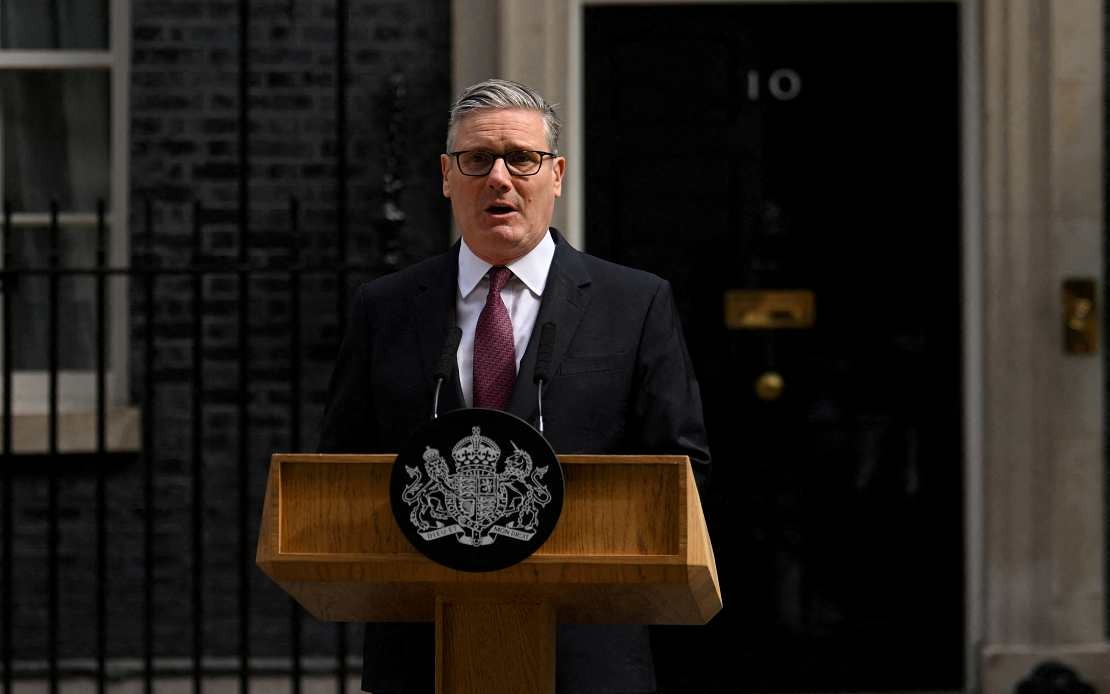
British Prime Minister Keir Starmer announced on Monday that he intends to step down from his post, with a replacement leader expected to be selected and installed before parliament reconvenes in September. The announcement marks a dramatic reversal of fortunes for a leader who secured a commanding electoral mandate less than two years ago with promises to restore stability to British governance and reverse years of political turbulence.
Starmer's decision reflects the severe erosion of his political standing within the Labour Party and the broader electorate. His personal approval ratings have fallen to historic lows for any sitting British prime minister, while Labour's broader support has haemorrhaged since taking office. The party faces the grim prospect of attempting to govern without the public confidence or parliamentary goodwill that typically sustains administrations through their initial period in office.
The accelerating pace of Starmer's departure was triggered by a weekend of political developments that exposed the depth of discontent within Labour ranks. Most significantly, Andy Burnham, the Mayor of Greater Manchester, secured a commanding victory in a parliamentary by-election on Friday, wresting the seat from Nigel Farage's Reform UK party—an outfit that has dominated national opinion polling for over a year. The result demonstrated that Burnham could appeal to voters alienated under Starmer's leadership and suggested he possessed the political capability to revitalise Labour's electoral prospects.
Burnham's profile as a potential successor differs markedly from Starmer's background. A seasoned politician with extensive experience in both local and national government, Burnham has built a reputation for effective public communication and media engagement. His demonstrated ability to connect with voters in a working-class metropolitan area offered Labour MPs a glimmer of hope that the party might recover ground lost during Starmer's tenure. However, Burnham has offered little public detail regarding his specific policy positions on critical areas including defence, foreign relations, and economic management.
The incoming government, regardless of whether Burnham becomes prime minister, will inherit a distinctly constrained operating environment. Britain currently carries the heaviest borrowing costs among the Group of Seven industrialised democracies, a consequence of elevated sovereign debt, substantial interest payment obligations, years of anaemic economic expansion, and persistent difficulties in either controlling expenditure or identifying new revenue sources. Defence investment requirements and infrastructure needs only compound the fiscal predicament facing policymakers.
Economists and market analysts harbour significant reservations about the toolkit available to any new Labour leader seeking to deliver meaningful change. Citibank's economics team cautioned that a Burnham-led government would assume power facing what they characterised as a precarious fiscal position with severely limited policy instruments for implementing substantive reform. This assessment underscores a fundamental tension facing Britain: voters demand dramatic improvement in living standards and public service quality, yet financial markets and fiscal constraints sharply limit the resources available for such initiatives.
Burnham's previous statements about British fiscal governance add another layer of uncertainty to market expectations. In September last year, he declared that Britain must move beyond its subordination to bond market investors—language that suggested potential willingness to challenge conventional monetary orthodoxy. Whether a Burnham premiership would actually follow through on such rhetoric, or whether practical governance realities would impose discipline, remains an open question that is preoccupying financial analysts and international observers.
Starmer's extended timeline for departure—remaining in post until a leadership successor emerges rather than resigning immediately—reflects practical political and diplomatic considerations. The proposed transition allows him to participate in a scheduled July summit aimed at resetting relations between Britain and the European Union, an initiative that carries significance for Britain's international standing and future trading relationships. The staggered approach also provides the Labour Party time to conduct an orderly leadership selection process and affords the winning candidate preparation time before assuming full governmental responsibility.
The turnover of British prime ministers has reached extraordinary levels in recent years. Starmer's successor will become the seventh prime minister to serve since the 2016 referendum that mandated Britain's departure from the European Union. This concentration of leadership changes—the highest in nearly two centuries of British political history—reflects the acute difficulty facing successive governments in maintaining voter confidence when confronted with persistently disappointing outcomes in living standards improvement, public service delivery, and management of illegal immigration.
For Malaysia and other Southeast Asian nations, Britain's internal political turbulence carries relevance beyond academic interest in Westminster dysfunction. The UK remains a significant economic partner, defence ally through historical ties, and participant in regional security architecture. Frequent changes in British political leadership complicate bilateral relationship management, introduce uncertainty into trade negotiations and defence cooperation, and potentially reduce Britain's diplomatic bandwidth for regional engagement. The instability in British governance may also influence how multinational corporations and international investors assess the predictability and consistency of British policy frameworks.
The deeper issue confronting Britain transcends individual leaders or their personal political fortunes. The country faces a genuine disconnect between voter expectations for improved living conditions and the practical constraints—fiscal, demographic, and structural—that limit any government's ability to satisfy those demands. Burnham, despite his communication skills and political experience, will discover that rhetoric about challenging market orthodoxy confronts hard limits when translated into actual policy. The question confronting British voters is whether new personnel in senior positions can genuinely alter the trajectory of national decline, or whether leadership rotation merely reshuffles the same constrained deck of governance tools.

