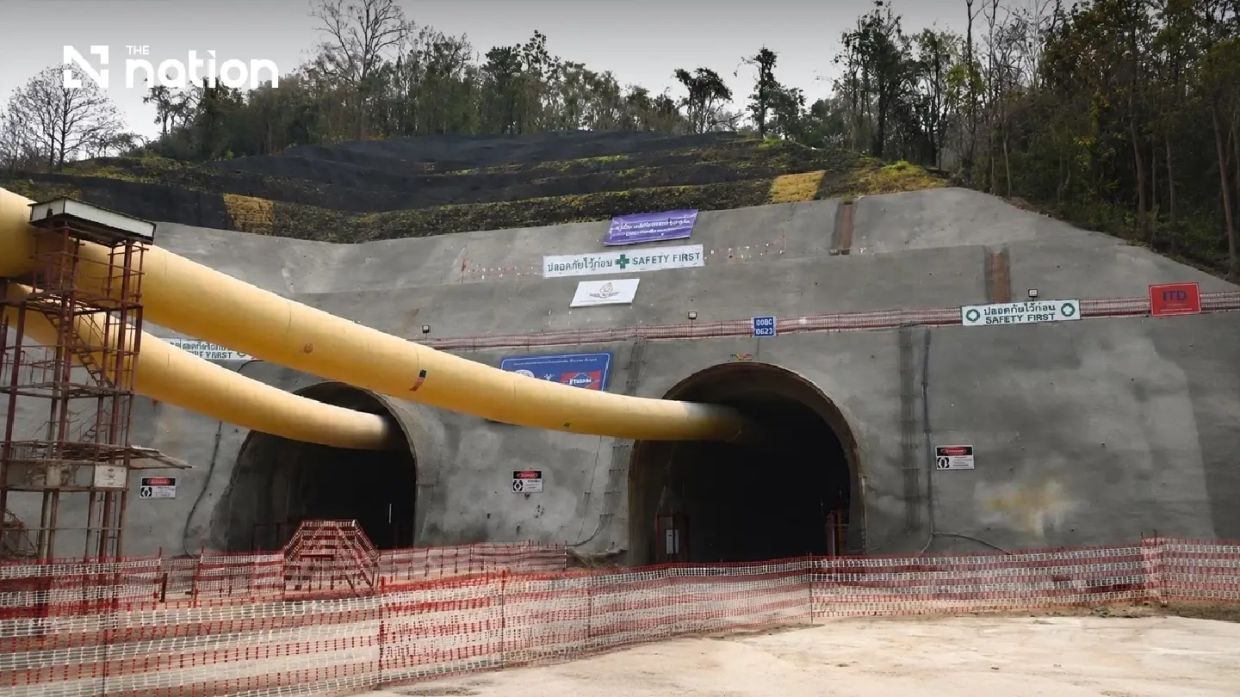
Two construction workers lost their lives and seven others sustained injuries in a catastrophic scaffolding collapse at the Doi Luang railway tunnel in Chiang Rai's Chiang Saen district on Saturday evening. The accident struck at approximately 8:35pm while crews were engaged in installing waterproofing systems inside the tunnel, a critical phase of the State Railway of Thailand's ambitious Den Chai-Chiang Rai-Chiang Khong railway line expansion.
According to Deputy Transport Minister Siripong Angkasakulkiat, preliminary investigations point to falling rocks dislodged from the tunnel wall as the likely cause of the collapse. Earlier reports had suggested the incident involved the shotcrete—a sprayed concrete application technique commonly used to stabilize tunnel structures—though authorities have not ruled out contributing factors and continue gathering evidence. The complexity of establishing a definitive cause reflects the technical challenges inherent in deep underground construction, where multiple systems and safety considerations intersect.
The casualty toll reflects the severity of the incident. Two workers were pronounced dead, while the injured comprised three individuals requiring serious medical intervention and four sustaining minor injuries. All affected personnel were transported to hospital immediately following the emergency response. Deputy Minister Siripong confirmed that the situation has been stabilized, with the accident zone now secured and access restricted to prevent further incidents while investigations proceed.
The State Railway of Thailand's Special Projects and Construction Department mobilized rapidly to inspect the scene and assess structural integrity. The project's dedicated safety unit has assumed direct control of the site and maintains continuous monitoring of conditions. This coordinated response underscores the high stakes attached to the railway development, which represents a significant infrastructure investment for Thailand and the broader Southeast Asian region.
The Doi Luang tunnel forms part of Contract 3 of the Chiang Rai-Chiang Khong section, a substantial component valued at THB19.385 billion. The tunnel itself extends 3.4 kilometers and has already been successfully bored through, meaning the current work focuses on interior systems and finishes rather than excavation. This distinction matters for understanding the accident's context—workers were engaged in post-excavation specialized work where different hazards emerge compared to the initial breakthrough phase.
Contract 3 encompasses far more than the single tunnel where the accident occurred. The scope includes approximately 87 kilometers of both at-grade and elevated railway tracks, three full stations, three station halts, signalling and telecommunications infrastructure, and associated works. This expansive remit demonstrates how a single tragedy reflects the scale and complexity of modern regional rail development projects that require hundreds of workers and subcontractors operating across multiple sites and shifting conditions.
The project is executed by the CKST-DC3 Joint Venture, a consortium bringing together three major construction entities: CH. Karnchang Public Company Limited, Sino-Thai Engineering & Construction Public Company Limited, and Chiangmai Construction Co., Ltd. This partnership structure, typical for projects of this magnitude, distributes both capabilities and responsibilities across established firms with relevant experience in railway and tunnel construction. The joint venture arrangement also distributes liability and decision-making across multiple organizations, which can complicate accident investigations and accountability processes.
For Malaysia and other Southeast Asian nations pursuing similar transport infrastructure ambitions, the incident carries sobering reminders about the human costs embedded in regional development. Thailand's railway expansion reflects broader ambitions across ASEAN to improve cross-border connectivity and economic integration. Yet these projects depend fundamentally on the safety protocols, worker training, equipment maintenance, and site management systems that prevent ordinary work from turning lethal. The accident raises questions about whether current safety frameworks adequately protect workers in the technically demanding environment of deep tunnel construction, where hazards multiply and emergency response becomes more complicated.
The ongoing investigation will likely examine multiple dimensions: the geological stability of the specific tunnel section, the adequacy of temporary support structures, worker training and certification levels, supervisory oversight on the shift when the collapse occurred, and whether safety equipment and protocols were properly implemented. Thailand's regulatory authorities will need to determine whether this represents an isolated failure or a symptom of systemic weaknesses affecting multiple sites under the same contractor consortium. Such findings could influence future safety requirements across Thailand's rail sector and potentially affect how Malaysian authorities structure safety provisions for comparable projects.
The Den Chai-Chiang Rai-Chiang Khong railway line holds strategic importance for northern Thailand and the broader region, promising improved freight and passenger connectivity. Yet infrastructure development pursued without adequate safety safeguards extracts human costs that undermine both the project's legitimacy and long-term sustainability. Workers deserve conditions where technical advancement and human safety advance together rather than in tension. The two fatalities in this accident represent not merely statistical tragedy but individuals whose families face permanent loss, a human dimension that sometimes recedes from policy discussions focused on completion schedules and budget efficiency.

