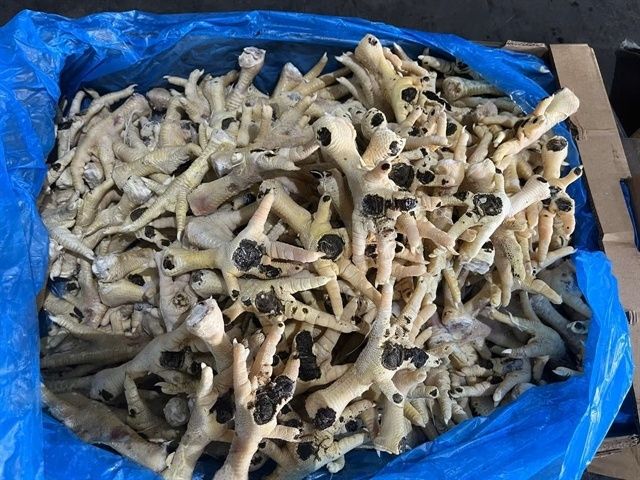
Hanoi police have filed smuggling charges against two Vietnamese women who orchestrated an operation importing hundreds of containers of frozen chicken feet from poultry disease-prone countries and distributing them illegally throughout the domestic market, circumventing regulations that strictly prohibit such sales. The investigation, culminating in Friday's charges, uncovered a scheme valued at more than VNĐ347 billion—approximately US$13 million—conducted between 2023 and 2026 with no import duties paid.
Nguyen Thi To Loan, 47, who served as director of ABF Food Import-Export JSC based in Ninh Binh Province, and Trang Tuyet Ngoc, 45, an official at An Binh Group's assistant department, have both admitted to the allegations. The operation's structure placed Loan at the apex of decision-making while Ngoc executed distribution across multiple provinces, demonstrating a deliberate division of responsibility designed to facilitate the illegal trade.
Vietnamese law explicitly restricts poultry products originating from countries experiencing active disease outbreaks to processing and re-export purposes only—domestic sales are categorically prohibited. This restriction exists as a critical biosecurity measure to protect the nation's food supply and public health. ABF exploited this framework by falsely declaring 339 imported containers on customs documentation as goods intended solely for processing and subsequent re-export, a declaration that proved entirely fraudulent given the company's actual distribution intentions.
Instead of honouring the declared purpose, Loan directed Ngoc to systematically release the chicken feet into Vietnam's domestic food supply. The scale proved staggering: investigators established that more than 10,000 metric tonnes reached food-service businesses across a sprawling network encompassing Hanoi, Cao Bang, Ninh Binh, Quang Ninh, and numerous additional provinces. This distribution reached countless restaurants, catering operations, and food establishments serving everyday consumers with no awareness of the product's illicit origins or potential health risks.
For Malaysian readers and Southeast Asian food industry observers, this case highlights vulnerabilities in regional supply chain controls and the ease with which determined operators can circumvent import safeguards. The scheme's longevity—spanning approximately three years—suggests enforcement gaps that mirror challenges across the region where frozen food products move through porous borders and complex distribution networks with minimal traceability.
Police raids on facilities connected to the operation revealed the true extent of the operation's ongoing nature and complacency. At An Viet 2, a freezer facility located in Hanoi's Quang Minh Industrial Zone, officers discovered over 1,000 metric tonnes of frozen chicken feet stored in cold facilities. Among these stocks, approximately 260 metric tonnes had already expired, displaying visible mould and foul odours—yet appeared deliberately staged for further distribution to consumers. This staging of contaminated products suggests awareness among the operators that the merchandise had deteriorated beyond safety standards, yet plans to distribute it anyway.
A subsequent raid at THL cold-storage warehouse in Lang Son Province in northern Vietnam uncovered an additional 1,030-plus metric tonnes, demonstrating that the operation maintained geographically dispersed storage points to sustain ongoing illicit distribution. The placement of facilities across provincial boundaries likely represented a deliberate strategy to complicate enforcement and maximize supply-chain resilience against potential detection.
Both suspects face charges under Article 188 of Vietnam's 2015 Penal Code, the statute governing smuggling offences. The formal charges represent the investigative conclusion's public phase, though authorities have signalled that the inquiry remains active and expanding. Investigators are currently attempting to identify and establish the participation of additional individuals and organizations within the broader network, suggesting the operation possessed greater complexity and possibly involved multiple stakeholders beyond the two primary accused.
The case carries particular significance for Southeast Asia's food security framework. Vietnam, a major poultry producer and exporter, maintains strict import regulations precisely because uncontrolled introduction of products from disease-affected regions threatens the entire regional supply chain. When such regulations are circumvented at scale, the consequences extend beyond Vietnam's borders, potentially affecting neighbouring countries including those in ASEAN that source poultry products from Vietnamese suppliers or share regional trade networks.
The inability to trace products through 10,000 metric tonnes of distribution across five provinces raises troubling questions about food safety verification mechanisms throughout the region. Freezer facilities that stored expired, visibly contaminated products intended for consumption represent a public health hazard that Vietnamese authorities have now exposed, but similar operations may persist elsewhere if enforcement remains inconsistent.
For Malaysian importers and food-service operators, this case underscores the importance of demanding transparent supply documentation and traceability for all frozen poultry purchases. The scheme exploited the global nature of frozen food commerce, where products change hands multiple times and origins become obscured without rigorous verification systems. Compliance with import restrictions on products from disease zones protects not only individual businesses from legal liability but also the broader public health infrastructure that regional economies depend upon.
As the Hanoi police investigation continues expanding to identify network participants beyond Loan and Ngoc, authorities will likely uncover the intermediaries, transporters, and downstream buyers who enabled the operation's success. The cooperation of both primary suspects may facilitate identification of these additional players, potentially leading to a more comprehensive dismantling of the smuggling infrastructure.

