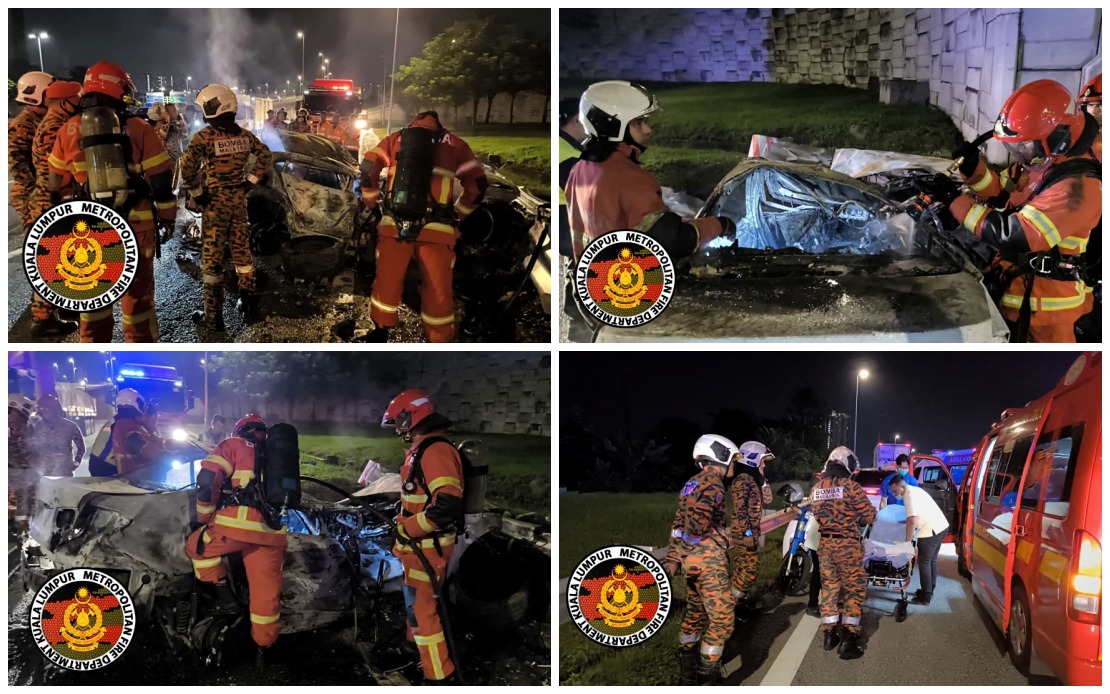
A tragic road accident on the Duta-Ulu Kelang Expressway claimed the lives of two Malaysian students in the early hours of Thursday, leaving authorities investigating the circumstances of one of the capital's deadliest recent crashes. The incident occurred at the Jalan Kuching exit ramp when a BMW 328i Sport burst into flames following impact with the road divider, trapping both occupants inside the burning wreckage. A third passenger managed to escape with only minor injuries, marking a stark contrast to the fatal outcome for his companions.
According to preliminary findings by the Kuala Lumpur Traffic Investigation and Enforcement Department, the vehicle was moving from Jalan Duta towards Selayang when it appears to have been travelling at excessive speed. The driver subsequently lost control of the sedan, causing it to skid across the expressway before colliding with the left-side divider. The impact triggered a fire that consumed the vehicle almost immediately, a sequence of events suggesting the force of the collision was considerable. Traffic officials indicate that speed played a determining role in the accident, though investigations remain ongoing to establish the precise contributing factors.
The two fatalities were identified as a 22-year-old male driver enrolled at Queensland University of Technology in Australia, and a 21-year-old male passenger studying at Sunway University in the Klang Valley. Both young men were pronounced dead at the scene, having become trapped within the vehicle as flames spread through the interior. The intensity of the fire rendered physical identification impossible, prompting authorities to rely on forensic methods to confirm the identities of the deceased. This additional investigative step typically extends the time required to formally notify families and conduct preliminary inquiries.
The lone survivor, a 20-year-old Singaporean male student, sustained only minor injuries despite the severity of the collision and subsequent fire. He was transported to Kuala Lumpur Hospital where he received medical evaluation and treatment for his wounds. His presence at the scene provided crucial eyewitness testimony, as he alone could offer firsthand accounts of what occurred during the final moments before impact. Police have already begun recording his statement as part of their formal investigation, seeking to establish whether any mechanical failure, road hazard, or other unforeseen circumstance contributed to the driver's loss of control.
The investigation is being conducted under Section 41(1) of the Road Transport Act 1987, a legal provision that addresses fatal traffic offences. Authorities are pursuing multiple investigative avenues simultaneously, including detailed examination of the crash site for physical evidence, analysis of closed-circuit television footage from cameras positioned along the expressway, and reconstruction of the vehicle's trajectory based on skid marks and debris patterns. The CCTV footage may prove particularly valuable in determining the vehicle's speed and whether any other road users were involved in or witnessed the incident.
The DUKE expressway is a major arterial route connecting Kuala Lumpur's northern suburbs and the city centre, experiencing particularly heavy traffic during peak hours. However, the accident occurred in the early morning when vehicle volume is typically lower, suggesting the BMW's speed may have been a primary factor rather than congestion or unavoidable collision with other traffic. The Jalan Kuching exit is a frequently used junction, and the expressway's design, maintenance, and safety features will likely be examined as part of the comprehensive investigation.
Identifying the charred victims will proceed through deoxyribonucleic acid analysis, a forensic technique that allows authorities to match remains against genetic material provided by family members or comparative samples. This process, while reliable, requires time to complete and extends the period before formal identification can be confirmed. The delay in confirmation adds to the distress of families awaiting news of their relatives' fates, though it ensures accuracy in one of the investigation's most sensitive aspects.
The fatal crash underscores ongoing concerns about speeding-related accidents on Malaysian expressways, particularly during off-peak hours when drivers may feel emboldened to exceed speed limits. Young drivers, statistically overrepresented in fatal accidents involving excessive speed, continue to present a significant road safety challenge across the region. Both victims were at ages associated with higher accident risk, raising questions about driver behaviour, vehicle safety features, and the effectiveness of speed enforcement mechanisms on major routes.
Police have appealed to members of the public who may have information about the accident or dashcam footage capturing the incident to come forward. Witnesses or drivers who were travelling on the DUKE expressway at the time may possess crucial evidence that could illuminate aspects of the crash investigation. The Traffic Police Station at Jalan Tun H.S. Lee and any nearby police station have been designated as contact points for such information, enabling investigators to gather comprehensive evidence from multiple sources.
The tragedy represents a significant loss within Malaysia's university community, with both victims holding active student enrolments at respected institutions. Queensland University of Technology and Sunway University will likely grapple with the impact of the accident on their respective campuses, as students and staff process the sudden loss of young members within their communities. The incident also carries implications for regional student populations, given one passenger's Singaporean nationality, underscoring how road safety challenges transcend national boundaries across Southeast Asia.
Further investigation into the circumstances surrounding the crash will continue as police gather and analyse evidence from multiple sources. The survivor's account, combined with forensic evidence, traffic camera footage, and scene examination, should eventually provide a comprehensive understanding of how the collision occurred and whether any factors beyond excessive speed contributed to the fatal outcome. The Road Transport Act investigation may also examine whether the vehicle was properly maintained and whether occupants were using safety restraints at the time of impact.

