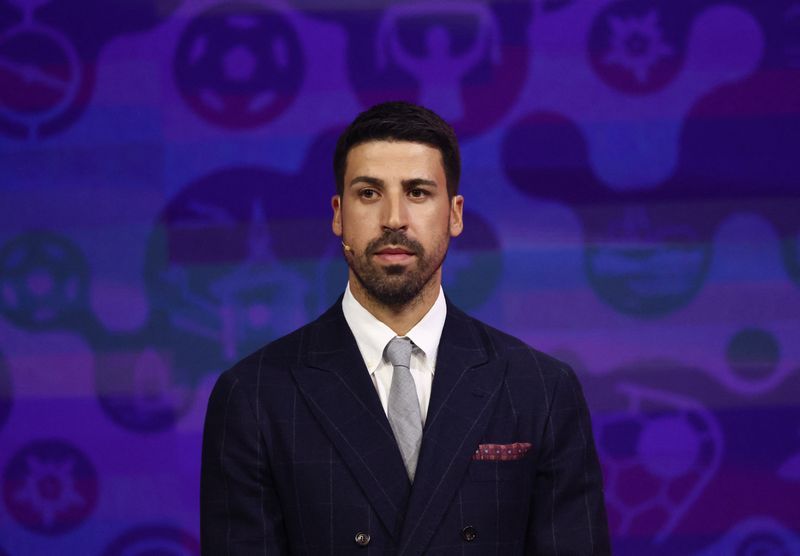
Sami Khedira, the German midfielder who won the World Cup in 2014, has emerged as an unlikely voice of acceptance regarding one of international football's most unusual scenarios: brothers wearing different national shirts at the same tournament. Speaking from the Home of Football museum in New York, Khedira articulated a refreshingly open perspective on dual national allegiances, drawing from his own lived experience as the son of a German mother and Tunisian father. With his brother Rani currently competing for Tunisia at the 2026 World Cup, Khedira sees in this arrangement not a troubling anomaly but rather a compelling portrait of how the modern game reflects the realities of contemporary families and global mobility.
The German footballer's philosophical stance carries particular weight because he has navigated these exact questions himself. Rather than viewing competing national identities as contradictory or problematic, Khedira frames them as fundamentally compatible aspects of a single person's lived experience. He notes that growing up between two cultures meant absorbing both mentalities naturally, without the need to privilege one over the other. This perspective challenges the traditional assumption that international football requires an absolute, singular loyalty—a notion increasingly at odds with demographic realities across Europe and beyond. Khedira's insistence that "both can be true" offers a corrective to gatekeepers who have questioned his own Germanness based on his name and appearance, while simultaneously recognising that in Tunisia he might be perceived as fundamentally German.
The 2026 World Cup will showcase an unprecedented number of sibling pairs navigating these transnational dynamics. Eight sets of brothers will feature across the tournament, with four playing together for the same nation and four representing different countries. Among the most prominent examples are Iñaki and Nico Williams, teammates at Athletic Bilbao who have taken divergent international paths—Iñaki for Ghana and Nico for Spain. Similarly, Guela and Désiré Doué represent the Ivory Coast and France respectively, while Derrick Luckassen and Brian Brobbey, separated by the surnames of their fathers, will compete for Ghana and the Netherlands. Harry and John Souttar embody the Australian-Scottish divide, demonstrating how national allegiances extend beyond purely ethnic or genealogical lines. The expanded 48-team format has intensified these patterns, creating more opportunities for smaller nations to field competitive squads while simultaneously making space for players with multiple heritage claims.
Khedira's turning point in embracing this reality came when observing the Doué brothers singing both national anthems before a France versus Ivory Coast friendly earlier this month. That image crystallised for him football's unique capacity to transcend the match itself and communicate something profound about belonging in an interconnected world. He recognised in that moment the sport's power to celebrate rather than condemn cultural multiplicity. For Khedira, this represents not a weakness in international football's structure but rather an opportunity to project a more authentic representation of how communities actually function in the twenty-first century. The emotional authenticity of brothers proudly acknowledging dual heritage sends what he considers "a strong message to the world" precisely because football commands such global attention and cultural resonance.
Beyond the emotional dimension, Khedira situates the brother phenomenon within broader developments reshaping competitive football. The expanded World Cup format has demonstrably altered the competitive landscape, enabling nations like Cape Verde, Curaçao, and Haiti to demonstrate their capacity to compete on football's grandest stage. More significantly, African and Asian teams have markedly narrowed the performance gap separating them from traditional European and South American powerhouses. Khedira attributes this structural improvement to enhanced educational systems, more sophisticated coaching methodologies, and better infrastructure investment. However, he cautions that European nations bear a responsibility extending beyond simply harvesting talented players through dual-nationality pathways. True development, he suggests, requires actively supporting football at its source rather than merely benefiting from brain drain or heritage-based recruitment.
The most delicate aspect of this globalised football reality, according to Khedira, involves young players confronting federation recruitment at ages when they lack the maturity to comprehend the magnitude of their decisions. The pressure applied to teenagers deciding between competing national claims represents an often-overlooked burden in football's pursuit of talent. Khedira emphasises that genuine national choice cannot be determined by political consideration, family pressure, or historical heritage alone—it demands an authentic internal compass. He reflects on his own adolescence, remembering himself at eighteen as still fundamentally a child despite facing the obligation to select a national community. That visceral gut feeling, he argues, should guide such pivotal choices, yet the institutional machinery surrounding elite football often drowns out that quiet internal voice.
Khedira's engagement with the Tunisian Football Association reflects this measured approach. Rather than dismissing federation overtures, he respected the dialogue while ultimately honouring his own authentic attachment to German football. He recognises that younger players deserve similar autonomy, even as they navigate legitimate persuasion from national associations seeking to strengthen their competitive positions. This nuanced stance avoids both the accusation that dual-nationality players lack commitment and the equally problematic notion that heritage claims should automatically determine national participation. Instead, it positions individual agency and emotional authenticity as paramount, acknowledging that institutions rightfully compete for players' allegiances while insisting that coercive pressure becomes counterproductive and ethically questionable.
The broader implications of Khedira's perspective extend far beyond individual cases. His worldview suggests that international football can accommodate multiculturalism not as aberration but as normalcy. In an era when migration, intermarriage, and diaspora communities fundamentally reshape national demographics, rigidly enforcing singular national identities becomes increasingly untenable. Football, with its global reach and emotional significance, occupies a unique position to model how plural belonging functions constructively. Khedira's insistence that brothers can authentically represent different nations while maintaining genuine connection to both constitutes a quiet but powerful statement about citizenship, identity, and the boundaries of national community in practice rather than theory.
Looking forward, Khedira's framework may prove prescient as demographic patterns continue evolving. The next generation of elite footballers will increasingly comprise individuals with legitimate claims to multiple national representations. Rather than treating this as an administrative headache or ethical problem, Khedira suggests embracing it as evidence of football's expanding reach and its capacity to reflect real human experience. His contention that the modern, global world where "we all come together" naturally produces these scenarios acknowledges both migration patterns and the beautiful complexity of contemporary identity formation. Whether federations and football's governing bodies can match this philosophical flexibility remains an open question, but Khedira's voice suggests that the sport's cultural credibility may ultimately depend upon doing precisely that.

