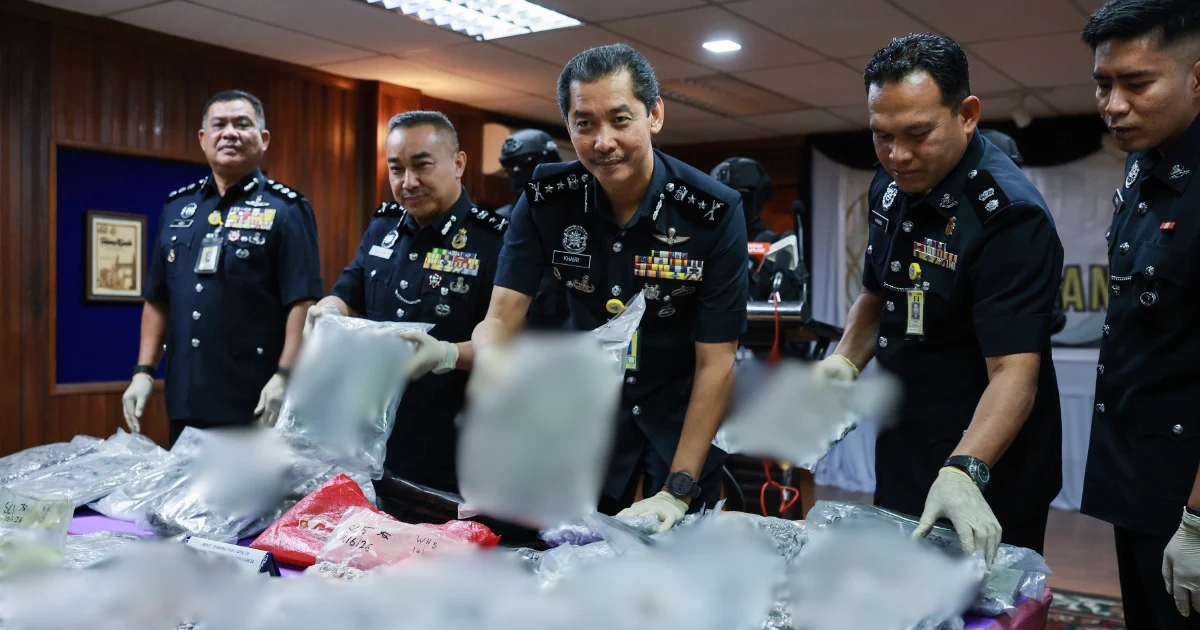
Police in Kuala Terengganu have arrested two brothers in connection with what authorities are describing as a major drug trafficking operation. The men are suspected of converting their residential dwelling in Kampung Duyong Besar into a distribution hub for controlled substances, a common tactic among organised narcotics networks seeking to evade detection by operating from seemingly innocuous residential locations rather than dedicated commercial premises.
The enforcement action resulted in the seizure of narcotics valued at RM1.76 million, representing one of the more substantial drug interdictions recorded in Terengganu in recent months. The scale of the contraband discovered underscores the sophisticated nature of the operation authorities were targeting and suggests the suspects may have been supplying multiple downstream dealers or operating within a larger trafficking network spanning several states.
The arrests highlight the continued challenge Malaysian law enforcement faces in combating the supply side of the narcotics trade. Residential-based distribution networks are particularly difficult to infiltrate, as they blend seamlessly into ordinary neighbourhoods and generate fewer of the telltale indicators—such as unusual commercial activity or high-volume foot traffic—that traditionally alert police to drug operations conducted from dedicated premises.
Kampung Duyong Besar, where the residence in question is located, has long been monitored by narcotics investigators as an area requiring heightened vigilance. The neighbourhood's characteristics, including its accessibility and proximity to transportation routes, make it an attractive location for those seeking to establish covert supply chains that can quickly distribute products across wider geographical areas.
The two-brother arrangement also illustrates a pattern commonly observed in Malaysian drug trafficking enterprises. Family-based operations reduce the risk exposure for principals, as family members are presumed to have greater loyalty and less incentive to cooperate with law enforcement than hired associates. This familial structure, however, has not proven sufficient to shield operations from police detection, particularly as intelligence-gathering capabilities and inter-agency information sharing have become increasingly sophisticated.
For Malaysian readers and the broader Southeast Asian context, this arrest carries wider implications. The region remains a critical transit point and consumption market for narcotics flowing from production hubs in the Golden Triangle and other sources. Malaysian law enforcement's capacity to dismantle domestic distribution networks directly impacts regional drug flows, as successful interdictions reduce the profitability and sustainability of trafficking routes that feed supplies throughout Southeast Asia.
The RM1.76 million valuation—presumably calculated by authorities based on prevailing street-level prices for the specific substances involved—provides insight into the economic magnitude of even moderately-sized operations. This figure suggests the brothers may have been operating at a mid-tier level within their supply chain, receiving bulk shipments from higher-level distributors and repackaging for sale to retail dealers.
Terengganu's enforcement authorities have intensified their focus on residential drug operations following recognition that traditional interdiction strategies targeting commercial distribution points have prompted trafficking networks to shift toward lower-visibility residential models. This operational adaptation by criminal enterprises requires corresponding tactical adjustments from law enforcement, including expanded use of neighbourhood intelligence and community reporting mechanisms.
The case also underscores the importance of sustained, intelligence-led policing in narcotics enforcement. Rather than relying solely on reactive responses to reported incidents, successful major seizures typically result from months of investigation, surveillance, and information correlation. The Kuala Terengganu operation appears to represent the culmination of such investigative groundwork, though specific details regarding the investigation's genesis remain undisclosed.
Moving forward, the investigation into these brothers' operations will likely focus on determining their suppliers at the higher levels of distribution and their customer base downstream. Such mapping of trafficking networks provides law enforcement with critical intelligence for disrupting the broader supply chain and potentially implicating larger criminal organisations operating across state boundaries.
The arrest carries symbolic significance for Terengganu's law enforcement agencies, demonstrating continued effectiveness in identifying and dismantling major drug operations despite the increasingly sophisticated methods employed by trafficking networks. However, the RM1.76 million seizure also serves as a reminder of the persistent scale and profitability of Malaysia's narcotics problem, suggesting that even successful enforcement actions represent merely incremental progress in addressing systemic supply-side challenges requiring sustained, coordinated regional responses.

