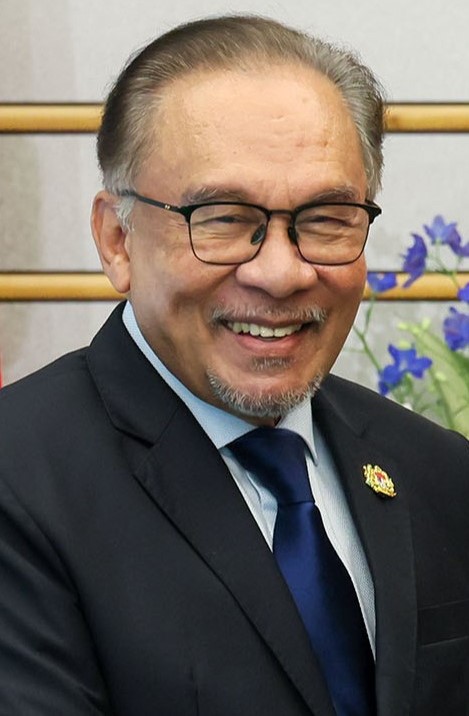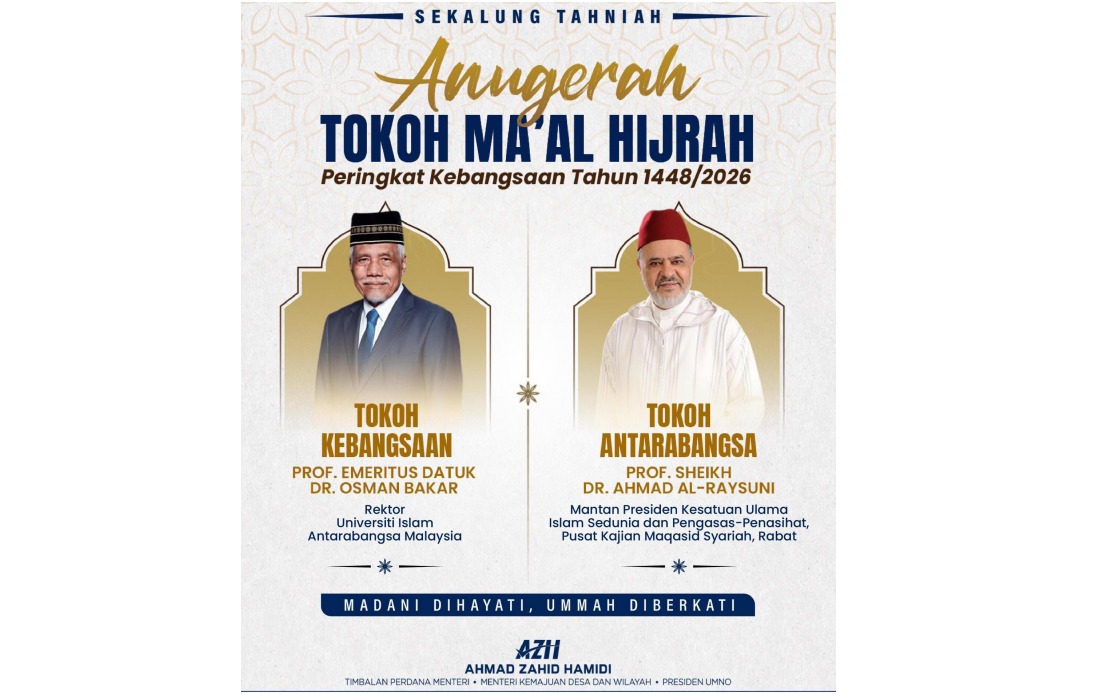
Malaysia's Deputy Prime Minister Datuk Seri Dr Ahmad Zahid Hamidi has called upon the nation's Muslim population to use the accomplishments of this year's Tokoh Maal Hijrah award recipients as a source of motivation and guidance for their own spiritual and social endeavours. Speaking in the wake of the award ceremony, Ahmad Zahid highlighted how the recognition extended to the honourees should galvanise the broader Muslim community to pursue greater heights in their contributions to society, their faith, and the broader Muslim world.
The two distinguished recipients selected for the 1448H/2026M edition of the awards were Prof Emeritus Datuk Dr Osman Bakar, who claimed the National Tokoh Maal Hijrah Award, and Prof Sheikh Dr Ahmad Al-Raysuni of Morocco, who received the International accolade. Both scholars earned their recognition through decades of meaningful work in strengthening Islamic thought, advancing knowledge within Muslim communities, and promoting a vision of Islam that emphasises compassion, prudence and societal benefit. Ahmad Zahid's remarks underscored the profound impact these figures have made across multiple domains of Islamic scholarship and community development.
In his statement posted on social media, Ahmad Zahid specifically commended the laureates for their instrumental role in advancing Muslim communities, elevating the standing of Islamic scholarship globally, and disseminating Islamic principles that carry relevance to contemporary challenges. He positioned their achievements not merely as personal milestones but as exemplars of what dedicated scholarship and service can accomplish when anchored in Islamic values. His comments reflected an official acknowledgement that these individuals represent ideals the government wishes to promote more broadly across Malaysian society.
Ahmad Zahid's appeal extended beyond mere congratulation, transforming the occasion into a broader call for action directed at all Muslims in Malaysia. He exhorted believers to maintain their commitment to lifelong learning, to remain engaged in serving their communities, and to channel their efforts toward strengthening the ummah—the global Muslim community—while simultaneously contributing to national development and the advancement of Islamic civilisation. This multi-layered appeal situated individual achievement within a framework of collective responsibility that spans local, national, and international dimensions.
Meanwhile, his fellow Deputy Prime Minister Datuk Seri Fadillah Yusof echoed comparable sentiments, framing the awards as catalysts for broader national inspiration. Fadillah extended the message beyond the Muslim community alone, addressing all Malaysians and calling upon them to adopt similar dedication to service and nation-building. His intervention broadened the moral resonance of the occasion, positioning the recipients' accomplishments as exemplars that transcend sectarian boundaries and speak to universal values of dedication and sacrifice.
Fadillah's commentary drew a deliberate connection between the Maal Hijrah—the Prophet Muhammad's migration from Mecca to Medina in the seventh century—and contemporary efforts to build cohesive, prosperous nations. He articulated the hijrah not as a mere historical occurrence confined to Islamic memory, but as an enduring philosophical framework embodying principles of personal sacrifice, collective unity, moral resilience, and unwavering commitment to constructive social transformation. This theological framing provided philosophical underpinnings for why these awards matter beyond ceremonial recognition.
The Deputy Prime Minister further maintained that the spirit underlying the Hijrah should animate contemporary efforts to establish societies grounded in both material progress and moral foundations. He envisioned a Malaysia that advances economically and technologically while maintaining strong ethical moorings derived from Islamic and universal principles. His articulation suggested that development divorced from values risks creating hollow prosperity, whereas value-based advancement generates meaningful and sustainable wellbeing.
Fadillah's closing remarks constituted an explicit call for national cohesion and strengthened faith. He urged Malaysians to work in concert toward reinforcing social unity, deepening religious conviction among Muslims, and multiplying virtuous deeds intended to benefit both the Muslim ummah and the Malaysian nation at large. This framing positioned the awards ceremony as an occasion not merely for honouring individuals but for recommitting the nation's leadership and population to shared civilisational goals.
The formal presentation of awards occurred during ceremonies held at Masjid Putra in Putrajaya, Malaysia's federal administrative centre. The Sultan of Perak, Sultan Nazrin Shah, presided over the event and personally conferred monetary prizes, commemorative trophies, and certificates of appreciation upon both honourees. The involvement of the Perak monarch underscored the significant stature accorded these awards within Malaysia's institutional hierarchy and reflected how the monarchy continues to serve as a custodian of Islamic values within the constitutional framework.
Prof Osman Bakar, the Malaysian recipient, represents a distinguished lineage of Islamic scholarly achievement and has dedicated his career to bridging contemporary intellectual pursuits with Islamic theological traditions. Prof Ahmad Al-Raysuni, hailing from Morocco, brings international perspective as a renowned expert in Islamic jurisprudence and has earned recognition across the Muslim world for his contributions to legal and philosophical thought. Their selection demonstrates Malaysia's commitment to honouring not only local scholarly achievement but also recognising intellectual excellence within the broader Islamic world, thereby positioning the nation as a participant in transnational conversations about Islam's relevance to modern circumstances.
The Tokoh Maal Hijrah awards represent Malaysia's periodic effort to identify and celebrate individuals who embody the values the government wishes to promote—knowledge advancement, community service, ethical leadership, and dedication to Islamic principles interpreted as broadly compatible with modernity and national development. By leveraging these awards as motivational instruments, government leaders send signals about which models of Islamic engagement they endorse, thereby shaping broader conversations about Islam's role in Malaysian public life.