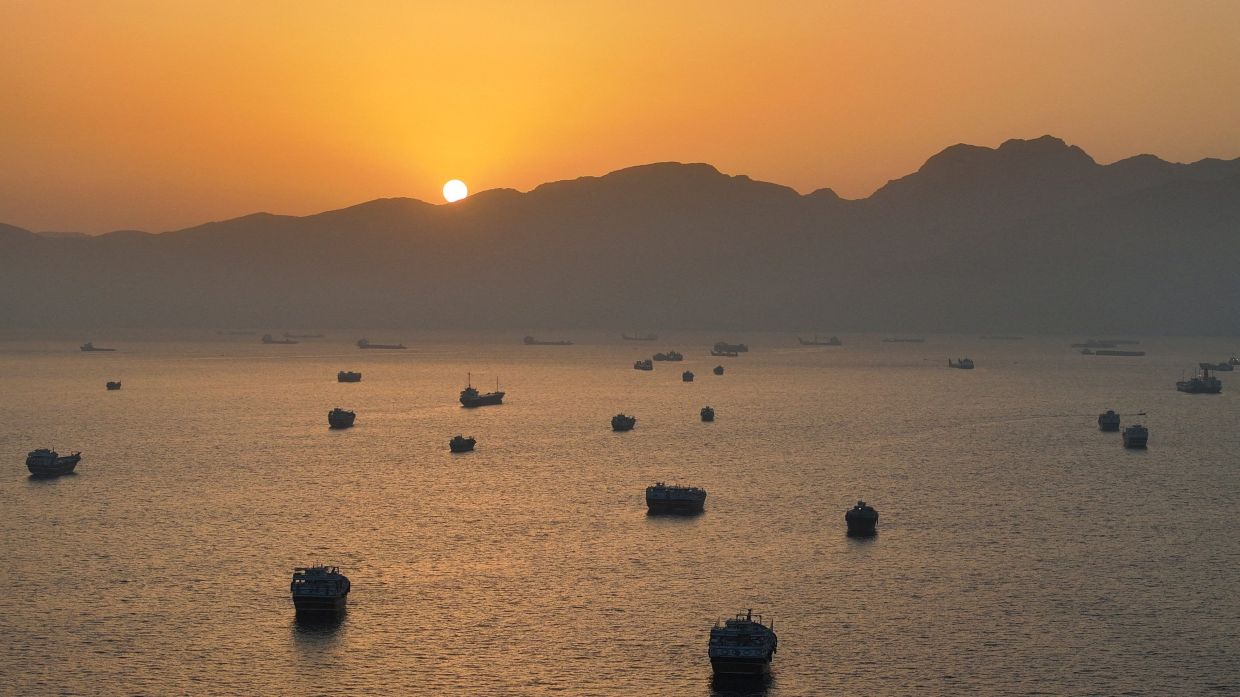
Three crude oil tankers carrying a combined 5 million barrels have begun exiting the Strait of Hormuz, marking a significant shift in the months-long logjam that has choked off petroleum supplies from the world's most critical chokepoint. The movements, captured in shipping data on Wednesday, reflect the emerging impact of an interim agreement between Iran and the United States that is gradually freeing up cargo vessels that have been trapped or reluctant to transit through one of global commerce's most strategically sensitive waterways. With two of these vessels destined for Asian refineries, the exodus is already beginning to influence international crude markets as traders anticipate a sustained release of pent-up supplies into the region most dependent on Gulf oil.
The South Korean-flagged VL Breeze, a Very Large Crude Carrier of the category that transports the planet's most substantial single shipments, has cleared the strait while carrying 2 million barrels of condensate from Qatar and crude from Abu Dhabi. The supertanker, chartered by Hyundai Oilbank, is now sailing toward the South Korean port of Daesan, where one of Asia's largest petrochemical complexes awaits the incoming supply. Simultaneously, the Indian Oil Corporation has dispatched the tanker Plata Carrier, a similarly massive vessel under Liberian registry, with 2 million barrels of Saudi Arabian crude. These two major shipments alone represent a material injection of supply into refineries serving the world's most economically dynamic region.
A third vessel, the Suezmax tanker Prudent Warrior, is transiting toward Sohar in Oman with 1 million barrels of Iraqi Basrah crude, the lighter grades of which are particularly valued by refiners seeking flexibility in their feedstock blends. The departure of these three carriers demonstrates that the confidence required for charterers and ship operators to commit expensive tonnage to the Hormuz transit is gradually returning. The willingness of major Asian refiners—among them South Korean and Indian national oil companies—to actively charter vessels once again suggests that the perceived risks associated with transiting contested waters are diminishing in their calculation.
The scale of the congestion becomes apparent when considering the broader picture of vessel accumulation. Kpler and Vortexa, two leading maritime analytics firms, estimated last week that approximately 90 million barrels of crude oil remained warehoused within the Persian Gulf, either stored aboard tankers idling at anchorages or remaining in port facilities as sellers and buyers grappled with geopolitical uncertainty. With three major carriers now departing, this represents only the beginning of what could become a substantial rebalancing of global crude flows, potentially releasing months of inventory overhang that has weighed on international prices. South Korea's maritime ministry confirmed that four vessels operated by South Korean shipping interests have now departed the strait, with one returning to South Korean ports and others proceeding to third-country destinations.
The broader context reveals just how constrained the situation has been since the Middle East conflict intensified. Of the 26 vessels that became stranded at the outset of the regional escalation, eighteen still remain bottled up within the Gulf. This means that approximately one-third of the initially trapped fleet is now in motion, a pace that suggests the unblocking may accelerate if the interim diplomatic arrangement between Iran and Washington holds steady. The composition of these departing cargoes—predominantly from established suppliers like Saudi Arabia, Iraq, and the UAE rather than Iran itself—indicates that the deal has primarily worked to restore confidence in the transit corridor rather than to immediately unlock significant volumes from Iranian sources. Nevertheless, the confidence effect may prove as economically significant as any immediate supply increase.
The facilitation of these departures owes partly to new maritime infrastructure created specifically to manage the risks of the Hormuz passage. Oman, working in coordination with the International Maritime Organization, has established two alternative shipping corridors positioned both north and south of the conventional shipping lane, providing vessel operators with options to minimise exposure to the areas where tensions have been highest. Oman has also pledged to maintain the strait as an open waterway without imposing transit tolls, a commitment that removes at least one economic barrier to resumed shipping activity. However, it remains unclear whether the three departing tankers have navigated through these designated safe passages or have instead utilised the standard shipping lane, suggesting that confidence may be extending beyond the formally protected corridors.
Liquefied natural gas markets are showing even more dramatic signs of normalisation. Two additional empty LNG tankers—the Shandong Redwood and Milaha Qatar—have recently moved westbound through the strait with the intention of loading from Qatar's LNG export terminals. This brings the total number of empty LNG carriers actively positioning for loads to nine vessels, representing the highest level of such activity since the conflict's onset. The message here is unmistakable: major international energy companies that operate and charter these specialised, capital-intensive vessels have concluded that the window of opportunity for resuming normal trade flows is now open. Given the extraordinary costs of idle LNG tonnage, their active positioning suggests conviction among logistics planners that the trend toward normalisation will persist.
Qatar itself appears to be betting heavily on sustained improvement in the operating environment. According to reporting from the Financial Times, Sheikh Mohammed bin Abdulrahman al-Thani, Qatar's Prime Minister, indicated that the nation's LNG production facilities will return to normal output levels within a matter of weeks. This timeframe is notably aggressive and suggests confidence that the geopolitical temperature in the Gulf is genuinely cooling. Qatar's LNG sector is critical not only to the Gulf economy but to global energy security, particularly for Asian markets that depend heavily on supplies from the region. A restoration of Qatari LNG to full capacity would represent a substantial addition to global liquefied gas availability and would provide some relief to the historically tight LNG market that has characterised recent years.
For Malaysian readers and regional observers, these developments carry concrete implications. As a nation heavily reliant on energy imports and as a member of the Asian refining community, Malaysia has a direct stake in the restoration of smooth Gulf supply flows. The potential stabilisation of crude prices—which have benefited from the anticipated supply increase signalled by these departures—supports the economic case for petrochemical projects and refinery expansion throughout Southeast Asia. More broadly, the apparent success of the interim Iran-US arrangement in unlocking stranded supplies without requiring dramatic shifts in geopolitical alignments suggests that pragmatic, incremental diplomacy may offer a path toward sustainable normalisation in one of the world's most critical energy corridors.
The immediate market implications are already being priced into global crude benchmarks, with traders anticipating that the steady release of 90 million barrels of accumulated inventory will place downward pressure on oil prices in the coming weeks and months. For energy-importing economies throughout Asia, including Malaysia, this represents welcome relief from the elevated energy costs that have persisted since the Middle East conflict's intensification. However, the sustainability of this normality depends entirely on the diplomatic arrangement holding firm and on a broader de-escalation of tensions in the region. The three departing tankers and the repositioning LNG carriers represent not merely commercial movements but barometers of the confidence that international energy traders place in the stability of the Gulf's geopolitical environment. As long as that confidence holds, the flow of energy to Asia should resume its historical patterns of reliability.

