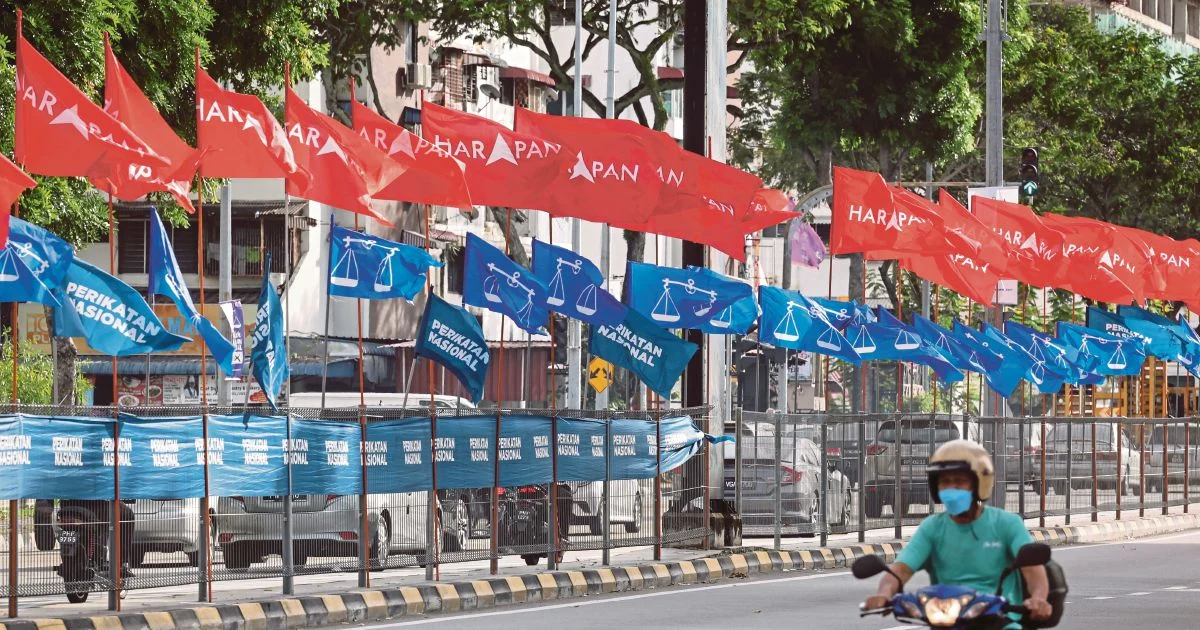
The political landscape in Johor is shaping up to be considerably more fractious than previous election cycles, with Barisan Nasional, Pakatan Harapan and Perikatan Nasional all fielding candidates in roughly 59 percent of the state's electoral divisions. This concentration of three-way contests across 33 of the 56 state seats in the forthcoming election underscores how significantly Malaysia's political architecture has transformed since the last round of state-level voting, fragmenting what were previously clearer two-coalition dynamics.
The proliferation of triangular contests carries profound implications for campaign strategy and voter behaviour across Johor. In such constituencies, the traditional patterns of vote distribution break down considerably, as candidates must appeal to distinct voter demographics while simultaneously attempting to consolidate fractional support bases. The tactical calculations that worked in binary contests become far more complex when three competitive forces are in play, forcing campaign teams to refine their messaging and resource allocation in ways that reflect the specific demographic and socioeconomic composition of individual seats.
For Barisan Nasional, the numerical dominance of three-way contests presents both opportunities and vulnerabilities. As the incumbent federal government and long-standing administrator across much of Johor's municipal structure, BN maintains organisational advantages rooted in decades of grassroots machinery. However, the presence of both PH and PN challengers means the coalition cannot rely upon traditional vote transfers or consolidation effects that characterised earlier electoral cycles. The split opposition, which might theoretically benefit BN, simultaneously indicates erosion of the coalition's core voter confidence and institutional loyalty.
Pakatan Harapan's participation in these triangular contests reflects the coalition's determination to challenge BN's incumbency across multiple fronts simultaneously. Rather than concentrating resources in targeted marginal constituencies, PH appears committed to maximising its geographic footprint throughout Johor, suggesting confidence in its messaging capabilities and grassroots organisation. This broad approach carries risks—spreading campaign resources thinly across numerous fronts—but also potential rewards if the coalition achieves breakthrough performances in unexpected constituencies or demonstrates ability to consolidate anti-BN sentiment.
Perikatan Nasional's decision to contest such a substantial number of seats indicates the coalition's ambitions to expand its presence beyond its core strongholds and establish itself as a meaningful electoral force within the peninsula's south. For many constituencies, PN's entry as a third competitor fundamentally alters the dynamics, particularly in regions where Islamist constituencies or rural voters might perceive PN's Malay-Islamic positioning as appealing. The practical impact depends heavily upon whether PN can differentiate its messaging sufficiently from both BN and PH while maintaining competitive campaign capabilities across numerous simultaneous contests.
The concentration of three-cornered contests also reflects shifting voter preference patterns and declining attachment to traditional political coalitions. Johor, which has experienced significant demographic change through internal migration and economic development, contains increasingly diverse electorate segments with distinct policy priorities and values. No single coalition can necessarily command overwhelming support across such fragmented constituencies, creating the electoral environment where multiple competitors perceive genuine opportunities for victory.
From a Malaysian electoral mechanics perspective, the 33 three-way contests create significant uncertainty regarding seat distribution outcomes. Standard psephological models developed for two-cornered contests perform poorly when three competitive forces simultaneously pursue votes in single-member constituencies. Polling organisations face methodological challenges in accurately assessing voter intention when respondents must contemplate more genuinely open choices, while constituency-specific dynamics become considerably more important than national-level trends or coalition-wide momentum.
The broader implications for Johor's governance structure depend substantially upon how these contests resolve. Should one coalition secure overwhelming dominance despite the fragmented contests, administrative continuity might continue relatively smoothly. However, if seats distribute more evenly among the three coalitions or if one coalition achieves plurality rather than majority positioning, post-election coalition negotiations and arrangements could prove contentious and protracted, potentially affecting government formation and legislative stability throughout Johor's subsequent term.
The three-way contest pattern also suggests that local candidate quality and individual reputation factors may exercise disproportionate influence relative to national political narratives. In constituencies where three broadly competitive forces exist, swing voters and persuadable constituencies will likely evaluate candidates based on their perceived competence, integrity and responsiveness rather than purely coalition affiliation. This localisation of electoral dynamics rewards candidates with robust ground presence and community integration while potentially disadvantaging those selected primarily for factional considerations within coalition structures.
Regional observers should note that Johor's electoral trajectory frequently foreshadows broader peninsular political shifts, given the state's substantial population, diverse demographic composition and historical political significance. The emergence of robust three-cornered contests across 33 seats suggests Malaysian politics continues moving toward more complex, multi-polar competition rather than reverting to simpler binary coalition structures. Understanding how voters navigate these multiple choices and which coalitions successfully consolidate support amid fragmentation will provide valuable indicators regarding Malaysian political preferences more broadly.
The month ahead will determine whether the anticipated three-cornered contests genuinely materialise at comparable intensity throughout the campaign period, or whether tactical adjustments, late-stage defections or coalition negotiations alter the actual number of truly competitive triangular races. Either scenario will reveal significant information regarding how durable Malaysia's recent political realignments have become and whether Johor voters perceive genuine substantive differences between the competing coalitions sufficient to warrant splitting votes across multiple options.

