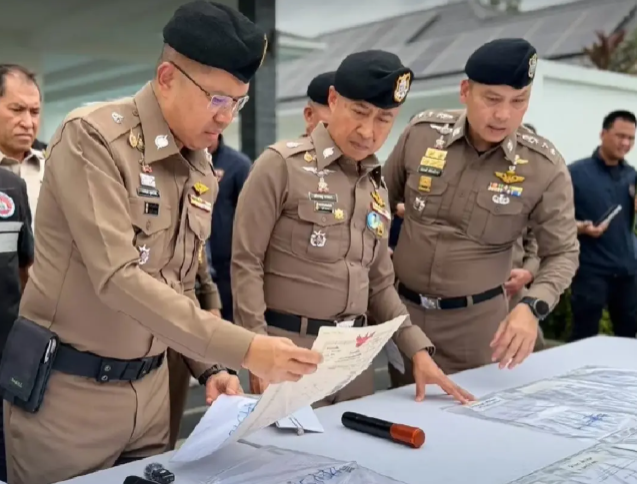
Thailand's police have intensified efforts to combat what officials describe as sophisticated schemes allowing foreign nationals to circumvent domestic property ownership restrictions, with the arrest of 13 foreign nationals during coordinated raids across Hua Hin in Prachuap Khiri Khan province. The operation, which unfolded on 10 August, represents the sixth major phase in a nationwide campaign targeting nominee corporate structures—a practice where properties are formally registered under Thai national shareholders while actual control and financial benefit flow to foreign individuals or entities. This latest push involved more than 200 police officers and government officials, signalling the scale of concern among Thai authorities about the scope and sophistication of these arrangements.
The arrested foreigners comprised three British nationals, four Chinese nationals and individuals from Italy, France, the Netherlands, Austria, the Philippines and the United States. Concurrently, courts had authorised the arrest of 45 foreign nationals across the broader investigation, while police summoned 39 Thai nationals for questioning regarding their role in facilitating these structures. The operation targeted a seaside development of pool villas in Thap Tai subdistrict, where individual properties commanded prices between 10 and 20 million baht—placing them squarely in the category of high-value assets that attract wealthy international investors seeking second homes or investment properties in Thailand's premium coastal markets.
The investigation has identified 33 companies suspected of holding land and property purportedly on behalf of foreign nationals, with the total value of assets involved estimated at approximately 300 million baht. At the Hua Hin development specifically, police identified six companies allegedly employing Thai nationals as nominee shareholders—four linked to the first phase of the development and two to the second phase. This granular level of detail suggests that the scheme was highly organised and likely operated across multiple tranches of a commercial property project, with separate corporate vehicles potentially created to manage different stages of construction or sales.
The modus operandi uncovered during questioning reveals a calculated approach to circumventing Thai foreign ownership restrictions. Foreign nationals reportedly explained to investigators that they had been advised by law and accounting firms to establish Thai companies as a means of legally acquiring and holding property in Thailand. These foreign purchasers believed the nominee arrangement represented a legitimate pathway to property ownership—a perception that underscores how such schemes often present themselves with a veneer of legality through professional intermediaries. However, Thai police contend that the companies in question were not engaged in genuine business operations but rather functioned purely as legal vehicles to mask foreign beneficial ownership.
The Thai nationals listed as shareholders in these corporate structures painted a picture of passive participation devoid of meaningful involvement. When questioned, they asserted that they had agreed to serve as shareholders on behalf of foreign parties but had never invested personal funds, participated in business decisions, or even reviewed financial documentation related to their supposed stakes in the companies. This admission effectively concedes that the shareholding arrangement was nominal rather than substantive—the Thai nationals were essentially holding shares in name only, creating the appearance of Thai control while exercising no actual authority. Police interpreted these findings as evidence that the corporate structures existed solely to obscure foreign control and beneficial ownership of valuable Thai real estate.
The raids themselves were comprehensive, with officers seizing company registration documents, accounting records, computers, mobile devices and electronic data. This material will now form the basis of detailed forensic analysis aimed at reconstructing financial flows, identifying additional participants in the networks, and tracing connections both within Thailand and internationally. Investigators anticipate that the electronic records will reveal payment flows from foreign nationals to the Thai nominees, contracts or agreements formalising the relationship, and communications between the parties involved in establishing and maintaining the schemes.
This operation fits into a substantially broader enforcement pattern that commenced with investigations on Koh Phangan in Surat Thani and has progressively expanded across Thailand's prime tourist destinations. The second phase examined nominee companies and associated law and accounting networks suspected of controlling property and tourism enterprises. The third phase expanded to Phuket, Phang Nga and Krabi, where authorities scrutinised 89 land parcels and structures valued at over 1.05 billion baht. The fourth phase shifted focus to Chonburi, while the fifth concentrated on Chiang Mai, investigating 31 companies and 29 land plots worth approximately 633 million baht.
Across the first five phases of this campaign, police examined 233 plots of land and buildings covering more than 160 rai—equivalent to over 25.6 hectares—with a combined estimated value of 2.539 billion baht. Courts approved 133 arrest warrants arising from these earlier operations, and 20 cases have proceeded to conviction. These statistics demonstrate the substantial scale of the enforcement effort and the depth of suspected illegality across Thailand's property sector, particularly in areas popular with foreign investors.
The implications of this investigation extend beyond Thailand's borders, with relevance for Southeast Asian property markets more broadly. Malaysia, which attracts significant foreign investment in real estate, particularly in Kuala Lumpur, Penang and Johor Bahru, operates under different but complementary frameworks regulating foreign ownership. Malaysian authorities monitor similar potential violations, where foreign individuals attempt to circumvent restrictions through proxy ownership structures or corporate vehicles. The Thai crackdown serves as a cautionary illustration of how such schemes ultimately attract regulatory and law enforcement attention, potentially exposing investors, facilitators and intermediaries to legal jeopardy.
Thai law explicitly restricts foreign ownership of residential land and buildings, though foreign nationals may lease land for up to 30 years and renew the lease. The nominee scheme represents an attempt to circumvent these restrictions by creating the false impression of Thai ownership whilst providing foreign nationals with substantially equivalent control and financial benefit. From the Thai government's perspective, such arrangements undermine the legislative intent behind ownership restrictions, which are designed to preserve national control over land and prevent speculative foreign capital from dominating Thai real estate markets.
The involvement of professional intermediaries—law firms and accounting practices—raises additional concerns about complicity in structuring potentially unlawful transactions. Although the police statement did not identify these firms by name, investigators indicate that the companies involved engaged such professionals to establish their corporate structures, suggesting that professional gatekeepers may have facilitated arrangements they understood to be designed to circumvent Thai law. This dimension of the investigation carries implications for professional accountability and regulatory oversight of legal and accounting services in Thailand.
The Thai authorities have explicitly clarified that the campaign targets nominee structures and foreign-backed enterprises suspected of operating unlawfully, rather than legitimate foreign investors complying with Thai property regulations. This distinction is important for the broader international business community and Southeast Asian investors seeking clarity about which arrangements fall within permissible boundaries. Legitimate foreign investors operating transparently through registered leasehold interests or genuinely operational Thai companies with foreign shareholders conducting authentic business operations should not face enforcement action.
Police have announced that the investigation will continue across Thailand's tourist destinations, with authorities also examining potential corruption among government officials suspected of improperly assisting those engaged in the schemes. The public is encouraged to report suspected illegal foreign business activity to local police stations or the Royal Thai Police hotline 1599, which operates 24 hours daily. This regional campaign reflects Thailand's determination to enforce its property ownership regime and protect its real estate sector from what officials characterise as exploitative foreign practices, while simultaneously maintaining the nation's appeal to legitimate international investors and the tourism industry that underpins significant portions of the Thai economy.

