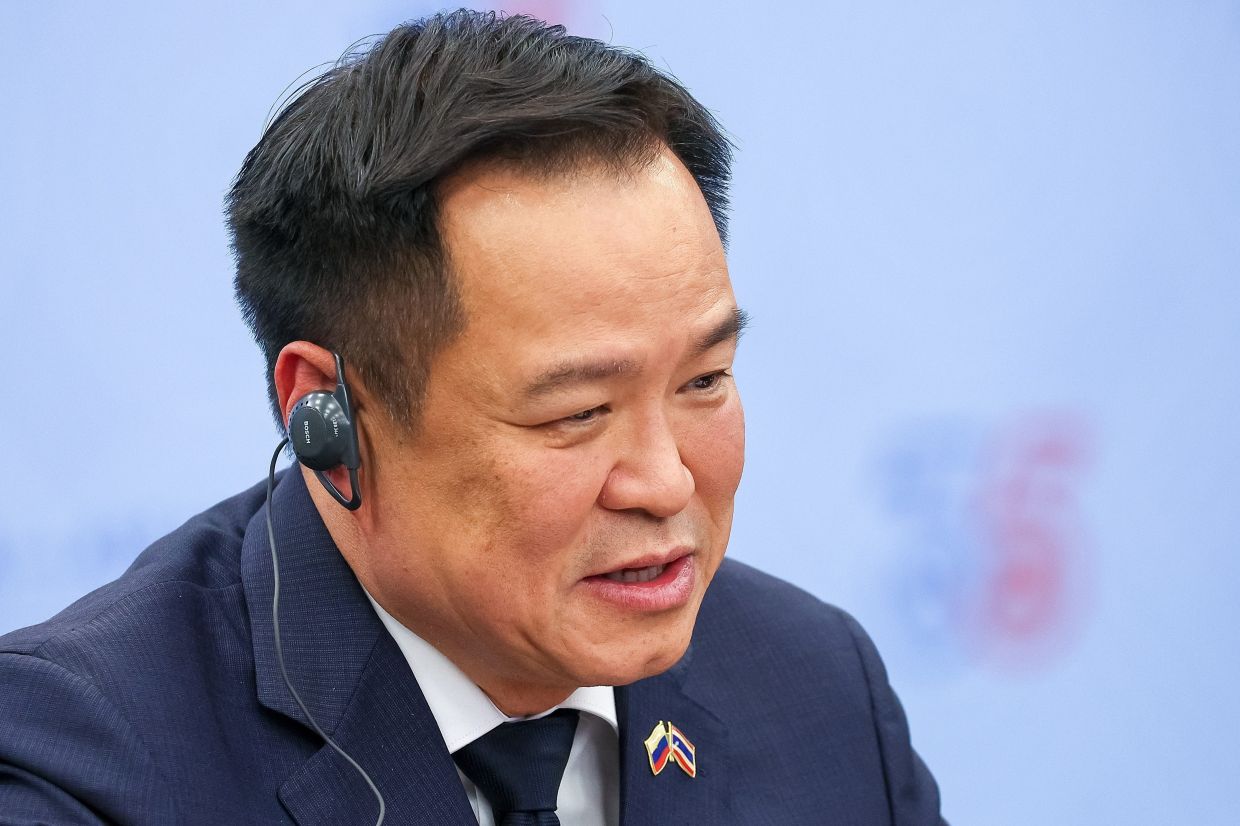
Thai Prime Minister Anutin Charnvirakul reached the 100-day milestone on June 27, having been sworn in as the kingdom's 32nd premier on March 20 following his re-election victory. The tenure represents a significant moment for a country accustomed to political tumult, coming roughly nine months after he first assumed office in September 2025 when the Paetongtarn Shinawatra government collapsed, before consolidating power through the February 2026 general election. Observers offer measured assessments of his performance so far, acknowledging success in preserving political stability and managing an immediate energy crisis, while expressing concern that his administration has shown little appetite for tackling Thailand's deepening structural economic malaise.
The new government faced its first major test almost immediately. Within weeks of Anutin taking office, the February 28 US-Israel attacks on Iran created severe disruptions to global oil supplies, triggering panic at petrol stations across Thailand and pushing prices to levels not seen in years. The crisis exposed Thailand's fundamental vulnerability to events beyond its control, particularly disruptions to shipping through the Strait of Hormuz, which sent international crude prices soaring above US$100 per barrel for extended periods. For a Southeast Asian nation heavily dependent on energy imports and with a population accustomed to relatively stable fuel costs, the shock presented both an immediate threat to public confidence and a longer-term question about energy security in an unstable world.
Anutin's administration responded with a pragmatic approach that drew on the government's fiscal capacity to cushion the blow. Officials tapped the national Oil Fuel Fund to subsidise fuel prices, protecting consumers from the full impact of rising international costs. The government simultaneously reduced borrowing costs for farmers and industrial operators, acknowledging that an energy shock could cascade through the economy and devastate rural livelihoods. Coal-fired power plants were ordered to maximum capacity, while officials pursued diversification of energy sources by increasing imports from neighbouring Malaysia and Brunei, as well as from the United States. These measures, according to political science analyst Mathis Lohatepanont of the University of Michigan, successfully allowed the government to "weather the initial storm and managed to avoid further instability" despite the underlying supply disruptions and price spikes.
What distinguishes Anutin's energy crisis response is not its technical sophistication but rather its political effectiveness. Despite continued public complaints about elevated fuel costs, Thailand has avoided the mass street protests that could have threatened government stability. For a nation haunted by two decades of military coups and short-lived administrations, the simple fact of maintaining public order during an economic shock represents a genuine achievement. The government's willingness to deploy fiscal resources and coordinate across state enterprises demonstrated a level of administrative competence that observers acknowledge, even if they reserve judgment on whether such crisis management translates into genuine leadership.
Beyond the energy crisis, Anutin has delivered on campaign commitments that directly address voter concerns about household finances. His signature initiative, the "Thais Help Thais Plus" scheme launched on June 1, allows approximately 30 million eligible Thai citizens aged 18 and above to purchase selected goods from participating merchants at just 40 per cent of regular prices, with government covering the remainder. The programme, allocated 176 billion baht (US$5.27 billion) in public funds, targets citizens excluded from previous welfare schemes and represents exactly the kind of visible, tangible benefit that builds political support. Yet analysts including Mathis and Puangthong Pawakapan of Chulalongkorn University view such programmes with ambivalence—they are undeniably popular and provide temporary relief, but they fundamentally address symptoms rather than underlying causes of economic stress.
Anutin has also burnished his nationalist credentials by maintaining a firm stance on the long-running border dispute with Cambodia. His Bhumjaithai Party won the most seats in February's election partly by appealing to nationalist sentiment and advocating a harder line in relations with Phnom Penh. As prime minister, Anutin has followed through on this mandate by ensuring the military retains primary responsibility for border protection and by unilaterally terminating a 2001 bilateral pact with Cambodia concerning disputed overlapping maritime boundaries. The decision to escalate the matter to UN arbitration demonstrates a willingness to take controversial positions, satisfying his party's support base while appealing to broader Thai nationalist sentiment. For Malaysian observers, Thailand's assertiveness in border matters serves as a reminder of the complex regional security dynamics in which Malaysia itself operates.
Yet beneath these tactical political successes lies a sobering reality about the limits of Anutin's vision. Thailand's underlying economic challenges remain largely unaddressed after his first 100 days. The country has failed to achieve annual economic growth exceeding three per cent over the past five years, a deeply concerning trajectory given regional competition. The International Monetary Fund projects Thailand's growth at just 1.5 per cent for the current year, positioning it as Southeast Asia's slowest-growing major economy. By comparison, Vietnam is expected to expand by 7.1 per cent, Cambodia by four per cent, and even Myanmar by three per cent despite its devastating civil conflict. These figures are not merely statistics; they represent foregone opportunities for employment creation, income growth, and improved living standards across the Thai population.
Thailand confronts a demographic challenge that will intensify over coming decades. An ageing population combined with high household debt levels creates a structural economic problem that no temporary subsidy programme can resolve. Meanwhile, households burdened by rising debt levels may find that even temporary government support proves insufficient to prevent erosion of consumption patterns. Anutin has made rhetorical commitments to developing new economic engines in digital technology, artificial intelligence, and clean energy, areas where Thailand lags behind more dynamic regional competitors. Yet observers have detected no coherent roadmap, no clear timeline, and no measurable commitments that would suggest serious implementation is underway.
Political scientist Stithorn Thananithichot of Chulalongkorn University offers a particularly sharp critique, observing that the Anutin administration's "energies have gone into routine administration and day-to-day management rather than into any initiative aimed at meaningful economic or political change." This assessment proves especially damning when considering constitutional reform, an issue with genuine democratic legitimacy. Nearly 60 per cent of Thai voters, approximately 20 million citizens, indicated in a referendum held alongside February's general election that they desire constitutional change. The 2017 Constitution was drafted under military rule following the 2014 coup and is widely viewed as undemocratic. Despite this overwhelming electoral mandate, constitutional reform has made negligible progress under Anutin's watch. Stithorn argues that a genuinely reform-minded government would have signalled substantive structural commitments during its opening weeks; the absence of such signals, he contends, reflects deliberate choice rather than mere timing or circumstances.
For Malaysian readers, Thailand's predicament offers instructive lessons about the dangers of prioritising short-term stability at the expense of long-term structural reform. A country with Thailand's advantages—geographic position, cultural attractions, developed infrastructure—should be growing faster and creating more widely-distributed prosperity. Instead, the pattern of crisis management followed by business-as-usual administration has allowed problems to fester for years. Malaysia itself faces comparable challenges regarding an ageing workforce, household debt, and the need for economic diversification away from traditional sectors. The contrast between countries like Vietnam, which has pursued consistent long-term economic strategies despite political constraints, and Thailand, which has struggled to maintain policy continuity, suggests that sustained growth requires more than crisis management and electoral promises.
Anutin's first 100 days ultimately reveal a government capable of competent administration but apparently uninterested in transformative change. The prime minister has demonstrated that he can navigate immediate crises without allowing them to spiral into political instability. He has delivered visible benefits to voters through subsidy schemes and maintained the nationalist positions that energise his political base. Yet these accomplishments, while real, do not address the fundamental questions about Thailand's economic trajectory or democratic development. As Anutin's administration moves beyond this initial period, the critical test will be whether it eventually pivots toward substantive reform or settles into a pattern of perpetual crisis management that characterises so much of Thai governance over recent decades. For Thailand's neighbours and trading partners throughout Southeast Asia, the answer matters significantly.

