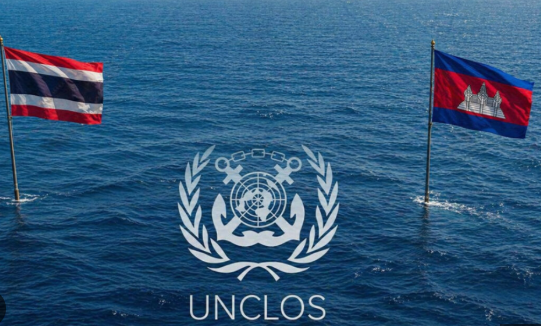
Thailand has formally agreed to participate in a compulsory conciliation process initiated by Cambodia under the 1982 United Nations Convention on the Law of the Sea to resolve their longstanding dispute over maritime boundaries in the Gulf of Thailand. The Thai government submitted its official response to Cambodia on June 19, two-and-a-half weeks after Cambodia lodged its formal request on June 2. However, Bangkok has been explicit in framing this development as a non-judicial process that will yield advisory recommendations rather than enforceable legal determinations, marking an important distinction as the two Southeast Asian neighbours pursue resolution of competing territorial claims in waters believed to contain substantial natural gas reserves and other hydrocarbon deposits.
The decision to accept Cambodia's conciliation request represents a pragmatic step forward in managing a dispute that has festered for decades without resolution. Thailand has designated Deputy Prime Minister and Foreign Minister Sihasak Phuangketkeow as its principal representative, or Agent, in the proceedings, demonstrating the seriousness with which Bangkok approaches the matter. Supporting him will be Songchai Chaipatiyut, Thailand's ambassador to Kuwait and a seasoned diplomat with extensive experience in treaty negotiations and international legal affairs through his previous tenure at the Department of Treaties and Legal Affairs. This institutional commitment indicates that Thailand intends to engage substantively with the conciliation mechanism despite its reservations about the scope and binding nature of any eventual outcome.
Thailand has appointed two internationally respected maritime law experts to serve as conciliators: Judge Albert J Hoffmann of South Africa and Judge Rudiger Wolfrum of Germany. These selections underscore Bangkok's recognition of the need for credible, impartial expertise in navigating complex questions of continental shelf delimitation and maritime sovereignty. Once Cambodia similarly designates its conciliators, the four appointees will have thirty days to select a fifth member to chair the conciliation commission. This deliberative structure, while time-consuming, reflects the intricate nature of maritime boundary disputes where geological, geographical, and equitable considerations must be weighed carefully against competing legal principles and historical claims.
The conciliation process itself is expected to unfold over approximately twelve months from Thailand's formal response, though both parties may mutually agree to extend this timeline if further deliberation proves necessary. Rather than functioning as a courtroom proceeding where one side emerges victorious and the other defeated, the conciliation commission will operate as a fact-finding and problem-solving body. The conciliators will hear presentations from both Thailand and Cambodia, examine historical documents and technical evidence, and attempt to identify common ground that might support a negotiated settlement acceptable to both nations. Importantly, Thai officials have stressed that conciliators are not advocates for either state but rather neutral facilitators tasked with fostering understanding and exploring potential compromises.
Thailand's emphasis on the non-binding character of the conciliation outcome reflects both strategic positioning and genuine concern about preserving Bangkok's negotiating flexibility. According to Thailand's interpretation, the conciliation commission's report will constitute a set of recommendations and findings that can inform future bilateral discussions but carries no legal weight that would compel either nation to adopt its conclusions. This interpretation aligns with Annex V of the Unclos convention itself, which explicitly states that a conciliation commission's conclusions and recommendations do not bind the disputing parties. For Thailand, this distinction proves crucial because it means the process functions as an information-gathering and dialogue-facilitating mechanism rather than as a substitute for direct governmental negotiations.
The scope of the conciliation process has emerged as a potential point of contention between the two countries. Thailand has advocated for a narrowly defined focus exclusively on maritime boundary delimitation—that is, determining where the line separating Thai and Cambodian maritime zones should be drawn. However, Cambodia's initial notification appeared to encompass not only this boundary question but also provisional arrangements for joint exploitation and equitable sharing of marine resources in overlapping zones. Thailand's resistance to broadening the mandate reflects Bangkok's preference for addressing boundaries first and then considering resource-sharing arrangements through separate negotiated agreements, rather than allowing conciliators to propose recommendations on resource management that might constrain Thailand's future bargaining position.
The conciliation request arrives in the context of Thailand's May 2024 decision to terminate the 2001 Memorandum of Understanding with Cambodia, commonly referred to in Thailand as MoU 44. This agreement had provided the primary framework for managing overlapping continental shelf claims for more than two decades, though it notably failed to produce a definitive boundary settlement. Thai Prime Minister Anutin Charnvirakul justified the termination by noting the absence of meaningful progress over twenty-five years, characterizing the move as an adjustment to the cooperation framework rather than an abandonment of dialogue. Thailand insisted that cancelling the memorandum did not reflect deteriorating relations with Cambodia or a shift away from resolving maritime disputes, but rather acknowledged that the existing mechanism had become ineffective.
The Gulf of Thailand represents economically significant maritime space for both nations, containing proven natural gas deposits that have historically supplied Thailand's energy sector. The boundary dispute's economic dimensions extend beyond hydrocarbons to encompass fisheries resources, potential mineral wealth, and strategic control of sea lanes. For Malaysia, which also has maritime boundaries in this region and maintains interests in regional resource management, the outcome of Thai-Cambodian conciliation discussions carries implications for the broader architecture of Southeast Asian maritime cooperation. The manner in which these two Unclos parties resolve their differences—or fail to do so—may set precedents influencing how other regional maritime disputes are handled and whether international law mechanisms gain greater prominence in Southeast Asian boundary negotiations.
Thailand's strategic approach emphasizes that Unclos provides the legal reference point for bilateral discussions, particularly now that both countries are parties to the convention. By accepting conciliation while reserving the right to reject recommendations and return to direct negotiations, Bangkok attempts to balance several competing objectives: demonstrating good faith commitment to international law mechanisms, obtaining an authoritative assessment of the competing claims that might facilitate compromise, and maintaining ultimate control over whether to accept any proposed settlement. This position reflects a broader pattern in Southeast Asia where nations simultaneously embrace international legal frameworks and insist upon preserving traditional bilateral diplomacy as the ultimate arbiter of boundary disputes.
The conciliation commission's role will extend beyond merely technical analysis of maritime geography and international law principles. The commissioners will need to understand the historical context of Thai-Cambodian relations, appreciate the domestic political constraints facing both governments, and identify recommendations that each side could realistically implement without losing face or alienating domestic constituencies. This contextual dimension helps explain why Unclos envisioned conciliation as distinct from litigation: the process permits flexibility and creative problem-solving that formal adjudication might preclude. For Thailand and Cambodia alike, the conciliation process offers an opportunity to benefit from expert guidance and neutral mediation without surrendering the final determination to an international tribunal.
Looking forward, the success or failure of this conciliation initiative will depend substantially on both nations' willingness to engage authentically rather than merely perform compliance with international procedures. Thailand's insistence that outcomes remain non-binding suggests Bangkok intends to evaluate recommendations carefully before deciding whether adoption serves Thai interests. Cambodia, having initiated the process, has positioned itself as the party seeking international legal resolution, though Cambodia too will ultimately retain discretion in responding to any recommendations. The thirteen-month timeline provides an extended window for substantive dialogue, offering possibilities for breakthrough negotiations that two-and-a-half decades of bilateral talks failed to produce. Whether the conciliation commission's work catalyzes genuine progress or merely documents irreconcilable positions will become apparent only as the process unfolds over coming months.

