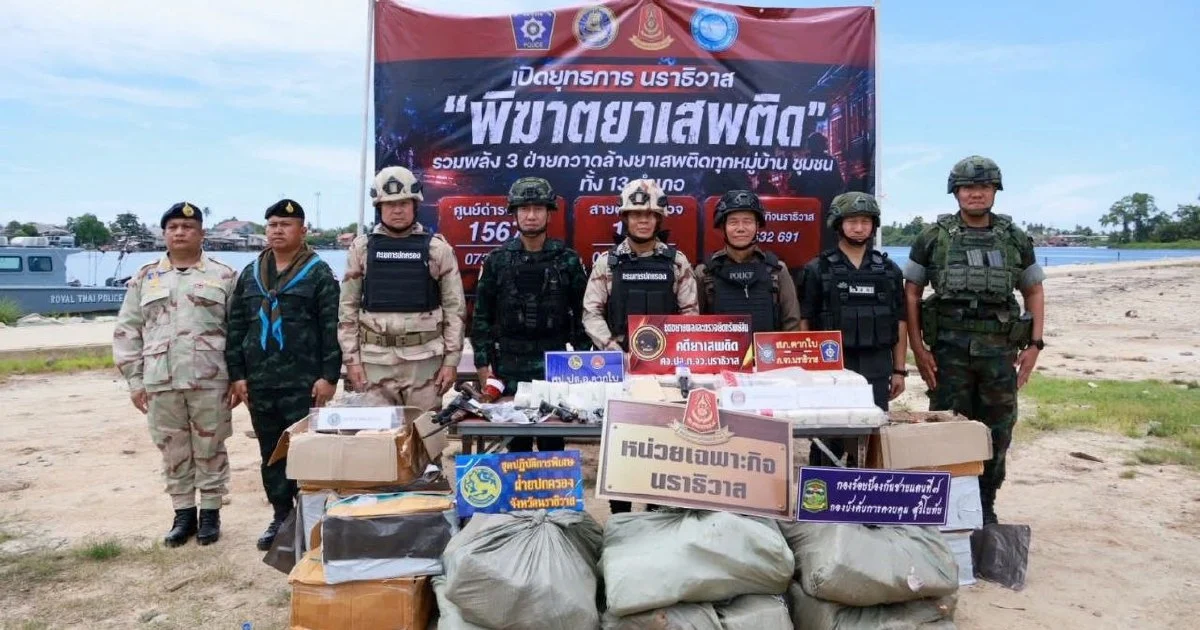
Thai authorities have dismantled a significant drug trafficking network in Narathiwat province, arresting 233 suspected members of organised syndicates with reported ties to Malaysian criminal operations. The month-long enforcement campaign highlights the persistent cross-border drug trafficking problem that continues to plague the region despite intensified law enforcement cooperation.
The crackdown, which targeted the southern Thai province bordering Malaysia, represents a substantial blow to trafficking organisations that have allegedly been channelling narcotics through Malaysian territory. Narathiwat's proximity to Malaysian states including Kelantan and Perlis has long made it a strategic transit point for drug smuggling networks seeking to move contraband between Southeast Asian production zones and distribution hubs. The arrest scale underscores the deep embeddedness of these criminal organisations within provincial communities.
A key element of this enforcement operation involved disrupting an attempt to smuggle RM1.2 million worth of illegal drugs, demonstrating the considerable financial stakes involved in transnational trafficking operations. Such seizures often represent only fractional recoveries, with law enforcement agencies estimating that substantially larger shipments successfully traverse borders undetected. The monetary value associated with intercepted consignments provides a snapshot of the overall illicit drug market flowing through regional corridors.
The involvement of Malaysian traffickers in networks centred on Thai territory reflects the borderless nature of Southeast Asian drug trafficking, where criminal organisations exploit jurisdictional gaps and coordinate operations across national boundaries. Malaysian syndicates have historically played crucial roles as intermediaries and distribution networks, leveraging the country's strategic geographic position and established port infrastructure. The identification of Malaysian connections in this Thai operation suggests ongoing collaboration between regional trafficking groups.
Narathiwat province has emerged as a persistent focal point for regional drug enforcement efforts, combining production capacity, trafficking transit routes, and distribution networks within a relatively compact geography. The province's remoter areas provide cultivation opportunities for narcotic crops and manufacturing facilities for synthetic drugs, while its coastline facilitates maritime smuggling operations. Political instability in the Deep South has also complicated law enforcement activities, creating operational challenges for Thai authorities attempting to maintain border security.
The scale of arrests—233 individuals—indicates that Thai police conducted systematic sweeps across multiple locations rather than targeting isolated trafficking cells. Such comprehensive operations require substantial coordination between provincial police forces, national narcotics agencies, and border security units. The month-long duration suggests sustained investigative work preceding actual arrests, likely involving intelligence gathering, surveillance, and coordination with Malaysian counterparts.
For Malaysian authorities, this operation underscores the ongoing threat posed by transnational trafficking networks utilising Malaysian territory for contraband transshipment and distribution. The presence of Malaysian traffickers within Thai-based syndicates indicates that criminal networks operate with significant geographical flexibility, moving personnel and contraband between countries according to operational requirements and law enforcement pressure. This mobility complicates enforcement efforts and requires sustained cross-border intelligence sharing.
The timing and scale of Thai enforcement efforts often reflect cyclical patterns in drug trafficking, with criminal organisations adapting their routes and methods in response to enforcement crackdowns. Malaysian authorities have similarly conducted periodic major operations targeting trafficking networks, suggesting a competitive dynamic where law enforcement disruption in one jurisdiction temporarily displaces trafficking activities to alternative routes or neighbouring countries. Sustainable reduction in drug trafficking requires consistent, coordinated pressure rather than episodic enforcement surges.
Regional cooperation frameworks, including information sharing agreements and joint task forces, have become increasingly important for addressing the transnational nature of drug trafficking. The identification of Malaysian connections in this Thai operation demonstrates the utility of such cooperation, though many regional experts argue that resources devoted to cross-border collaboration remain insufficient relative to the scale of trafficking operations. Enhanced coordination could potentially improve detection rates and prosecution success.
The synthetic drug market, particularly methamphetamine production and trafficking, represents a significant portion of Southeast Asian narcotic trade and likely constitutes a substantial component of the contraband interdicted during this Thai operation. Production facilities in Myanmar and Thailand supply regional markets including Malaysia, with trafficking networks continuously innovating distribution methods to overcome enforcement barriers. The RM1.2 million seizure reflects the considerable profit margins sustaining these operations despite enforcement risks.
Longer-term solutions addressing drug trafficking require comprehensive approaches extending beyond enforcement to include drug demand reduction, alternative livelihood programmes in source regions, and international cooperation on precursor chemical controls. Thailand, Malaysia, and other regional partners have invested in such complementary strategies, though implementation remains inconsistent and funding often inadequate. Law enforcement successes such as this Narathiwat operation provide temporary disruption but rarely achieve lasting reductions without accompanying prevention initiatives.
The arrested individuals now face prosecution under Thai narcotics laws, which carry severe penalties including lengthy imprisonment and capital punishment for large-scale trafficking. However, incarceration of individual traffickers has historically proven insufficient for sustained disruption of trafficking networks, which simply recruit replacements from available criminal talent pools. The identification of Malaysian connections suggests that Thai prosecutors may seek extradition of some individuals for Malaysian trial, potentially enabling enhanced coordination in dismantling transnational organisations.

