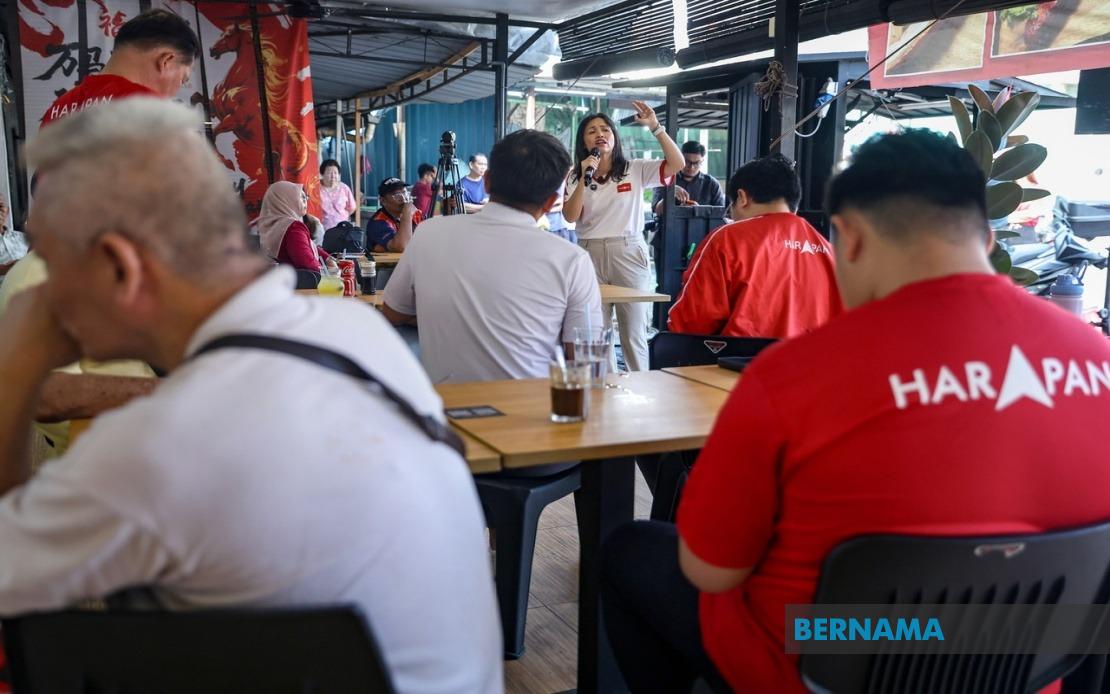
The Johor state election campaign has been shadowed by fresh allegations of inappropriate political activity, with Johor DAP chairman Teo Nie Ching calling on Menteri Besar Datuk Onn Hafiz Ghazi to clarify his involvement in what the opposition claims was a TVET event hijacked for electoral purposes. The controversy centres on the Johor MARA TVET Roadshow held at the Inland Revenue Board Hall in Kluang on July 4, where attendees were allegedly instructed to support the Barisan Nasional candidate despite the event being billed as an educational initiative.
According to complaints received by the DAP, both parents and students reported being mandated to attend the programme, with warnings that non-attendance would be recorded as absenteeism. This mandatory attendance at what was ostensibly a government-organised vocational training event raises significant questions about the blurring of lines between administrative obligation and political participation—a distinction that carries particular weight in the context of educational settings where young people may feel unable to resist official directives. The allegation suggests that participants faced implicit pressure to attend not for educational value but to serve as an audience for political messaging.
Teo's concerns extend beyond mere attendance requirements to the substantive content of the event itself. She contends that the Menteri Besar used the platform to openly advocate for the Barisan Nasional candidate by explicitly referencing the candidate's election number, transforming what should have been a neutral government programme into a campaign rally. This distinction matters considerably: attending a government function is a civic expectation, but being conscripted into political support constitutes a different category of imposition, particularly when those attending include young, largely powerless students in a vocational training context.
The DAP has assembled documentary evidence to support its allegations. Teo indicated that the party possesses the original programme itinerary, written directives mandating attendance, and video recordings purporting to show campaign-related remarks by the Menteri Besar. This accumulation of material suggests that the opposition has pursued the matter with some rigour, moving beyond anecdotal complaints to gather substantive proof. The existence of pre-written documentation explicitly requiring attendance strengthens their contention that the event was designed to ensure maximum audience capture rather than operating on voluntary participation.
A fundamental issue at stake concerns the permissibility of using government facilities for party political purposes. Teo posed the critical question pointedly: if this was genuinely a government programme, then political campaigning should have no place within it; conversely, if it was fundamentally a party event, whether a state agency's hall should be made available for such partisan use requires examination. This dual-track critique reflects the practical complexity facing election regulators and demonstrates why clear separation between state machinery and political machinery remains essential for democratic credibility.
Speaking from the perspective of a parent as much as a politician, Teo highlighted the ethical dimensions of the allegations. The scenario of a child being compelled to attend an official event and subsequently pressured to support a particular political party encroaches on fundamental freedoms and raises child welfare considerations. In vocational education settings where students often come from economically vulnerable backgrounds with limited bargaining power against authority figures, such dynamics warrant careful scrutiny.
The matter now moves toward potential formal action, with PH candidates considering whether to lodge complaints with the Election Commission. Such complaints, if filed, would place the electoral authority in the position of investigating alleged governmental misuse of state resources and official channels to advance partisan objectives during the campaign period. Given that early voting was occurring on July 7 and polling was scheduled for July 11, any investigation would necessarily occur in close temporal proximity to the actual election, potentially influencing voter perception of institutional fairness.
Teo also used the opportunity to counter recent criticism from Onn Hafiz regarding federal government policies. The Menteri Besar had called for reviews of certain policies on grounds that they burdened citizens, but Teo characterised such attacks as misrepresenting how Malaysia's governmental structure functions. She emphasised that major policy decisions require Cabinet approval rather than individual state initiative, suggesting that Onn Hafiz was selectively claiming credit for popular measures while deflecting blame for unpopular ones by attributing them to federal actors or opposition parties. This cross-fire illustrates how state and federal governance layers become entangled in election messaging.
Lim Kit Siang, present at the DAP forum in Kulai, steered discussion toward broader electoral themes, urging voters to reject racial and factional division in favour of what he termed the Malaysian Dream—a vision grounded in equality, freedom, prosperity and human rights protections. His framing suggested that the Johor contest should not be understood merely as a technical dispute over event management but as a referendum on the kind of Malaysia voters wish to build. Lim called for voters to consolidate support for opposition parties rather than fragment votes, a strategic plea designed to maximise PH's parliamentary seat count in a 56-seat chamber.
The 172 candidates contesting the 56 Johor state seats would themselves be aware of the allegation and its potential resonance with voters concerned about fairness and governmental propriety. Such controversies, even if ultimately unresolved, contribute to the broader electoral atmosphere and shape how voters perceive institutional integrity. The TVET event incident, whether or not it results in formal censure, exemplifies the ongoing tension between those wielding state power and opposition figures vigilant against its misuse for electoral advantage.
With polling set for July 11, the timing of these allegations meant they would permeate campaign discussions during the final days before voters cast their ballots. The controversy touches on enduring Malaysian political anxieties about whether state resources and official authority will be deployed fairly across all contestants or whether incumbents retain structural advantages that fundamentally compromise electoral competition. For a state where previous elections have generated considerable competition between major coalitions, allegations of this nature invite close examination of whether institutional norms are being respected.

