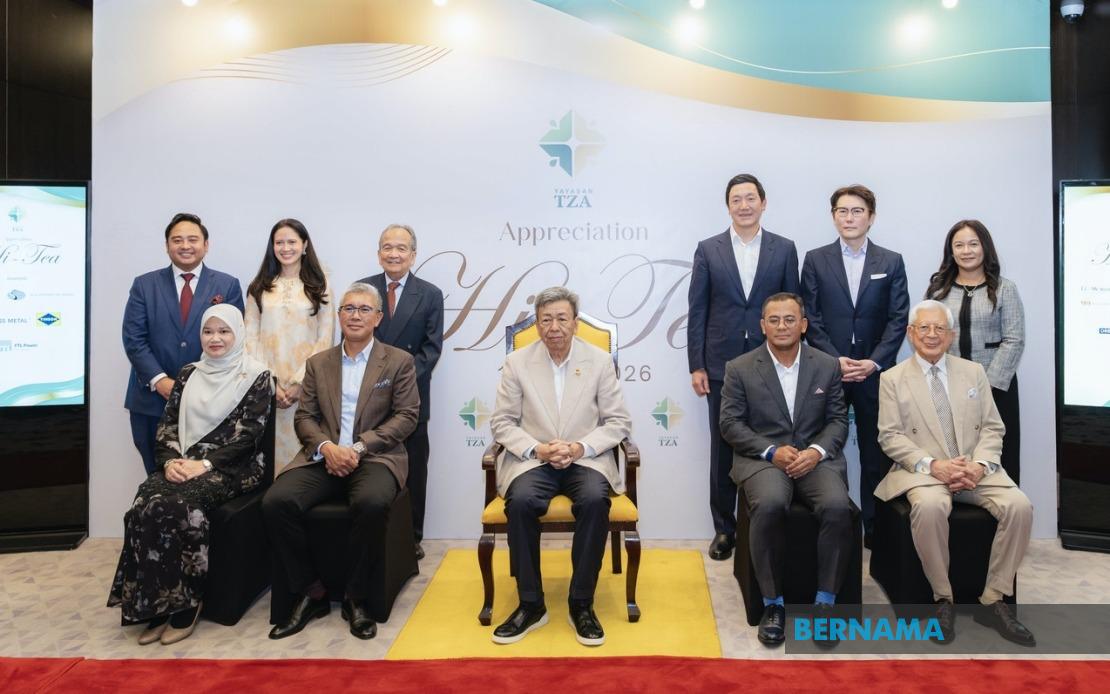
Sultan Sharafuddin Idris Shah, the reigning monarch of Selangor, attended an appreciation ceremony hosted by Yayasan TZA (YTZA) in Kuala Lumpur on June 18, underscoring the royal family's continued engagement with community development initiatives across the state. The Sultan's presence at the event, which commenced at approximately 3.50 pm, reflected the foundation's standing in addressing socioeconomic challenges through structured charitable programmes.
The ceremony drew several prominent government officials, including Selangor Menteri Besar Datuk Seri Amirudin Shari and Education Minister Fadhlina Sidek, signalling alignment between the foundation's objectives and broader state and federal educational agendas. YTZA chairman Tan Sri Arshad Raja Tun Uda and foundation advisor Tengku Datuk Seri Zafrul Abdul Aziz welcomed the Sultan, who serves as patron figure to numerous state-level philanthropic ventures.
Tengku Zafrul, speaking during the ceremony, articulated the foundation's holistic approach to social uplift, emphasising that its programmes transcend immediate relief to foster sustainable community resilience. He outlined how YTZA's initiatives—spanning educational scholarships, environmental sustainability projects, and cultural engagement with marginalised communities—collectively work towards creating structural improvements in quality of life rather than temporary assistance alone.
The centrepiece of YTZA's current focus is ACE SPM, an academic enrichment programme specifically targeting Form Five students from households in the bottom 40 per cent income bracket. The initiative addresses a critical gap in Malaysia's educational ecosystem: the disparity between metropolitan and rural examination preparation resources. By providing structured tuition and mentorship, ACE SPM seeks to level the playing field for underprivileged candidates sitting the Sijil Pelajaran Malaysia examination, a pivotal qualification determining tertiary education access.
The programme's reach in 2025 demonstrates meaningful scale and impact. Approximately 467 students across 10 Selangor schools directly benefited from in-person interventions, while YTZA's digital offerings—comprising online modules, virtual coaching sessions, and interactive learning platforms—extended the foundation's footprint to more than 4,000 students. This dual-track delivery model proves particularly relevant in Malaysia's post-pandemic education landscape, where hybrid learning mechanisms have become embedded in institutional practice.
Tengku Zafrul announced plans to expand ACE SPM significantly in coming years, acknowledging that current enrolment figures represent only a fraction of eligible beneficiaries across Selangor. The foundation's expansion trajectory reflects broader recognition within Malaysia's charitable sector that educational inequality, once entrenched, perpetuates intergenerational poverty cycles difficult to reverse in adulthood. By intervening at the secondary education stage—a critical juncture determining career pathways—YTZA targets the problem at its most tractable point.
During the event, the Sultan witnessed presentations of substantial corporate commitments to the foundation's work. Kuok Brothers Sdn Bhd pledged RM1 million, whilst YTL Power International Berhad contributed RM300,000, collectively generating RM1.3 million in fresh funding for programme expansion. These donations underscore the foundation's success in mobilising Malaysian corporate philanthropic capital toward education-focused causes, a demonstration of how business entities increasingly recognise their stake in developing human capital across all socioeconomic strata.
Tengku Zafrul extended formal gratitude to corporate sponsors, individual donors, strategic partners, and volunteer networks whose cumulative efforts sustain YTZA's operational capacity. He acknowledged that Malaysia's charitable ecosystem depends fundamentally on coordinated contributions from multiple stakeholder categories—neither government budgets nor corporate donations alone suffice to address social needs comprehensively. This recognition reflects mature understanding of how modern philanthropy functions as a tripartite partnership between state, business, and civil society.
The ceremony also marked the official launch of Larian KITA@Klang, a community fun run scheduled for October 10, 2025, coinciding with the Sultan of Selangor's Silver Jubilee celebrations. This represents the fourth iteration of the Larian KITA series, a carefully conceived blend of recreational activity, cultural celebration, and community cohesion. The event deliberately incorporates local culinary and cultural dimensions, transforming charitable fundraising into inclusive experiential gatherings that transcend traditional donor-beneficiary hierarchies.
From a Southeast Asian perspective, YTZA's model offers instructive lessons in structured poverty alleviation. Rather than perpetuating dependency through unconditional assistance, the foundation invests in human capability development, particularly targeting education as the primary vehicle for upward mobility. This philosophy aligns with contemporary international development thinking, where capacity building takes precedence over subsidy provision as the preferred anti-poverty strategy.
The foundation's emphasis on digital reach—extending programming to 4,000 students through online channels while maintaining direct contact with 467 students—reflects pragmatic adaptation to Malaysia's mixed urbanisation patterns. Rural and semi-urban areas, which house significant B40 populations, often lack access to premium tutoring services available in metropolitan centres. Digital intermediation partially bridges this geographic disadvantage, though quality and engagement challenges remain.
Looking forward, YTZA's expansion trajectory will face resource constraints typical of Malaysian charitable organisations. Sustaining growth across ten schools whilst scaling to additional institutions requires either exponential growth in corporate donations or strategic partnerships with government agencies willing to integrate ACE SPM methodologies into public school curricula. The presence of the Education Minister at this ceremony suggests receptiveness to such collaboration possibilities, potentially opening pathways for institutional scaling beyond the foundation's independent operational capacity.