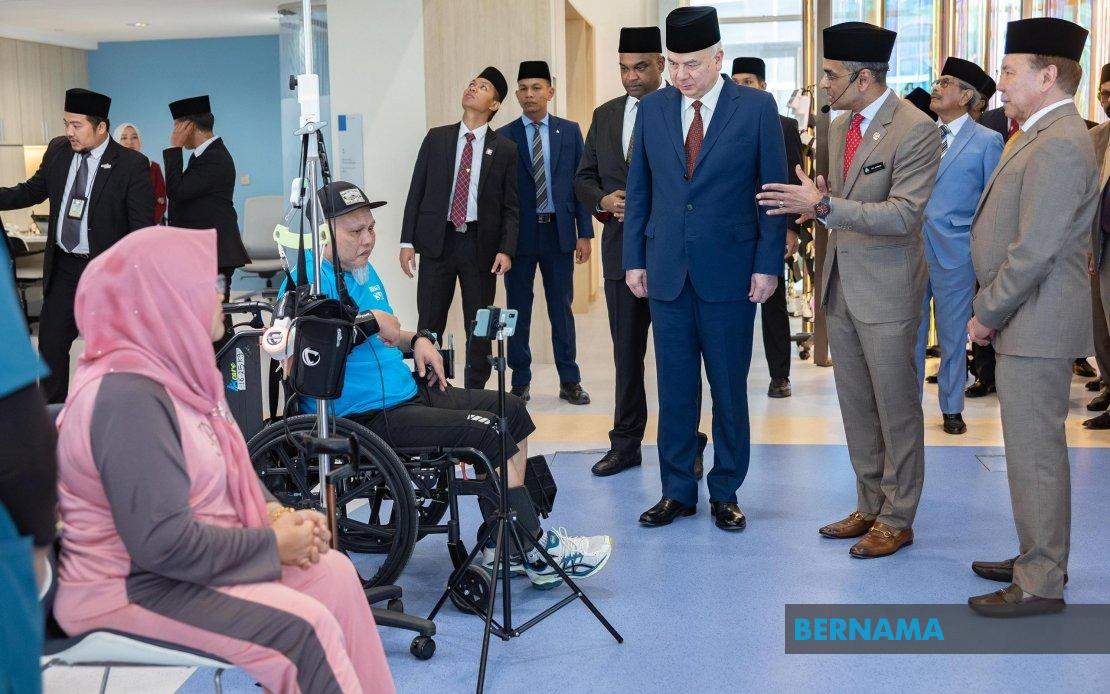
Sultan Nazrin Shah, the Sultan of Perak, officially opened the Social Security Organisation's (PERKESO) Neuro-Robotics and Cybernetics Rehabilitation Centre in Meru Raya on June 16, marking a significant advancement in Malaysia's approach to modern rehabilitation and social healthcare. The facility, which draws architectural inspiration from traditional gold-thread embroidery, has been formally named the Pusat Rehabilitasi Perkeso Sultan Nazrin Shah in recognition of the Sultan's patronage. The inauguration ceremony included Raja Muda Perak Raja Jaafar Raja Muda Musa, Raja Di Hilir Perak Raja Iskandar Dzulkarnain Sultan Idris Shah, Perak Menteri Besar Datuk Saarani Mohamad, and Human Resources Minister Datuk Seri R. Ramanan.
In his address, Sultan Nazrin positioned the centre not merely as a collection of advanced medical equipment, but as a comprehensive institution reflecting Malaysia's evolving commitment to rehabilitation as a human-centred endeavour. The Sultan emphasised that the facility's true value emanates from the multidisciplinary expertise housed within its walls—a collaborative ecosystem encompassing medical specialists, assistive technology engineers, physiotherapists, occupational therapists, vocational rehabilitation counsellors, social workers, and mental health professionals. This integrated approach represents a departure from fragmented service delivery, instead offering stroke survivors, workers with neurological injuries, and individuals with traumatic brain injuries a coordinated pathway to recovery that addresses both physical and psychological dimensions of rehabilitation.
The Sultan articulated a philosophical vision extending beyond conventional healthcare infrastructure. He stressed that the centre symbolises a fundamental reconceptualisation of how the nation views disability, recovery, and the role of injured workers within society. Rather than treating rehabilitation as a clinical process isolated from social reintegration, the facility embodies an integrated model where advanced technology, medical expertise, and compassionate human support converge to restore independence and preserve dignity. This perspective carries particular significance for Malaysia's workforce, where occupational injuries and neurological conditions frequently disrupt employment trajectories and family stability, often without adequate pathways for meaningful recovery and return to productive work.
Recognising the centre's genesis, Sultan Nazrin acknowledged M. Kulasegaran, the Ipoh Barat MP who conceptualised the project during his tenure as Human Resources Minister from 2018 to 2020. This recognition underscores the cross-party commitment to rehabilitation infrastructure, suggesting that workforce welfare initiatives transcend political divisions. The Sultan's reference to specific patient scenarios—stroke survivors regaining mobility, neurological injury patients rebuilding strength, traumatic brain injury survivors restoring cognitive function—grounds the centre's abstract mission in concrete human outcomes, illustrating how technological investment translates into restored capabilities and reclaimed futures for individuals and families facing life-altering health crises.
A critical element of Sultan Nazrin's address centred on post-rehabilitation employment integration, a persistent challenge in Malaysia's disability services ecosystem. The Sultan specifically commended PERKESO's collaboration with 7-Eleven in providing workplace training and employment opportunities for rehabilitation programme graduates. This public-private partnership model addresses a systemic gap: many individuals complete intensive rehabilitation only to face unemployment or underemployment, negating the therapeutic gains achieved during treatment. By institutionalising the link between rehabilitation completion and employment placement, the partnership creates incentives for sustained commitment to recovery and demonstrates tangible pathways to self-reliance, countering the narrative that disability inevitably leads to prolonged dependence on social assistance.
The Sultan made an explicit appeal to Malaysia's private sector, urging corporations to extend beyond traditional corporate social responsibility rhetoric toward structured engagement with PERKESO's initiatives. He called for systematic vocational training programmes, dedicated employment pipelines, and formal collaboration frameworks that would enable successful rehabilitation centre graduates to transition into sustainable livelihoods. This appeal carries economic logic alongside moral imperative: Malaysia's workforce is aging, occupational injuries remain a persistent challenge, and retention of injured workers through effective rehabilitation represents prudent human capital management. Companies investing in such programmes simultaneously address labour shortages in specific sectors while demonstrating authentic commitment to inclusive employment practices that strengthen community resilience.
Crucially, Sultan Nazrin addressed social attitudes toward disability, calling for elimination of prejudice against persons with disabilities. This framing transcends charity or benevolence, instead positioning inclusive employment and disability accommodation as matters of social justice and national obligation. The Sultan's insistence that disabled individuals should be afforded opportunities to regain independence through work, rather than relegated to permanent welfare dependency, reflects an evolving global understanding of disability as a social construct partly shaped by employment barriers rather than inherent incapacity. For Malaysian employers and policymakers, this perspective offers a reframing that shifts focus from deficits and limitations toward capabilities and potential contributions that disabled individuals can make when structural barriers are dismantled.
The Sultan's broader philosophical statement—that national progress transcends economic indicators and infrastructure development—provides valuable context for Malaysia's ongoing development trajectory. As the nation pursues middle-income and high-income aspirations, the Sultan reminds stakeholders that genuine development includes the capacity to preserve human dignity, protect vulnerable populations, and furnish second chances to individuals tested by adversity. This standard of progress measurement resonates particularly in Southeast Asian contexts where rapid urbanisation and industrialisation sometimes marginalise populations unable to participate in formal economies. The PERKESO centre, from this perspective, becomes emblematic of a development model prioritising inclusive citizenship and social protection alongside GDP growth.
The centre's architectural design—inspired by traditional gold-thread embossing techniques—carries symbolic significance beyond aesthetic considerations. By embedding contemporary rehabilitation technology within design language rooted in Malaysian cultural heritage, the facility communicates that modernisation need not entail cultural displacement. For Malaysian workers from diverse backgrounds navigating rehabilitation services, this design choice may signal institutional recognition of cultural identity and traditional values, potentially improving therapeutic engagement and outcomes. Such attention to cultural dimensions of healthcare delivery reflects international best practices in rehabilitation medicine, where patient dignity and cultural respect significantly influence treatment adherence and psychological recovery.
For the broader Southeast Asian region, the PERKESO centre's inauguration offers important lessons regarding rehabilitation infrastructure development and workforce protection. Many regional economies confront similar challenges: rapidly aging workforces, insufficient rehabilitation capacity, persistent employment discrimination against disabled workers, and fragmented social protection systems. The Malaysian model—combining technological sophistication with multidisciplinary expertise, embedding public-private partnerships, and framing rehabilitation as essential infrastructure rather than welfare expenditure—provides a replicable framework for neighbouring countries. International collaboration on rehabilitation best practices, worker protection standards, and disability inclusion initiatives could yield significant regional benefits, particularly if mechanisms exist for knowledge transfer and technical assistance among ASEAN economies.
Looking forward, the centre's success will likely depend on sustained funding, workforce capacity development, continuous technological upgrading, and crucially, the private sector's willingness to translate Sultan Nazrin's appeal into concrete employment commitments. The intersection of rehabilitation outcomes and employment placement remains the pivotal juncture determining whether the PERKESO centre achieves its transformative potential or becomes isolated from the economic reintegration realities facing graduates. Monitoring employment rates, wage trajectories, and job retention for centre graduates will provide essential indicators of whether institutional innovation successfully bridges the rehabilitation-employment gap that historically undermines recovery outcomes. The Sultan's vision of dignity, second chances, and restored independence ultimately rests upon employers and policymakers translating rhetorical commitments into structural systemic change.