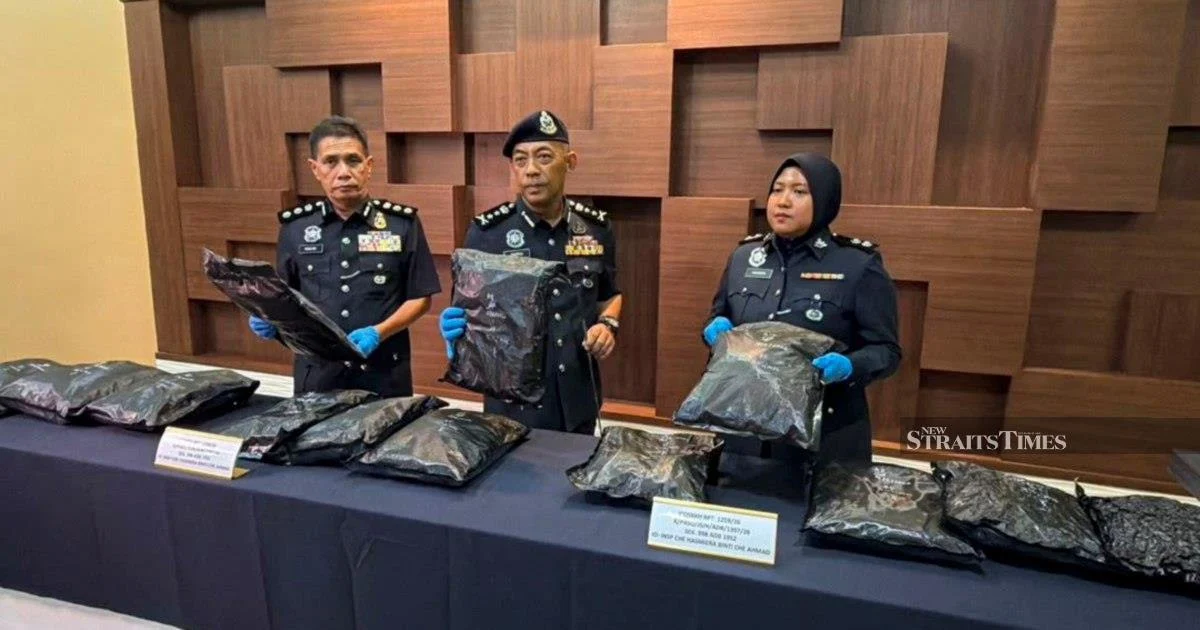
Police in Kedah have arrested a student enrolled at a private higher education institution in connection with an attempted large-scale cannabis smuggling operation intercepted at the Bukit Kayu Hitam border checkpoint on Monday. The seizure represents a significant drug trafficking bust for the northern region, with authorities recovering approximately 14.63 kilograms of cannabis buds with an estimated street value of RM1.17 million.
The arrest marks another chapter in the ongoing battle against drug trafficking along Malaysia's porous borders, particularly the lengthy Thailand frontier in the north. The Bukit Kayu Hitam checkpoint, located in Kedah and serving as a crucial gateway between Malaysia and Thailand, continues to be a focal point for enforcement operations targeting cross-border narcotics movement. The interception demonstrates the persistent vulnerability of transport routes linking the two nations, despite stepped-up security measures at formal crossing points.
The suspect's status as a private university student underscores a troubling trend of younger individuals becoming entangled in organised drug networks. Rather than pursuing legitimate academic goals, the student allegedly became involved in the logistics of large-scale drug trafficking—a position in the supply chain that authorities describe as essential to criminal organisations seeking to distribute narcotics across Malaysian cities and beyond. The use of tertiary education as a cover for such activities raises questions about recruitment tactics employed by trafficking syndicates targeting educated young people.
Cannabis trafficking has emerged as a growing concern across Southeast Asia, driven by rising regional demand and improving profit margins as supply chains mature. Malaysia's position as a transit hub between major production regions in the Golden Triangle and consumer markets throughout the region makes it an attractive target for traffickers seeking to move contraband through established networks. The drug's increasing potency and the development of cannabis-derived products have attracted both organised criminal syndicates and smaller independent operators seeking to capitalise on market opportunities.
The method of smuggling—direct transportation across the land border rather than through more sophisticated concealment techniques—suggests either opportunistic trafficking or reliance on less experienced operatives. Enforcement officials have historically observed that smaller operations and independent smugglers often employ more direct approaches, whereas established criminal organisations typically employ innovative concealment methods and multiple transportation layers. The straightforward nature of this attempted smuggle may indicate that the suspect was a lower-level operative rather than a key figure in a broader trafficking network.
Bukit Kayu Hitam's strategic location in Kedah, approximately 130 kilometres north of Alor Star, makes it a natural convergence point for cross-border movement of both legitimate goods and contraband. The checkpoint experiences significant daily traffic from tourists, commercial vehicles, and local commuters, creating both opportunities and challenges for enforcement personnel attempting to identify suspicious consignments. Security agencies must balance effective interdiction with maintaining fluid border operations essential to regional trade and tourism.
The asset value of RM1.17 million reflects the substantial profitability of cannabis trafficking in the Malaysian market, where demand has reportedly increased in urban centres and among younger demographics. This valuation, based on expected retail prices, illustrates why trafficking organisations continue to take considerable risks—the potential financial returns substantially exceed legitimate employment opportunities available to university students, a fact that makes such individuals vulnerable to recruitment by criminal networks.
The incident occurs within a broader context of increased drug enforcement activity in Kedah and throughout northern Malaysia. State authorities have intensified operations targeting smuggling corridors and distribution networks, particularly following intelligence suggesting escalating transnational trafficking activity. However, the persistence of attempts such as this demonstrates that supply continues to meet demand despite these enforcement efforts, suggesting that disruption of individual trafficking networks has limited overall impact without simultaneous action against underlying demand factors and organisational structures.
Investigations into the arrest will likely extend beyond the individual student to determine whether larger trafficking networks were involved in arranging the transportation and identifying end-market distribution points. Police typically pursue such enquiries to identify other participants in the supply chain, from source-country suppliers through to domestic distribution networks. The outcome of these investigations could provide valuable intelligence regarding operational patterns of trafficking syndicates exploiting the Malaysia-Thailand border region.
The case highlights persistent challenges facing Malaysian law enforcement in combating large-scale drug trafficking despite technical and human resource investments in border security. While individual seizures of high-value contraband represent operational successes, they represent only a fraction of overall trafficking volumes crossing into Malaysia. Addressing the underlying economic incentives driving young people toward involvement in drug networks, coupled with simultaneous pressure on supply sources and distribution channels, remains essential for meaningful progress in this persistent enforcement challenge.