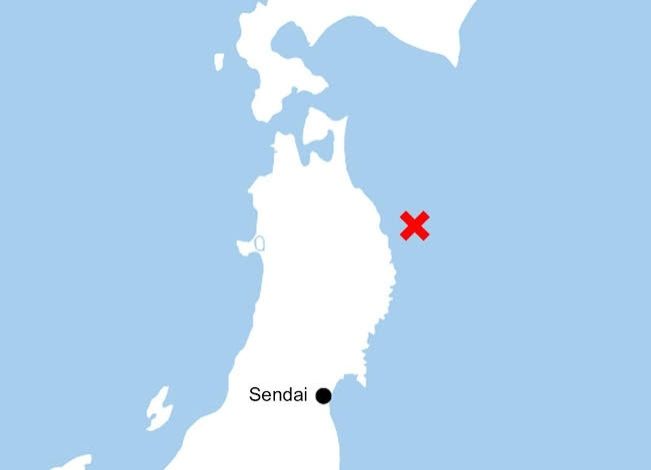
Northern Japan experienced a powerful 7.2-magnitude earthquake on Thursday morning, with tremors felt across a vast region extending several hundred kilometres to Tokyo, though authorities moved quickly to confirm that the disaster caused minimal harm and no loss of life. The seismic event originated in waters off Iwate Prefecture on the main island of Honshu at 7:30 am local time, with the Japan Meteorological Agency initially calculating the magnitude at 6.9 before revising upward to 7.2 and pinpointing the epicentre at a depth of 44 kilometres.
While the earthquake's raw power was considerable, the practical impact on affected communities remained limited. Kitchen appliances tumbled from shelves and shop merchandise scattered across floors in television footage, yet residents in the affected areas reported only minor household damage. Mutsumi Shimohata, a 61-year-old food processing employee in Hashikami, Aomori Prefecture, described how an alarm on her smartphone triggered almost instantaneously as the ground shook. She noted that her own residence suffered only a fallen picture frame, though her workplace sustained more substantial harm when the office's automatic door mechanism failed and sections of ceiling came loose, prompting management to instruct staff to remain home and on alert.
Transportation networks experienced disruption in the immediate aftermath. Certain shinkansen bullet train services halted operations as a precautionary measure, while local authorities temporarily shuttered at least one primary school in Hashikami to assess conditions. Emergency services responded to at least four calls in the Hashikami and Hachinohe area, including reports of individuals trapped within a lift, stuck doors in buildings, and a tanker truck that had overturned on roadways. Despite these incidents, normality gradually returned, with footage from Hachinohe city showing vehicles moving freely and traffic signals operating without malfunction as the day progressed.
Japan's sophisticated early warning systems and robust building codes, forged through centuries of seismic experience, once again demonstrated their value in limiting casualties and major destruction. Prime Minister Sanae Takaichi moved swiftly to coordinate response efforts, instructing national and local government agencies to maintain close communication and monitoring. In a statement on social media platform X, Takaichi urged residents across areas affected by strong shaking to remain vigilant for the possibility of additional earthquakes of comparable intensity, reflecting awareness that major seismic events frequently generate powerful aftershocks capable of causing additional damage.
The intensity of Thursday's earthquake registered at the upper sixth level on Japan's seven-point Shindo scale in Aomori Prefecture, a rating that indicates substantial physical consequences. At this intensity threshold, individuals typically struggle to maintain their balance without support and can be knocked down by the ground motion. Unsecured furniture tends to overturn, windows frequently fracture, and structural elements may sustain cracks. Notably, no tsunami warning was activated following the undersea event, sparing coastal communities from the secondary hazard that often causes the greatest destruction and loss of life in Pacific seismic zones.
Nuclear safety officials moved to verify the security of regional reactor facilities, with the Nuclear Regulation Authority reporting through Kyodo News that no abnormalities appeared at nuclear power stations in the affected region. This verification proved particularly significant given Japan's heightened sensitivity to nuclear risks following the 2011 Fukushima catastrophe. That catastrophic event, triggered by a 9.0-magnitude undersea earthquake and subsequent tsunami, killed or left missing approximately 18,500 people and destroyed the Fukushima Daiichi nuclear complex, fundamentally reshaping Japan's approach to seismic preparedness and nuclear regulation.
Thursday's earthquake arrived roughly two months after Japan experienced another major seismic event on April 20, when a 7.7-magnitude tremor struck the country's northern region, injuring at least ten people and shaking tall buildings across Tokyo with considerable force. That April earthquake prompted authorities to issue an unusual special advisory warning the public of an elevated risk for earthquakes measuring 8.0 magnitude or stronger. The advisory remained in effect for seven days before being withdrawn, reflecting the evolving understanding of seismic clustering and the unpredictable nature of earthquake forecasting even in a nation that monitors seismic activity with unparalleled technological sophistication.
Geographically and geologically, Japan occupies one of Earth's most tectonically restless regions, positioned atop four major tectonic plates along the western perimeter of the Pacific Ring of Fire. This unfortunate location makes the archipelago a constant laboratory for earthquake science and a testing ground for disaster response systems. The nation's 125 million residents typically endure hundreds of seismic jolts annually, and Japan accounts for approximately 18 per cent of all earthquakes globally, a staggering concentration of seismic energy that shapes infrastructure design, building codes, and emergency protocols throughout society.
The majority of Japan's earthquakes remain relatively mild, though even moderate tremors can produce significant damage depending on their precise location, depth, and proximity to populated centres. The severity of consequences depends less on magnitude alone and more on where the rupture occurs and how forcefully energy propagates through different geological layers. Shallow earthquakes in populated areas generate far more destructive potential than deeper events in remote locations, a reality Japan's building standards explicitly account for through sophisticated design requirements and continuous upgrading of seismic resilience infrastructure.
Thursday's earthquake, while substantial in absolute terms, demonstrated the effectiveness of Japan's integrated approach to seismic hazards spanning detection, early warning, building engineering, and coordinated emergency response. The minimal damage reported underscores how systematic investment in earthquake preparedness, accumulated through painful historical experience, translates into practical protection for one of the world's densest populations living in one of its most seismically active zones. As aftershocks inevitably follow in the coming days, residents and authorities across northern Japan remain on heightened alert, prepared to respond swiftly should secondary tremors reach comparable intensity levels or trigger additional ground failures.

