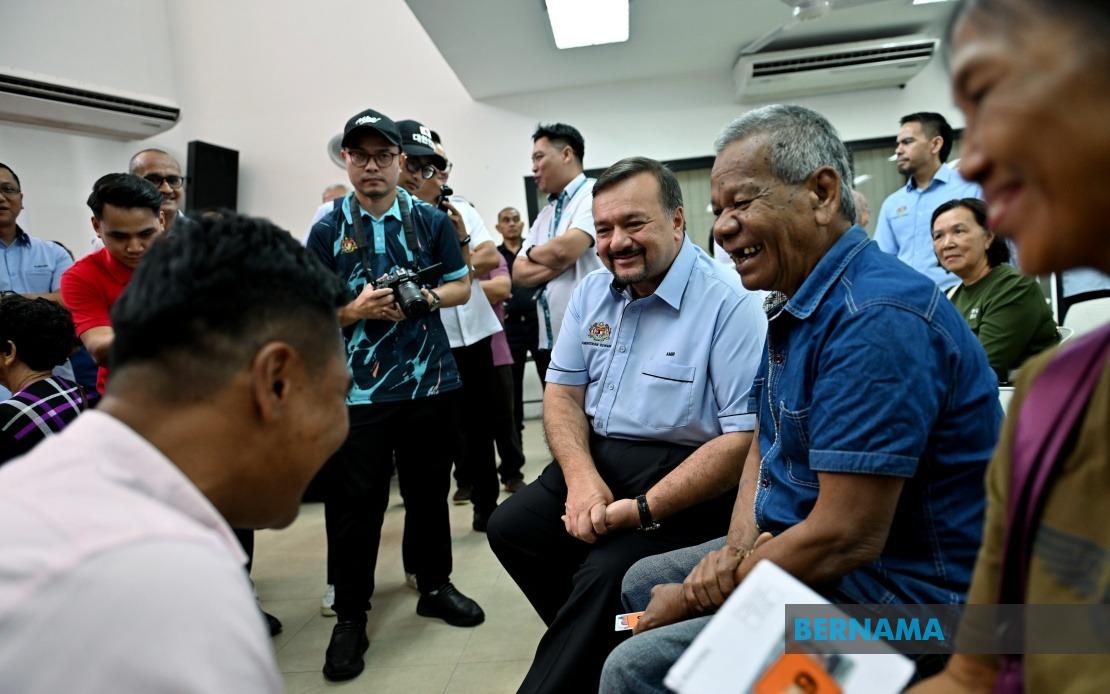
The Sumbangan Tunai Rahmah (STR) cash assistance programme, a cornerstone of Malaysia's cost-of-living support measures, has broadened its reach across Sarawak through the establishment of distribution points at 20 different locations. This expansion directly addresses accessibility challenges faced by vulnerable populations across the state, particularly older citizens, individuals managing chronic health conditions, and communities situated in remote areas where travel to centralised offices poses logistical and financial difficulties.
Finance Minister II Datuk Seri Amir Hamzah Azizan outlined the rationale behind this spatial expansion during his visit to Lundu, emphasising that the programme's dual purpose encompasses both streamlining administrative processes and ensuring direct cash transfers to those most dependent on government support. The decentralisation strategy recognises that traditional centralised distribution models inadvertently create barriers for precisely those demographic groups most reliant on such assistance. By positioning collection points throughout the state, officials aim to eliminate unnecessary travel burdens that could diminish the real economic value of the aid received.
A significant dimension of the programme addresses the banking infrastructure gap affecting portions of Sarawak's population. The Finance Minister acknowledged that a substantial cohort of STR recipients remain unbanked, lacking formal savings accounts through which assistance could be electronically transferred. To bridge this gap, the government has introduced alternative collection mechanisms that accommodate those without banking relationships, ensuring that exclusion from the formal financial system does not prevent access to critical support. This pragmatic approach recognises Malaysia's ongoing financial inclusion challenges, particularly in states with geographically dispersed populations.
The programme incorporates proxy collection provisions for recipients facing physical impediments to personal attendance. Elderly beneficiaries suffering from mobility limitations or those managing debilitating illnesses may designate authorised representatives to claim assistance on their behalf, provided appropriate documentation and supporting evidence accompany the request. This arrangement balances security and verification protocols with compassionate recognition that health circumstances should not disqualify individuals from benefits they have legitimately qualified to receive. The policy demonstrates administrative flexibility in responding to real-world vulnerabilities.
Simultaneously, government officials are actively encouraging financial institution engagement among STR recipients. Amir Hamzah articulated a broader developmental objective: establishing banking relationships would eliminate future administrative friction and reduce personal expenses associated with physical collection. Recipients in geographically isolated regions understand intuitively that travelling to designated centres incurs costs—transport, meals, accommodation for longer journeys—that effectively diminish their assistance value. By promoting account opening, the government seeks to create permanent infrastructure that supports not only current disbursements but also facilitates straightforward delivery of future targeted support schemes without repeated logistical complications.
The STR programme operates as a focused intervention within Malaysia's broader anti-poverty framework, targeting more than eight million low and middle-income households nationwide. Sarawak alone has witnessed nearly 900,000 beneficiaries accessing support through both the STR initiative and its complementary scheme, the Sumbangan Asas Rahmah (SARA). These figures underscore the substantial administrative undertaking required to process, verify, and disburse assistance to economically vulnerable populations distributed across an exceptionally large state characterised by challenging geography and dispersed settlement patterns.
The expansion represents pragmatic learning from earlier programme implementation phases. Government administrators, encountering firsthand accounts of recipients abandoning assistance applications due to travel barriers, recognised that expanding physical access points could substantially increase uptake among eligible but previously disconnected populations. Rural communities that had regarded the administrative burden as prohibitive may now discover that newly proximate collection centres transform participation from theoretical possibility to practical reality. This refinement embodies evidence-based policy adaptation responding to implementation feedback rather than top-down assumption about recipient circumstances.
Sarawak's particular geography creates distinctive challenges absent in more densely populated peninsular regions. Communities distributed throughout the state encounter vastly different transportation costs and travel time requirements depending on their proximity to urban centres. Some residents might require multiple days of travel and substantial expense to reach a centralised office; the identical task from an urban location might consume an hour and minimal cost. By positioning 20 distribution points throughout the state, officials attempt to equalise effective access, ensuring that geographic circumstance—largely a matter of chance rather than merit—does not determine whether eligible citizens access assistance they qualify to receive.
The programme's allowance for alternative payment mechanisms and proxy arrangements reflects sophisticated understanding of barriers that prevent theoretically available benefits from reaching intended recipients. In many development contexts, programme designers discover that logistical impediments, bureaucratic complexity, and administrative friction create invisible gatekeepers that exclude vulnerable populations as effectively as explicit eligibility restrictions. By recognising and accommodating legitimate practical obstacles, the STR expansion transforms from mere geographic multiplication of offices into genuine accessibility enhancement that acknowledges the diverse circumstances of beneficiary populations.
Looking forward, the success of this expansion will likely influence how Malaysia designs and implements future targeted assistance initiatives. If the 20-location model in Sarawak demonstrably increases participation among previously unreached populations while maintaining appropriate verification protocols, other states may adopt similar approaches. The banking promotion component introduces important questions about financial inclusion strategy: whether government support programmes should simultaneously function as recruitment mechanisms for financial institutions, potentially extending formal financial services into underbanked regions. For Malaysian policymakers monitoring cost-of-living pressures and income inequality, the STR programme's evolution from centralised to distributed model offers practical lessons about converting policy intention into equitable implementation reality.

