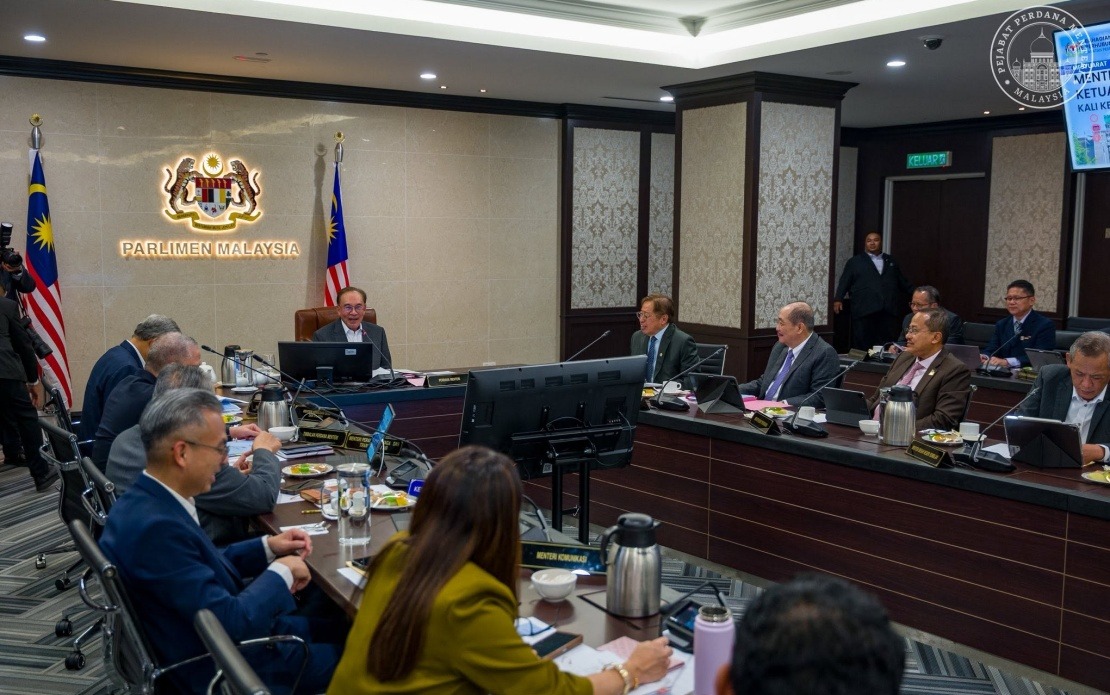
Prime Minister Datuk Seri Anwar Ibrahim convened the 149th Meeting of Menteris Besar and Chief Ministers at the Parliament Building in Kuala Lumpur, steering high-level discussions toward a coordinated national strategy for economic recovery and resilience. The gathering brought together state leaders from across the federation to address mounting pressures on Malaysia's economic performance, signalling the government's determination to present a unified front amid turbulent global conditions.
The central concern dominating the agenda was how to fortify Malaysia's economy against cascading effects of geopolitical instability in West Asia. These regional conflicts have already begun rippling through global supply chains and financial markets, prompting Malaysian policymakers to recalibrate growth strategies and investment priorities. Anwar stressed that this coordinated approach—bringing federal and state administrations into alignment—would prove crucial in maintaining investor confidence and steady economic momentum during an extended period of international uncertainty.
Beyond immediate economic concerns, the meeting addressed a second significant threat to Malaysia's development trajectory: the El Niño phenomenon. The Prime Minister highlighted how this climatic pattern poses complex, interconnected challenges across multiple critical sectors. Water supply infrastructure faces potential strain during the dry season, while agricultural production could suffer dramatically from moisture shortages and elevated temperatures. Food security, a foundational pillar of national stability, emerged as a key focal point given Malaysia's reliance on both domestic production and regional food trade.
The El Niño discussion extended to public health and environmental dimensions often overshadowed in mainstream economic discourse. Rising temperatures would intensify heat stress across populations, particularly affecting outdoor workers and vulnerable communities in lower-income areas. Simultaneously, haze—a persistent regional phenomenon exacerbated by dry conditions—threatens air quality and respiratory health across Malaysia and neighbouring countries. State governments, which oversee local environmental management and agricultural support systems, played a crucial role in articulating ground-level vulnerabilities and proposing mitigation measures.
Anwar emphasised that the meeting reinforced a principle increasingly central to Malaysian governance: policy integration across multiple domains. Rather than allowing economic, environmental, and social initiatives to proceed along parallel, disconnected tracks, the gathering stressed the importance of ensuring each government initiative advances multiple objectives simultaneously. This approach reflects recognition that Malaysia's development challenges are inherently interdependent—an economic policy that ignores climate risks or social inclusion, for instance, will ultimately undermine long-term competitiveness and stability.
The concept of people-centric implementation emerged prominently in the Prime Minister's characterisation of deliberations. This signals a shift toward ensuring that policies translate into tangible benefits reaching ordinary Malaysians, rather than remaining confined to headline announcements or development statistics visible primarily to technical analysts. The emphasis suggests the government recognises potential public frustration if recovery efforts concentrate benefits among larger corporations or certain regions while marginal populations experience continued economic strain.
Attraction of quality foreign investment featured as a strategic priority within the recovery agenda. Rather than pursuing volume-based investment targets that may bring low-value operations and limited job creation, Malaysian policymakers appear focused on securing capital inflows in higher-skill sectors and technology-intensive industries. This distinction carries significance for Malaysia's long-term competitiveness trajectory, particularly as regional economies compete aggressively for the same investment pools. States must therefore position themselves attractively while the federal government provides conducive macroeconomic conditions and regulatory frameworks.
The meeting's emphasis on consensus and togetherness between federal and state governments underscores the federal nature of Malaysia's constitutional structure. Economic recovery cannot be imposed unilaterally from Kuala Lumpur; it requires genuine collaboration with state administrations that control land policy, local business regulations, and crucial service delivery mechanisms. The gathering appeared designed to build this consensus explicitly, reducing potential friction that could undermine implementation of coordinated national policies.
For Malaysian business communities and foreign investors monitoring government direction, the 149th Meeting conveyed reassurance that leadership recognises current challenges and possesses structured mechanisms for addressing them. The visible coordination between federal and state authorities suggests less risk of policy incoherence or institutional paralysis. However, the true test lies in implementation—whether the integrated, efficient execution promised in the communiqué translates into measurable improvements in business conditions, employment generation, and household incomes across Malaysia's diverse states and territories.

