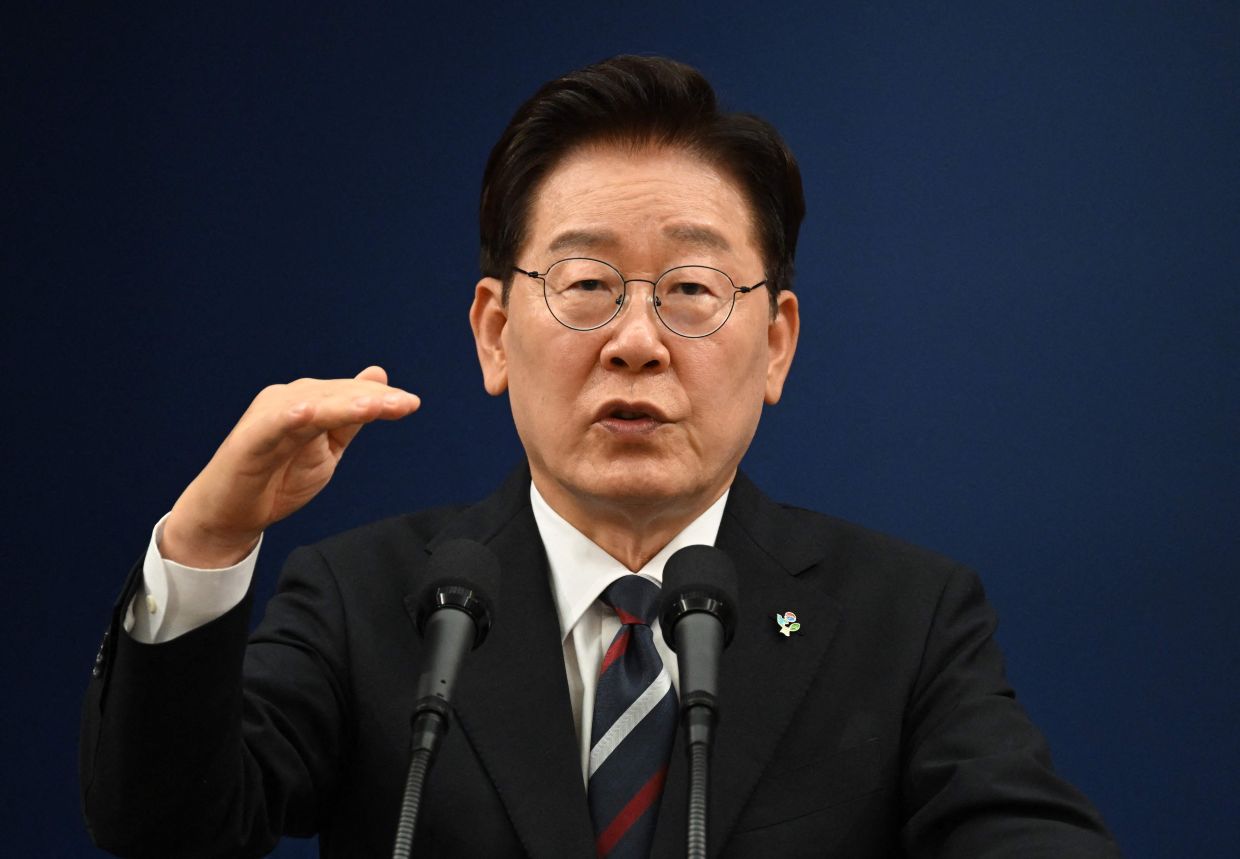
South Korean President Lee Jae Myung is facing a significant erosion of public confidence, with his approval rating dropping to 46.7 per cent in late June, marking a watershed moment in his young presidency. For the first time since Lee assumed office on June 4, 2025, disapproval of his performance has surpassed approval, according to polling data released by local research firm Realmeter. The slide represents the fifth consecutive week of declining support, presenting an early challenge to the newly elected leader as he navigates the complexities of South Korean politics.
The deterioration in Lee's standing has been pronounced and steady. His approval rating stood at a respectable 60.5 per cent in mid-May but has eroded consistently over the subsequent month, declining through 59.3 per cent, 59.1 per cent, and 55.2 per cent in successive weeks before reaching the critical 46.7 per cent threshold. This represents a drop of more than 13 percentage points in just over a month, a trajectory that underscores the velocity of political momentum shifting against the president. The Realmeter survey of 2,517 voters aged 18 and above, conducted between June 15 and 19 using automated response technology, found that negative evaluations reached 49.7 per cent, effectively inverting the typical approval dynamics that favour newly inaugurated leaders.
Two substantive issues have driven the shift in public sentiment, according to Realmeter's analysis. The primary culprit appears to be the ballot shortage that occurred during South Korea's June 3 local elections, a administrative failure that prompted widespread criticism and demands for accountability. Compounding this electoral management fiasco is turmoil within Lee's own Democratic Party of Korea, which is consumed by internal divisions over the party leadership race ahead of an August 17 convention to elect a new chairman. The combination of these two dynamics has created a damaging political narrative that overshadows positive developments during Lee's tenure, including a successful European trip and the breakthrough of South Korea's Kospi index above the 9,000-point mark.
The regional breakdown of approval ratings reveals concerning patterns for the president. Most troubling is the steep decline in conservative strongholds such as Daegu and North Gyeongsang Province, where support plummeted 9.9 percentage points to just 34.6 per cent. This deterioration in what should be natural support bases suggests that even Lee's core constituency is expressing reservations about his performance. In the Greater Seoul metropolitan area, which encompasses Incheon, Gyeonggi Province, and the capital itself, approval ratings fell between 7.6 and 44.8 per cent, indicating weakness in an economically significant region.
Wider demographic analysis illuminates the fracturing of Lee's coalition. Support among moderate voters, traditionally a pivot group in presidential politics, declined 4.9 percentage points to 47.5 per cent, suggesting that concerns about asset market disparities and economic inequality are resonating particularly strongly with this segment. While liberal voters remain substantially supportive at 80.4 per cent, this represents a 3.2 percentage point decline, indicating some slippage even among sympathetic constituencies. Conservative voters show only 19.8 per cent approval, down marginally from the previous week but reflecting the alienation of ideological supporters who might normally rally behind a conservative president during early setbacks.
The presidential office's response to the polling data has struck a tone of contrition and attentiveness. In a statement from Cheong Wa Dae, the presidential compound, officials acknowledged the fluctuations as reflecting public assessment of both economic conditions and the overall conduct of state affairs. The response promised heightened attention to citizens' concerns and expectations, a diplomatic formulation that essentially conceded ground to critics without offering specific policy adjustments or explanations for the administration's early missteps.
Historical comparison provides sobering context for Lee's predicament. Former President Yoon Suk Yeol experienced a similar crossover from positive to negative approval only six weeks into his term, while previous presidents have encountered comparable thresholds at varying intervals. Park Geun-hye witnessed disapproval exceed approval roughly 16 months into her presidency in June 2014, while Moon Jae-in experienced the same inflection point about 19 months into his term in December 2018. Lee's trajectory suggests he is on pace to match or potentially exceed the speed of approval decline experienced by his immediate predecessor.
Parallel party-level polling complicates the political picture further. Support for Lee's Democratic Party of Korea rose 2.1 percentage points to 40.1 per cent, narrowly trailing the main opposition People Power Party at 42.3 per cent, though the gap has compressed from previous weeks. This suggests that while Lee personally is experiencing approval challenges, his party is benefiting modestly from what Realmeter characterises as a crisis-management phase following a bipartisan agreement to investigate the election administration failures. The Democratic Party's rebound, despite factional tensions, appears rooted in an emphasis on party unity and focus on government success.
The situation facing the People Power Party, however, presents a contrasting narrative. The conservative opposition is struggling with mounting pressure to respond to election controversies, including contentious debates over holding a full rerun of the June 3 elections and abolishing early voting procedures. Internal conflicts within the party, particularly disputes over whether leadership should resign, have weakened cohesion among conservative voters and prompted a continued exodus of younger voters in their 20s and 30s. Support among voters in their 20s fell 10.5 percentage points to 48.6 per cent, while backing among those in their 30s declined 5.1 percentage points to 47.4 per cent, indicating a troubling demographic trend for the conservative movement.
For Malaysian and Southeast Asian observers, Lee's predicament offers instructive lessons about the fragility of presidential mandates in technologically advanced democracies where public opinion can shift rapidly in response to administrative failures and intra-party conflict. The incident underscores how electoral mismanagement, even when not involving fraud but merely logistical failure, can fundamentally alter political dynamics and erode public trust in governance institutions. South Korea's experience demonstrates that in contemporary Asian democracies, the ability to manage state affairs competently during the honeymoon period is essential for establishing political capital.
The trajectory of Lee's approval also raises questions about the sustainability of governing coalitions when party management and policy delivery do not proceed in tandem. The internal Democratic Party divisions over leadership succession, occurring just weeks into a new presidency, suggest organisational dysfunction that voters interpret as a lack of direction and coherence. This dynamic is particularly relevant for Southeast Asian political systems, where coalition stability and party management often determine the difference between transformative presidencies and administrations consumed by internal distraction.
Looking ahead, Lee faces a critical window to stabilise his political standing and arrest further erosion of support. The August 17 party convention will be closely watched, as resolution of the Democratic Party's leadership questions could either restore organisational focus or deepen factional wounds depending on the outcome. Meanwhile, the administration must demonstrate competent governance and responsiveness to public concerns about economic inequality and asset market disparities to rebuild credibility with moderate voters who have proven willing to shift away from Lee in recent weeks. The next monthly approval reading will signal whether the downward trajectory can be arrested or whether South Korean politics is entering a phase of sustained presidential weakness.

