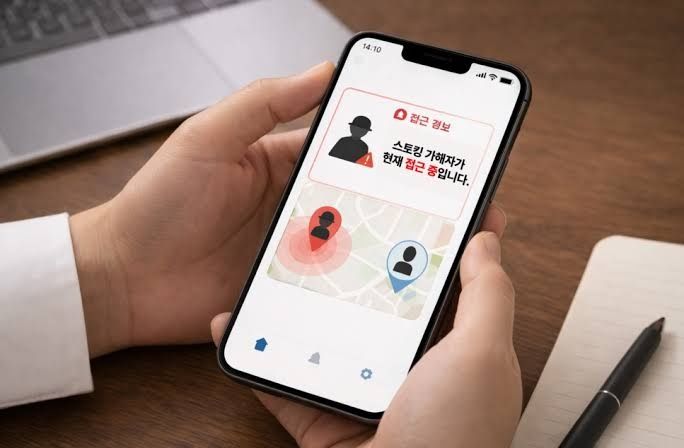
South Korea marked a significant stride in victim protection on June 24 with the rollout of an innovative mobile application designed to equip stalking victims with immediate access to the whereabouts of individuals suspected of harassment. Administered by the Ministry of Justice, the system represents a direct technological response to persistent concerns about the adequacy of current safeguarding mechanisms in a country grappling with rising rates of intimate partner violence and targeted harassment.
The application functions as a location-sharing platform, delivering real-time data about a suspect's current position and directional movements to registered victims. By integrating electronic ankle monitor information into a user-friendly mobile interface, the government has sought to bridge the gap between enforcement and victim empowerment, allowing those at risk to maintain constant awareness of potential danger rather than remaining passive recipients of protective measures implemented by authorities.
The initiative emerged from growing dissatisfaction with existing protections, which have proven insufficient in preventing tragic outcomes. Starting in 2024, courts began ordering electronic monitoring in certain high-risk stalking cases, building upon an earlier system of smartwatch-type emergency alert devices distributed to victims over several years. Yet these measures failed to prevent the deaths and attempted murders of 23 victims between 2021 and August 2025, according to data presented by Representative Lee Gwang-hee of the ruling Democratic Party of Korea. This grim statistic underscores the limitations of reactive rather than proactive protective mechanisms.
The transparency afforded by real-time location tracking represents a philosophical shift in victim protection policy. Rather than relying solely on law enforcement responses triggered after alert activation, victims gain the capacity to anticipate and potentially avoid confrontations by knowing precisely where a suspected stalker is located at any given moment. This agency-based approach acknowledges that victims themselves, intimately familiar with their stalkers' patterns and tendencies, are often best positioned to make informed decisions about their safety.
However, the introduction of location-sharing technology inevitably raises thorny questions about surveillance and privacy rights, even when applied to individuals subject to court-ordered monitoring. Recognising these tensions, the Justice Ministry undertook a regulatory revision in December 2025 to establish safeguards governing how electronic monitoring data could be accessed and deployed. These privacy protections aim to ensure that suspects' location information, whilst accessible to victims, remains subject to appropriate legal restrictions and oversight.
The stalking epidemic in South Korea reflects broader patterns affecting women throughout East Asia, where intimate partner violence and harassment frequently escalate despite legislative reforms. The proliferation of digital communication technologies has enabled abusers to pursue victims across multiple platforms, rendering traditional protective measures—such as restraining orders or emergency alert systems—insufficient for preventing contact and threat. The new application acknowledges that effective protection requires victims to move beyond reactive alerting towards anticipatory awareness.
The regulatory framework governing electronic monitoring had to balance competing imperatives: providing victims with actionable information whilst protecting suspects' constitutional rights and preventing the misuse of location data. This calibration reflects South Korea's broader struggle to strengthen victim protections without creating surveillance infrastructure susceptible to abuse or overreach. The December 2025 regulatory revision represented an attempt to establish this equilibrium, though civil liberties organisations continue debating whether the balance adequately safeguards both victim safety and suspect privacy.
Beyond the immediate application launch, the Ministry of Justice has signalled its commitment to systemic reform. A planned initiative set for April 2027 would enable stalking victims to directly petition courts for restraining orders, circumventing the current requirement that law enforcement agencies file such petitions on their behalf. This procedural change would empower victims to initiate legal protections independently, reducing delays that sometimes prove consequential when abusers escalate their behaviour. Currently, victims must convince police of the necessity and legitimacy of restraining order requests, introducing a potential bottleneck in the protective process.
The multi-layered approach—combining real-time tracking, privacy-protected data access, and enhanced victim petition mechanisms—suggests that South Korean policymakers view stalking prevention as requiring comprehensive institutional reform rather than single-point interventions. Each component addresses a specific vulnerability in the existing system: the application provides immediate situational awareness, the regulatory revisions establish data governance, and the forthcoming petition process eliminates intermediaries between victims and courts.
For regional observers, particularly in Malaysia and other Southeast Asian nations confronting similar challenges, the South Korean experience offers both cautionary lessons and potential models. Countries across Asia have witnessed dramatic increases in cyberstalking, intimate partner harassment, and technology-facilitated abuse, yet institutional responses remain fragmented and victim-centered frameworks remain underdeveloped. South Korea's investment in technology-enabled victim protection, whilst imperfect, demonstrates political willingness to modernise response mechanisms and prioritise victim agency in safety planning.
The application's success will ultimately depend upon victim awareness and adoption rates, police cooperation in ensuring monitors are functioning reliably, and the effectiveness of privacy safeguards in maintaining public confidence. Early implementation challenges may emerge regarding technical reliability, data accuracy, and victim education about the application's capabilities and limitations. Subsequent months will reveal whether real-time location tracking materially reduces victimisation rates or simply shifts the terrain of potential confrontations.
South Korea's technological intervention represents an acknowledgment that traditional law enforcement and judicial mechanisms, whilst necessary, prove insufficient in isolation. By granting victims immediate visibility into suspects' movements, the government has effectively decentralised protective responsibility, placing crucial decision-making authority in the hands of those most vulnerable to harm. Whether this empowerment-based approach proves transformative or merely incremental will influence how other jurisdictions across Asia design their own victim protection infrastructure in coming years.

