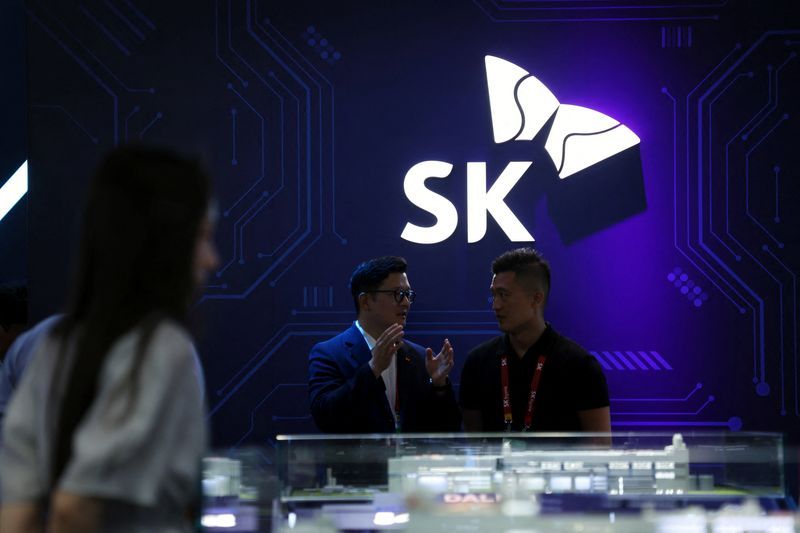
South Korea's SK Hynix announced on Wednesday that it intends to mobilise up to 45.45 trillion won, equivalent to $29.43 billion, through a listing of American Depositary Receipts as it aggressively pursues growth in the high-stakes artificial intelligence semiconductor sector. The fundraising represents a strategic repositioning for the world's second-largest memory chipmaker, which is capitalising on surging global demand for chips powering AI systems and large language models. The company will issue 17.79 million new shares to support the ADR listing scheduled for July 10 on the Nasdaq exchange, with the final amount potentially adjusted following the bookbuilding process that typically determines institutional investor appetite and optimal pricing.
The capital injection will be deployed across multiple fronts in SK Hynix's manufacturing infrastructure. The company plans to construct a new chip fabrication facility in Yongin, establish an advanced packaging manufacturing plant in Cheongju, and acquire cutting-edge production equipment including Extreme Ultraviolet Scanner technology. This three-pronged investment approach reflects the capital-intensive nature of semiconductor manufacturing and the critical importance of maintaining technological parity with rivals in producing next-generation memory chips.
Structuring the offering around American Depositary Receipts allows SK Hynix to tap deep US institutional capital markets while maintaining its primary listing in Seoul. Under the arrangement, ten ADRs will correspond to one common share, a ratio designed to position the securities within an accessible price band for US investors. Goldman Sachs, Bank of America Securities, Citigroup Global Markets, and JP Morgan Securities are jointly managing the transaction, underscoring the deal's significance within global investment banking circles.
Should the offering close at the upper end of the proposed price range, SK Hynix would eclipse Alibaba's 2014 New York market debut, which raised $21.8 billion and previously held the record for the largest ADR issuance globally. This milestone would underscore the dramatic shift in market capitalisation flowing toward semiconductor manufacturers at the intersection of artificial intelligence advancement and geopolitical competition for technological dominance.
SK Hynix's timing reflects its emergence as one of the most conspicuous winners in the global AI boom. The company supplies high-bandwidth memory chips that are essential components in AI infrastructure, with major customers including Nvidia and Google's parent company Alphabet. These specialised memory chips represent critical bottlenecks in AI system deployment, making suppliers like SK Hynix indispensable to technology companies racing to scale their generative AI capabilities.
The company's strategic ascendancy becomes evident when examining recent shifts in South Korean corporate valuations. On Monday, SK Hynix surpassed Samsung Electronics to become South Korea's most valuable company, a symbolic moment reflecting the semiconductor sector's dramatic evolution and the particular advantages of focusing on memory chips rather than the more commoditised logic chip segments. This valuation flip highlights how concentrated the value creation has become in AI-enabling technologies.
For Malaysian and Southeast Asian investors and policymakers, SK Hynix's expansion plans carry implications for regional semiconductor ecosystem development. South Korea's aggressive capital deployment in manufacturing capacity and equipment procurement signals confidence in sustained AI-driven semiconductor demand extending beyond the near term. The expansion also reinforces South Korea's position as a regional manufacturing powerhouse, potentially influencing technology investment patterns across neighbouring economies.
The fundraising underscores the acute capital requirements of competing in advanced semiconductor manufacturing. Building state-of-the-art fabrication facilities requires investments measured in billions of dollars, and acquiring cutting-edge production equipment from suppliers like ASML represents a recurring expense as manufacturing technology evolves. SK Hynix's ability to mobilise nearly $30 billion in capital markets reflects both investor confidence in the company's prospects and the existential importance investors attach to AI-related semiconductor supply chains.
Geopolitically, SK Hynix's capital raising occurs against the backdrop of intensifying competition between the United States, South Korea, and Taiwan for semiconductor manufacturing leadership. The company's decision to list ADRs on Nasdaq rather than expanding through alternative capital structures reflects the continued centrality of US capital markets in facilitating large-scale technology sector financing. Simultaneously, the investment into Korean manufacturing facilities demonstrates Seoul's commitment to building domestic capacity rather than ceding production entirely to Taiwan or other jurisdictions.
The memory chip sector itself has undergone consolidation, with SK Hynix and Samsung effectively controlling most global DRAM and NAND flash memory production outside China. This duopoly structure gives both companies pricing power and strategic importance to global technology infrastructure, justifying the substantial capital commitments they are willing to undertake. SK Hynix's fundraising thus represents not merely a corporate financing event but a statement about future market structure and competitive positioning.
Looking forward, the success of this ADR listing will depend on sustained demand for memory chips in AI applications remaining robust. Market cycles in semiconductors are notoriously volatile, and companies that over-invest during demand booms have historically suffered significant write-downs when demand normalises. SK Hynix's management is clearly betting that the AI revolution represents a structural shift in computing architecture rather than a cyclical demand spike, justifying the massive capital expenditure programme.
The fundraising also highlights the relative scarcity of capital-efficient technology businesses in today's market. While many technology companies can scale with relatively modest capital requirements through software development or service provisioning, the semiconductor manufacturing base remains stubbornly capital-intensive. This creates barriers to entry that protect incumbents like SK Hynix but also necessitate the kind of periodic massive fundraising campaigns the company is now undertaking.

