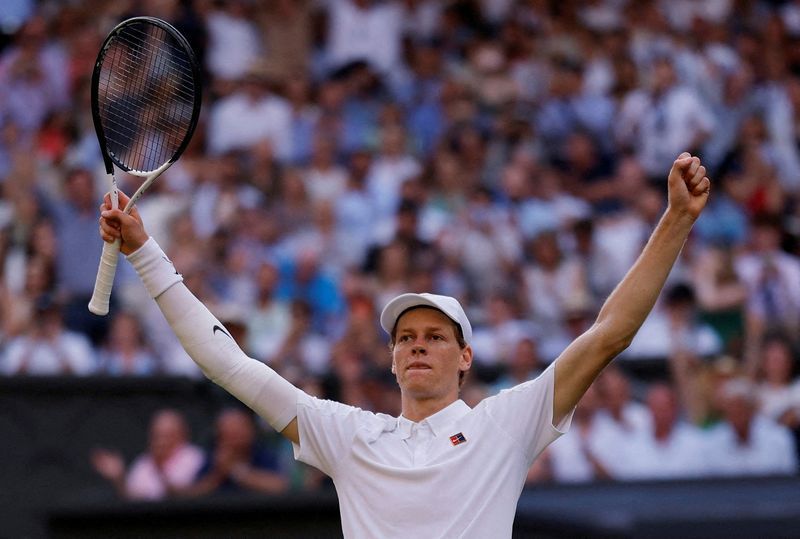
Jannik Sinner returns to the All England Club this week as defending champion, yet the Italian's previously unassailable position atop men's tennis has been visibly weakened by a jarring collapse at the French Open. The world number one must now navigate not only the distinct demands of grass but also the psychological burden of proving he remains the player to beat—a narrative considerably complicated by his unravelling in Paris and the circling opportunism of his rivals. The Wimbledon fortnight beginning Monday offers Sinner both sanctuary and test: a chance to reset his season trajectory on a surface that has traditionally favoured aggressive, serve-dominated tennis, but equally a forum in which former champions sense vulnerability and the absence of injured Carlos Alcaraz has created a competitive vacuum.
Sinner's dominance through the first half of 2024 appeared untouchable. A 30-match winning streak extending back to February positioned the 24-year-old as potentially the most dominant force men's tennis has seen in years, yet the scaffolding holding that excellence collapsed remarkably quickly when it mattered most. His second-round elimination at Roland Garros came as a shock to many, though the physical toll of a gruelling clay-court campaign—minimal recovery periods and limited intensive training—left him depleted precisely when Grand Slam pressure intensifies. The combination of accumulated fatigue and the relentless demands of Paris conditions exposed what might be termed a fragility in his application, raising legitimate questions about whether his current physical and mental infrastructure can sustain excellence across the punishing sequence of major tournaments.
Mats Wilander, the seven-times Grand Slam champion and respected analyst, offered measured perspective on Sinner's predicament while sounding a cautionary note about grass. Wilander acknowledged that the physical strain of Sinner's schedule leading into Roland Garros—two months of heavy competition with insufficient recovery and training—created an energy deficit that proved decisive. However, Wilander also recognised that grass presents its own particular challenges regardless of form, introducing a layer of unpredictability that even the most in-form players must navigate. This observation carries weight: grass rewards different technical and tactical approaches than clay, and the transition can prove disorienting even for supremely talented individuals. Sinner's decision to skip tune-up tournaments before Wimbledon suggests a deliberate recalibration strategy, prioritising rest and preparation over competitive sharpening—a gamble that could either restore sharpness or leave him underprepared.
Among those poised to exploit any sustained weakness in Sinner's performance stands Novak Djokovic, whose grass-court credentials remain formidable despite his 39 years. The Serbian champion's movement and return of serve—traditionally his most imposing grass-court strengths—make him a credible title contender in the absence of Alcaraz. More significantly, Wimbledon represents something approaching final-opportunity territory for Djokovic: an eighth title would match Roger Federer's record at the venue, while an elusive standalone 25th Grand Slam trophy has become increasingly pressing as the window for achievement narrows in the twilight of his career. Djokovic's early exit at Roland Garros, rather than dampening his prospects, may have inadvertently sharpened his focus for grass. As Andy Roddick, the three-times Wimbledon finalist, observed on his podcast, Djokovic possesses the capacity to convince himself that he remains grass-court tennis's finest exponent and sufficiently equipped to reclaim the trophy he last won four years ago.
Roddick's analysis captured something essential about Djokovic's psychological approach: the ability to reframe narrative and see possibility where others perceive decline. In Roddick's assessment, Djokovic can plausibly argue that having photographed the contemporary landscape of men's tennis, he understands both where Sinner might be vulnerable and where his own grass-court mastery remains undiminished. This mindset has historically served Djokovic well in major tournaments, particularly when circumstances create openings. The Serbian's failure to progress far at Roland Garros thus removes distractions and concentrates his energies entirely on what he perceives as genuinely achievable—a psychological advantage that should not be underestimated.
Alexander Zverev, meanwhile, arrives at Wimbledon on a genuine crest of momentum following his first Grand Slam breakthrough at Roland Garros. The 29-year-old German's triumph in Paris represents the validation of a long career trajectory, and grass-court conditions appear particularly well-suited to his serve-dominated game. Boris Becker, the six-times major champion and fellow German, offered notably bullish assessment of Zverev's prospects, suggesting that with Alcaraz sidelined and genuine uncertainty surrounding Sinner's form, Zverev must rank among genuine favourites. Becker's reasoning carries force: Zverev possesses the calibre of serve that traditionally provides semi-final insurance on grass, and should he execute necessary adaptations, his weapons appear sufficient to contend for the title. The combination of fresh Grand Slam confidence and technical suitability to grass conditions creates compelling narrative around Zverev's potential impact.
Carlos Alcaraz's enforced absence has fundamentally altered the competitive landscape at Wimbledon in ways that extend beyond simple mathematics about one fewer threat to Sinner. Alcaraz's presence in previous years represented a genuine countervailing force to Sinner's dominance, and his demonstrated ability to win on grass (successfully defending his title in 2024) meant the draw always contained at least two players capable of imposing their game on the surface. His departure consequently opens meaningful pathways for a broader cohort of contenders. The American contingent notably includes Ben Shelton, Taylor Fritz, and Frances Tiafoe—all players possessing weapons sufficiently potent to trouble elite competition on grass. Similarly, Flavio Cobolli, the Roland Garros runner-up, represents a younger generation pushing for major tournament breakthrough and cannot be dismissed from discussions about realistic contenders.
The absence of a clear alternative favourite creates unusual dynamics as the tournament approaches. Traditionally, tennis Grand Slams develop around established hierarchies where one or two players assume favourite status while others pursue narrower pathways. This Wimbledon presents a more fractured competitive picture: Sinner remains nominally the favourite and tournament favourite in betting markets, yet his credentials have been substantially damaged. Djokovic and Zverev cannot reasonably be dismissed, and the American trio combined with Cobolli ensures that multiple routes to the final exist. This diffusion of advantage paradoxically benefits certain players. Those ranked fourth through eighth possess legitimate grounds to believe that the traditional pecking order has sufficiently fractured to create opportunity where normally the gap between top-seeded players and challengers remains unbridgeable.
For Malaysian tennis enthusiasts and regional observers, Wimbledon 2024 thus carries particular intrigue as a potential inflection point in men's tennis hierarchy. The narrative of Sinner's invincibility being challenged—potentially shattered—speaks to broader questions about sustainability of dominance in professional sport. Furthermore, Djokovic's lingering pursuit of records and Zverev's breakthrough represent compelling human-interest dimensions that transcend pure tennis analysis. The tournament will demonstrate whether the shock of Paris can be rapidly overcome or whether it signals more fundamental fragility in the sport's presumed leader. For regional audiences following professional tennis, these questions will resonate well beyond grass-court technicalities.

