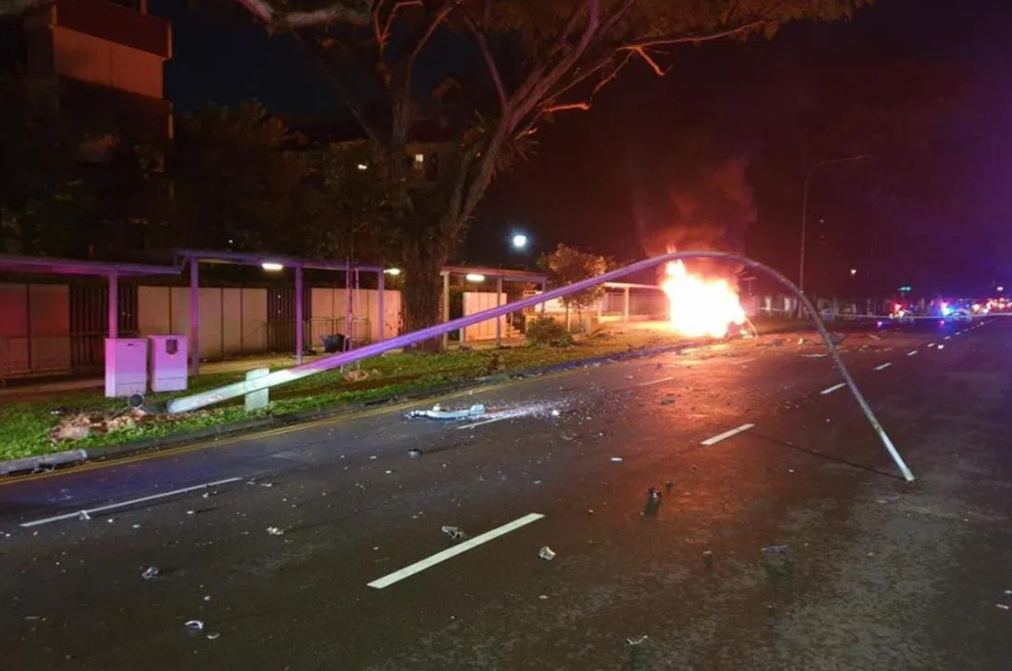
A 29-year-old Singapore man faces up to two years in jail after an early morning driving incident that endangered schoolchildren and left his vehicle engulfed in flames. Aaron Tan Yao Cong was formally charged on Thursday with drink-driving, dangerous driving causing injury, and four additional traffic offences stemming from a chaotic chain of events on March 6, 2024. The severity of the charges reflects not only the danger posed by his actions but also Singapore's increasingly strict stance on repeat drink-driving offences, an issue that resonates across Southeast Asia as road safety concerns mount.
Court documents reveal a troubling pattern beginning at 5.50am along Cavenagh Road near Bukit Timah, where Tan first disregarded a straight-only traffic sign and veered left into oncoming traffic lanes. Rather than proceeding as directed, he negotiated a sharp left bend and drove directly towards vehicles travelling in the opposite direction before eventually stopping on the left side of the road. Inside his vehicle were three passengers who would narrowly escape serious injury when the situation escalated dramatically minutes later. The calculated disregard for road signs suggests impaired judgment consistent with his later-confirmed alcohol consumption, raising questions about how long he had been driving in this state before authorities became aware of the danger.
Within minutes, Tan's erratic behaviour intensified. Police records show that as officers approached his stationary vehicle at 6am, rather than submitting to inspection, Tan accelerated suddenly and fled the scene. What followed was a high-speed pursuit along Bukit Timah Road that would span several kilometres and multiple intersections. Between 6.16am and the collision, Tan maintained an average velocity of 114 kilometres per hour while weaving aggressively through morning traffic on Upper Bukit Timah Road, navigating between Coronation Road and Anamalai Avenue with apparent disregard for other motorists. This sustained speeding through a residential area during early morning hours dramatically increased the likelihood of catastrophic collisions.
The inevitable result came at the junction of Sixth Avenue. Tan approached a red traffic light signal but made no attempt to stop or slow his vehicle. Instead, he drove through the intersection directly into the path of a private bus that was executing a lawful U-turn. The impact was severe enough to destabilize both vehicles. Tan's car then struck a concrete lamp post, the collision igniting a fire that quickly consumed the vehicle. The rapid onset of flames created an emergency situation where both Tan's three passengers and the bus occupants faced immediate danger. Remarkably, all occupants managed to evacuate before the fire became completely uncontrollable, likely preventing fatalities.
Among those hospitalised following the collision were a bus driver and two young passengers aged nine and ten. The involvement of primary school-aged children fundamentally alters the public perception of this incident, transforming it from a traffic accident into a matter affecting vulnerable road users. Both children required medical attention for injuries sustained in the impact, though specific details regarding the severity of their conditions have not been disclosed. For Malaysian readers familiar with school commute routines, the incident underscores how quickly a child's ordinary morning journey can turn traumatic through another road user's recklessness. The incident adds weight to ongoing discussions across the region about protecting young passengers and holding accountable those who endanger them.
Tan's blood alcohol content provided objective evidence of intoxication. Testing revealed approximately 148 milligrams of alcohol per 100 millilitres of blood, substantially exceeding Singapore's legal driving limit of 80 milligrams per 100 millilitres. Notably, Tan initially refused to cooperate with a breathalyser test when arrested, a refusal that itself constitutes a separate criminal charge. His subsequent blood test results were obtained through alternative means and definitively established his impaired state. This refusal to cooperate, combined with the severity of his actions, suggests either deliberate obstruction or dangerous overconfidence in evading accountability.
Perhaps most troubling is Tan's prior criminal record in this specific domain. He was previously convicted of drink-driving and driving without due care and attention in 2019, merely five years before this current incident. This history transforms his behaviour from a momentary lapse of judgment into a pattern of persistent disregard for road safety laws and the safety of others. Repeat offenders typically face enhanced sentencing, and prosecutors will certainly leverage this prior conviction to argue for maximum penalties. For Singapore and by extension Southeast Asian policymakers grappling with road safety statistics, such cases demonstrate the limitations of existing deterrents when previous convictions fail to prevent recidivist behaviour.
The charges filed on June 18 represent the full scope of Tan's documented violations. Beyond drink-driving, he faces charges for dangerous driving causing hurt, which addresses the collision itself and resulting injuries. Additional charges cover leaving his vehicle in a position creating hazard to others, failing to provide a breath specimen as required, and driving against the flow of traffic. These layered charges allow prosecutors to pursue sentences across multiple categories, potentially resulting in cumulative penalties that exceed what a single conviction would permit. Tan declined to enter pleas at his initial appearance and has been scheduled to return to court on July 16 for further proceedings.
The potential sentencing exposure Tan faces is substantial. Conviction for drink-driving as a repeat offender carries imprisonment up to two years and fines reaching $20,000 Singapore dollars. The dangerous driving causing hurt charge permits imprisonment up to two years and fines of $10,000, with repeat offender penalties climbing to $20,000. Failing to provide a breath specimen invokes potential six-month imprisonment and $5,000 fines for repeat offenders, while driving against traffic flow carries three-month to six-month imprisonment depending on prior records. The cumulative nature of these charges suggests Tan could realistically face substantial prison time should the prosecution successfully prove all elements.
For Malaysian observers, this case mirrors concerning trends in regional traffic safety. Both countries struggle with drink-driving enforcement despite legal frameworks, and the involvement of children in this Singapore incident echoes similar tragedies that have occurred locally. The case demonstrates how swiftly a single impaired individual can transform a morning commute into a life-altering event for multiple families. The prosecution's aggressive multi-charge approach reflects growing judicial impatience with repeat offenders, a philosophy increasingly adopted across Southeast Asia. Whether Tan's upcoming trial results in deterrent-level sentencing or demonstrates continued gaps in enforcement remains to be seen, but the case will likely influence discussions about road safety interventions throughout the region.