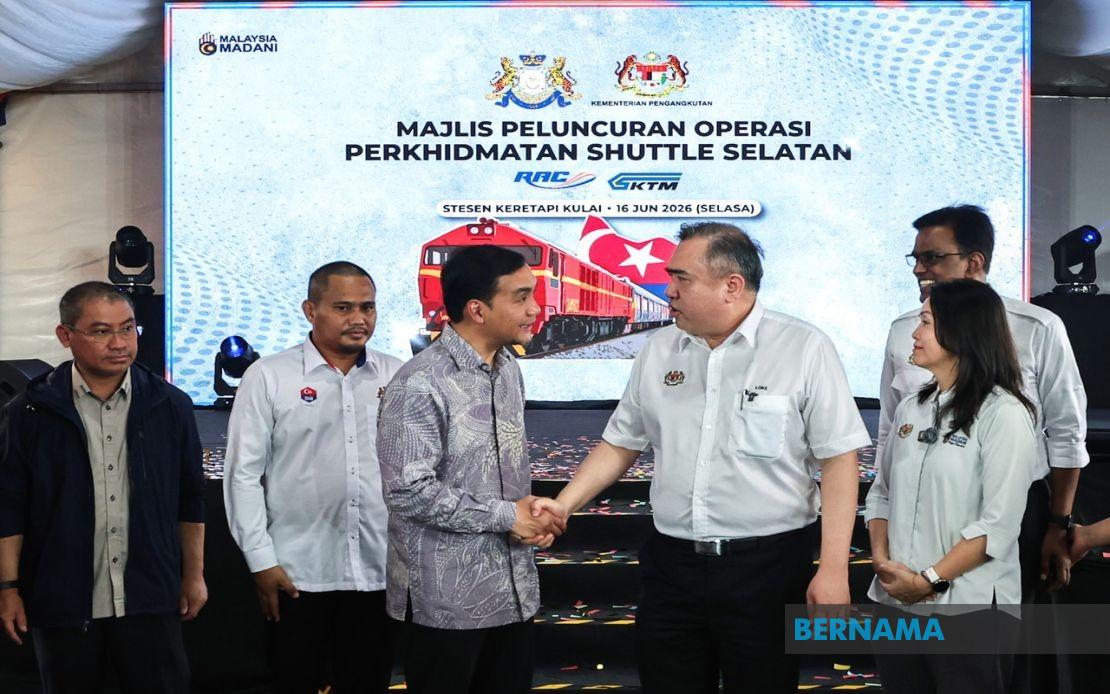
The Shuttle Selatan service, officially inaugurated at Kulai KTM station, represents a significant expansion of Johor's public transport network designed to integrate the state's rapidly growing residential and industrial corridors. With more than two million residents across Kulai, JB Sentral and Pasir Gudang set to benefit, the service addresses a critical infrastructure gap in one of Malaysia's most economically dynamic regions. The launch reflects mounting pressures to improve connectivity as Johor's economy expands across multiple sectors including manufacturing, logistics, port operations and tertiary education.
Transport Minister Anthony Loke announced that the shuttle will commence with two primary operational corridors: a Kulai-JB Sentral-Kulai route and a separate Kempas Baru-Pasir Gudang-Kempas Baru circuit. Journey times of approximately 40 minutes between Kulai and JB Sentral, and 40 to 45 minutes on the Kempas Baru-Pasir Gudang stretch, position the service as a competitive alternative to private vehicle travel for commuters navigating these congested corridors. The dual-route structure allows the authorities to serve distinct geographic and demographic clusters while establishing operational foundations for future expansion.
Among the most ambitious elements of the rollout is a planned extension from Paloh through Kluang, Renggam and Layang-Layang to Kulai, which would substantially broaden the service's geographic footprint across southern Johor. Complementing this expansion are three additional stations under development—Taman Daya, Bandar Baru Sri Alam and Pasir Putih—strategically positioned to capture demand from growing residential communities and ensure equitable access to rail-based transit. This phased approach reflects lessons from earlier Malaysian transport projects, prioritizing foundational routes before pursuing capital-intensive extensions.
Johor's state leadership, represented by Menteri Besar Datuk Onn Hafiz Ghazi and committee chairman Mohamad Fazli Mohamad Salleh, underscored the initiative's alignment with the state's development trajectory. Johor has consistently ranked among Malaysia's fastest-growing economies, with its diversified industrial base, burgeoning port facilities and expanding tertiary education sector generating sustained employment growth and population inflow. Without accompanying public transport infrastructure, such expansion risks exacerbating congestion, environmental degradation and reduced quality of life for residents—challenges the Shuttle Selatan directly targets.
To smooth the critical first-and-last-mile connectivity challenge that has derailed previous Malaysian transport initiatives, authorities have implemented a multi-modal ecosystem around the shuttle. This includes coordinated feeder bus services, integration with the Bas.My mobile platform for route planning, dedicated shuttle services at Kempas Baru interchange, and park-and-ride facilities at AEON Bandar Dato' Onn. Such comprehensive integration acknowledges that rail services operate optimally within broader transport ecosystems rather than in isolation—a principle often neglected in earlier Malaysian schemes that concentrated solely on core rail infrastructure.
The government has introduced the Commuter MADANI Shuttle Selatan Card as a behavioral incentive to accelerate modal shift toward public transit. Three thousand cards have been distributed costlessly to Johor residents, each offering unlimited rides for a specified period at a face value of RM50. This subsidy mechanism, underpinned by a Railway Assets Corporation allocation exceeding RM150,000, acknowledges that price barriers significantly influence commuter choices, particularly among middle-income workers who represent the target demographic. The initiative also signals confidence that sustained ridership will materialize once users experience the service's convenience.
The Shuttle Selatan project exemplifies the collaborative framework increasingly necessary for transport infrastructure delivery in Malaysia. Coordination among the Transport Ministry, Keretapi Tanah Melayu Berhad and the Railway Assets Corporation demonstrates institutional recognition that fragmented ownership and decision-making have historically undermined Malaysian public transport schemes. By concentrating project authority and ensuring aligned incentives across agencies, the shuttle's implementation architecture addresses organizational dysfunction that plagued earlier projects.
For Malaysian and Southeast Asian readers, the Shuttle Selatan signals a broader shift in how government approaches transport planning in high-growth regions. Rather than pursuing reactive, congestion-driven infrastructure after bottlenecks emerge, Johor's authorities have positioned the shuttle as anticipatory investment aligned with economic expansion. This proactive stance contrasts sharply with Kuala Lumpur's experience, where transport infrastructure persistently lags demand growth, creating chronic congestion. The shuttle's success will depend heavily on whether commuters adopt the service at projected levels and whether the supporting ecosystem functions seamlessly—both conditions that remain uncertain pending operational data.
The service's emphasis on connecting residential neighborhoods to employment centers and logistics hubs reflects sophisticated understanding of Johor's economic geography. Kulai hosts significant manufacturing and petrochemical facilities; Pasir Gudang functions as a major port-adjacent logistics cluster; and JB Sentral serves as the state's primary commercial and administrative nexus. By directly linking these zones via rapid rail transit, the shuttle potentially unlocks latent labor mobility that congestion currently suppresses, enabling workers to access broader employment opportunities and employers to recruit from wider talent pools. This productivity dimension may generate economic returns exceeding the transport service's direct revenue generation.
Looking forward, the Shuttle Selatan's trajectory will offer instructive lessons for transport planning across Malaysia and the broader Southeast Asian region. Should the service achieve projected ridership targets and operational efficiency benchmarks, it may catalyze similar rapid-transit initiatives in other high-growth corridors. Conversely, underperformance could reinforce skepticism about public transit viability in Malaysian contexts. The initiative's careful attention to first-and-last-mile connectivity, modal integration and behavioral incentives suggests that success is plausible—but execution risk remains substantial, particularly in sustaining user engagement beyond initial novelty phases and managing operational costs as capital expenditure flows diminish.

