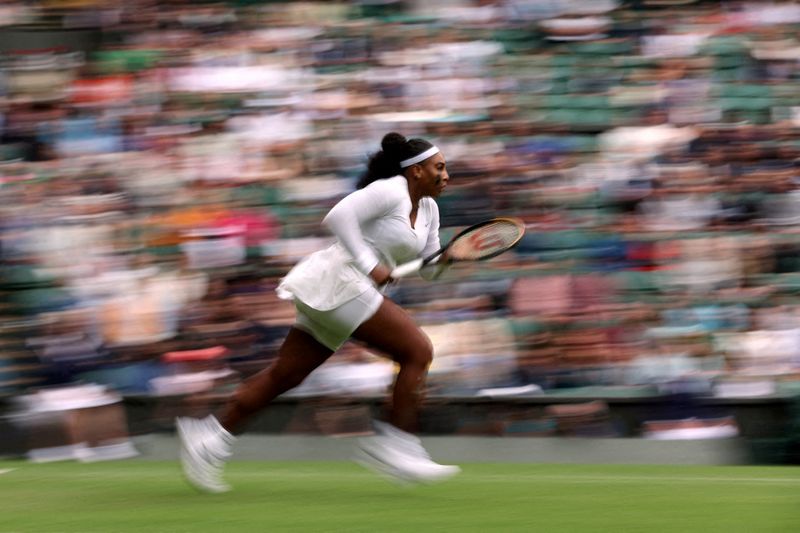
When 44-year-old Serena Williams steps onto Wimbledon's Centre Court next week, she will instantly become the gravitational centre of the entire championship, overshadowing every other narrative in what is otherwise an exceptionally wide-open women's singles draw. The American icon, holder of 23 Grand Slam singles titles and a seven-time Wimbledon champion, returns after four years away from competitive tennis, granted the eighth and final wildcard by the All England Club. This will be her first singles match since the 2022 U.S. Open, a hiatus that makes her comeback arguably the most compelling storyline in professional tennis today.
Williams' reappearance transforms the championship landscape in ways that extend far beyond the individual matches she will contest. The women's game has fundamentally shifted in her absence, with eight different champions crowning themselves at the All England Club since her 2016 triumph. That decade of change reflects the democratisation of excellence at tennis' highest level—a far cry from the era when Williams' dominance seemed almost inevitable. Yet her return instantly recalibrates expectations and injects an element of historical resonance that no other competitor can match.
The preparation for this comeback has been methodical and deliberately low-key, even as it became one of tennis' worst-kept secrets. Williams re-entered the anti-doping testing pool in December, signalling her intentions to anyone paying attention. She has reportedly shed approximately 20 pounds through medical weight-loss interventions and has been working intensively with coach Rennae Stubbs, methodically rebuilding the machinery that once terrorised opponents worldwide. The famous 120-mile-per-hour serve—arguably the most devastating weapon in women's tennis history—was glimpsed during her doubles partnership with Victoria Mboko at Queen's Club, suggesting the explosive power remains intact, though transferring that form into the demands of singles competition will present an entirely different challenge.
Perspective on Williams' audacious scheduling choice comes from two legendary American champions. Former world number one Andy Roddick expressed astonishment at her confidence in selecting Wimbledon as her singles return venue, noting that most players would schedule multiple lower-level events to rebuild match fitness. Lindsay Davenport, a fellow Grand Slam champion, acknowledged the immense difficulty of beginning on grass—a surface that demands explosive movements, rewards aggressive serving, and punishes loss of focus—but allowed that Williams possesses the pedigree to overcome such obstacles if anyone could. The question of whether she will face an opponent in the early rounds remains secondary to the broader question of whether she can translate her doubles success and training achievements into competitive singles reality.
For Aryna Sabalenka, currently ranked world number one, Williams' presence creates an uncomfortable psychological scenario. The Belarusian has dominated the rankings since October 2024, yet her recent form suggests fragility rather than supremacy. At the French Open, she squandered a position just two points from a semi-final berth, then collapsed spectacularly, losing the final ten games and falling in the quarter-finals. Her Berlin warm-up tournament featured another concerning collapse, as she surrendered a deciding set 6-0 to Jessica Pegula. Should Sabalenka encounter Williams in any round, she faces a no-win scenario: victory over an opponent returning from four years away carries no prestige, while defeat would resurrect questions about her mental resilience and emotional control under pressure.
Poland's Iga Swiatek harbours ambitions of becoming the first player since Williams in 2016 to capture back-to-back Wimbledon titles, targeting what would represent the most significant achievement in her career. Russia's 19-year-old Mirra Andreeva, fresh from becoming the youngest French Open champion in 34 years, arrives with an audacious, unorthodox game that could flourish on grass' fast courts. Elena Rybakina, the 2022 champion, possesses an understated yet nearly impenetrable power game that frequently dismantles opponents through sheer force and precision. Coco Gauff, the American prodigy, makes yet another attempt to decode grass-court tennis, a surface that has consistently eluded her despite her success on harder grounds. Emma Raducanu's potential resurgence carries additional weight given the possibility of British support propelling her toward the nation's first female champion since 1977.
Yet all these compelling individual narratives fade to insignificance when Williams takes the court. The storyline becomes singular: the greatest player of her generation, away for half a decade, testing herself against a new generation that has evolved in her absence. Television networks will experience soaring ratings, social media will amplify every gesture and service hold, and the broader sporting public will tune in with a curiosity that transcends normal tennis viewership patterns. Her return satisfies an appetite for narrative drama that pure sport rarely delivers with such natural potency.
The fundamental unpredictability of this Wimbledon championship stems from the fragmentation of dominance across the women's game. Where Williams once imposed her will through a combination of power, athleticism, and unyielding mental fortitude, contemporary tennis has distributed excellence across multiple players with diverse styles and strengths. The last six Grand Slam tournaments have each crowned a different champion, a statistical reality that emphasises how thoroughly the sport has transformed since Williams' era of seemingly inevitable supremacy. This democratisation benefits the tournament's competitive narrative—any of several players could plausibly win—but it also creates space for an anomalous comeback story that defies the normal progression of tennis careers.
Observers from the inside of professional tennis acknowledge that Williams would not have committed to this return unless she harboured genuine belief in her capacity to make meaningful impact. The decision to begin at Wimbledon rather than building across multiple lower-profile events demonstrates confidence bordering on defiance—a trademark Williams trait. Former professionals emphasise that competitive tennis at the highest level is exponentially more demanding than practice or exhibition settings, particularly on a surface like grass where defensive positioning offers limited refuge from aggressive opponents. Yet Williams has always inhabited a category of athlete apart, someone whose competitive fire and technical excellence have repeatedly transcended age-related expectations.
The implications for Malaysian and Southeast Asian tennis interest extend beyond mere spectacle. Williams' comeback provides a narrative template for understanding longevity in professional sports, relevant to regional players considering their own career trajectories. Her return also reminds audiences that tennis remains a sport where individual excellence and determination can produce unexpected narratives, a counterpoint to the relentless progression and planning that typically characterises modern athletics. For casual viewers, Williams' presence transforms Wimbledon from a relatively predictable championship into unmissable viewing, with every round potentially carrying historical significance.
Williams' impact will ultimately be measured both in tournament results and in the broader transformation of championship narrative that her mere presence effects. Whether she advances through multiple rounds or exits in early-round competition becomes almost secondary to the cultural moment her return represents—a legendary athlete defying conventional wisdom about career arcs, age, and competitive viability. The wide-open women's draw, featuring multiple credible champions and genuine uncertainty, suddenly acquires a wild-card element that neither the players nor the organisers anticipated.

