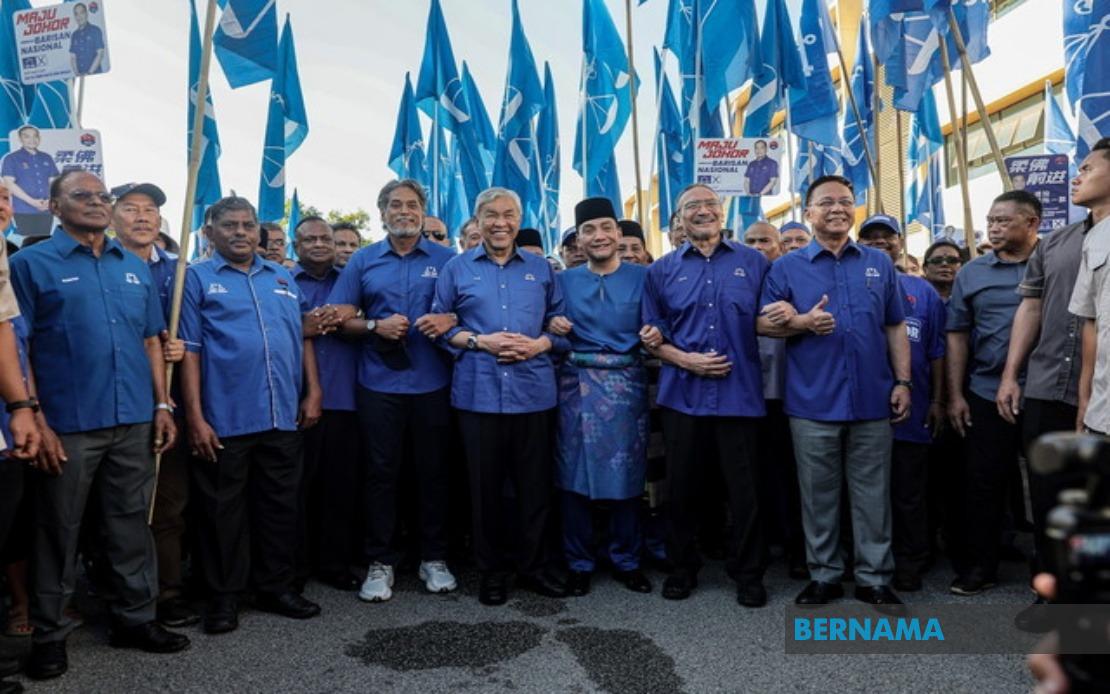
The Machap state assemblyman and Johor Barisan Nasional chairman Datuk Onn Hafiz Ghazi officially registered his candidacy for the upcoming Johor state election on Wednesday morning, submitting his nomination documents at 9.10 am at the Muafakat Hall within the Simpang Renggam District Council complex. The filing represented a formal step in what is shaping up as a closely watched electoral contest in Malaysia's southern stronghold.
Onn Hafiz's submission was marked by conspicuous support from the upper reaches of UMNO's leadership structure, underscoring the party's commitment to retaining its grip on Johor politics. UMNO president Datuk Seri Dr Ahmad Zahid Hamidi was among those accompanying the Machap assemblyman to the nomination centre, signalling the party hierarchy's confidence in the candidate and the broader BN strategy for the state contest. The presence of such senior figures at routine nomination proceedings is typically reserved for symbolically important candidacies or high-stakes races.
The entourage also featured Sembrong Member of Parliament Datuk Seri Hishammuddin Tun Hussein, whose participation underscored the cross-factional unity UMNO sought to project ahead of polling day. Hishammuddin's attendance carried particular significance given his veteran status within the party and his representation of the influential East Coast political establishment. Former minister Khairy Jamaluddin similarly joined the delegation, reflecting efforts by UMNO to mobilise its experienced cadre in support of the election campaign across multiple demographic and generational lines.
Beyond the immediate party hierarchy, former Johor Menteri Besar Datuk Seri Hasni Mohammad lent his presence to the proceedings, drawing upon his credibility accumulated through prior stewardship of the state government. The appearance of such elder statesmen signals continuity and institutional gravitas, elements that Barisan Nasional traditionally leverages when seeking voter endorsement in established strongholds. Hasni's involvement reconnected the nomination ceremony to Johor's recent political history and the period of BN dominance that the coalition seeks to restore or reinforce.
The scene at Simpang Renggam reflected the grassroots mobilisation that accompanies state election contests in Malaysia. Party supporters congregated in the vicinity of the nomination centre, organised along partisan lines and visibly displaying the emblems, banners, and flags associated with their respective organisations. This spontaneous assembly of the party faithful demonstrated the logistical preparations undertaken by BN and its component parties to create an atmosphere of momentum and popular backing at key moments during the electoral cycle.
Onn Hafiz's nomination as the BN standard-bearer in Machap carries significance within the broader context of Johor's political realignment in recent years. The state had been governed by Pakatan Harapan until the 2022 election reversed that outcome, returning Barisan Nasional to control of the state assembly. The forthcoming poll therefore represents a test of whether BN can consolidate those gains or whether the opposition can mount a credible challenge to reclaim lost ground. Machap, as a component seat within that state equation, holds implications extending beyond the immediate locality.
The nomination process itself, while ceremonial in many respects, functions as a critical juncture in Malaysia's electoral system. The formal submission of papers, witnessed by multiple officials and party hierarchies, establishes the legal candidacy and initiates the formal campaign period. For candidates like Onn Hafiz, the appearance at the nomination centre with leading party figures serves to amplify media coverage and project organisational readiness to both supporters and opponents. The visual messaging conveyed through such carefully choreographed moments influences voter perceptions of candidate viability and party stability.
The mobilisation of UMNO's top leadership for a state-level nomination filing, while ostensibly routine, also carries internal party implications. It demonstrates the party president's engagement with state-level campaigns and signals to grassroots members the importance assigned to Johor within UMNO's broader electoral calculations. Such visible support can influence the allocation of campaign resources and shape how party machinery operates during the canvassing phase. For UMNO members in Machap and surrounding constituencies, the presence of Ahmad Zahid and other senior figures telegraphs organisational backing and resource availability.
From a regional perspective, Johor's electoral trajectory holds ramifications for the wider stability of Malaysian politics. The state's large population, diverse voter base, and historical significance as either a BN or opposition stronghold make it a bellwether for national political sentiment. Elections in Johor frequently precede or influence federal-level calculations by major parties, making state contests valuable indicators of evolving voter preferences. The confidence displayed by UMNO's leadership in fielding Onn Hafiz and the resources marshalled for his campaign reflect assessments of electoral prospects that extend beyond Machap to encompass state and national positioning.
The nomination ceremony at Simpang Renggam exemplifies how Malaysian political parties operationalise key campaign moments to generate visibility and momentum. The timing, location, attendee list, and media presence at such events are calibrated to reinforce campaign narratives and demonstrate organisational strength. For Barisan Nasional, the deployment of multiple senior figures to endorse Onn Hafiz's nomination emphasised unity, experience, and institutional continuity. Whether such backing translates into electoral success will depend on how voters in Machap and other contested constituencies respond to the substantive policy platforms and local grievances that ultimately drive electoral choices in Malaysian politics.

