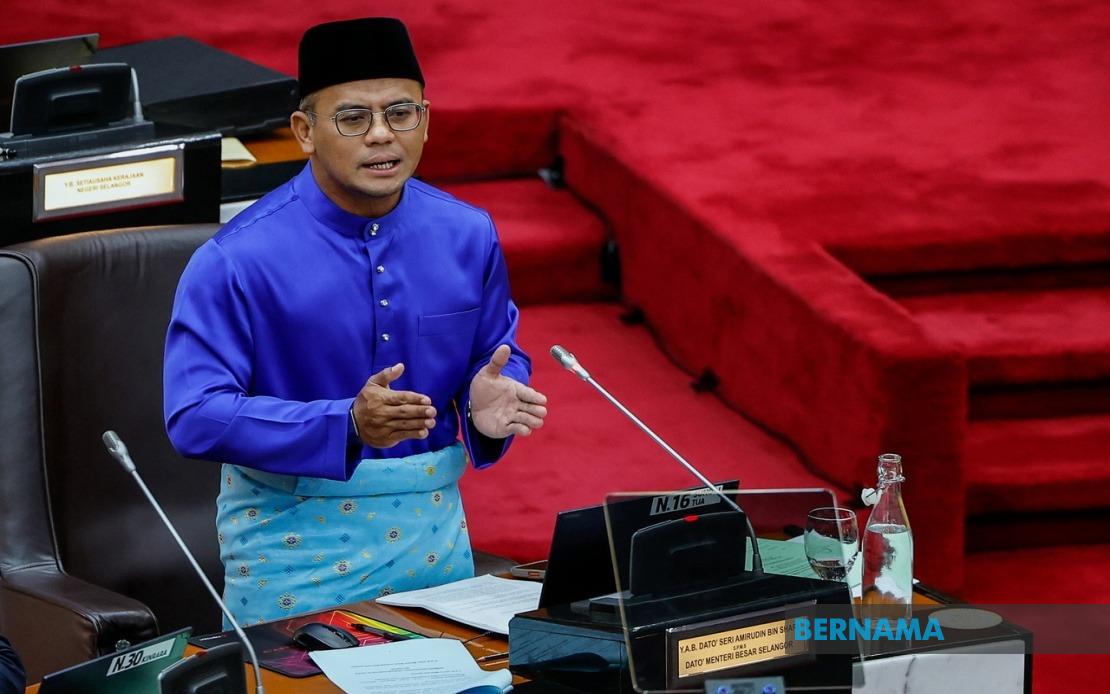
Selangor's government has unveiled an ambitious second phase of its economic resilience strategy, committing RM209.26 million through 15 separate programmes designed to insulate the state from mounting pressures triggered by global energy disruptions and geopolitical tensions in West Asia. Menteri Besar Datuk Seri Amirudin Shari presented the Pakej Pengukuhan Daya Tahan Selangor during a special sitting of the State Legislative Assembly, framing the intervention as a comprehensive response extending well beyond conventional financial handouts to encompass structural economic empowerment.
The timing of this announcement reflects genuine economic headwinds facing the state. Labour data from the Social Security Organisation reveals that Selangor shed 10,869 jobs between January and May 2023, a sobering figure that underscores vulnerability within the state's employment base. The retail sector absorbed the heaviest blow, with 2,549 workers losing their positions—accounting for nearly a quarter of total job losses. Manufacturing followed closely with 2,316 redundancies, representing 21.3 per cent of the displaced workforce. These figures carry particular significance for Malaysia's most economically diverse state, which depends heavily on both sectors for revenue generation and employment absorption.
What distinguishes this response is its architectural focus on worker transitions rather than mere income replacement. Approximately 40 per cent of those who lost employment occupied management and professional positions, suggesting the crisis has penetrated beyond entry-level ranks into the skilled workforce. The remaining workers comprised technicians, sales personnel, and machinery operators—occupational categories requiring targeted reskilling initiatives. This demographic breakdown informed the state government's decision to prioritise entrepreneurship pathways and skills enhancement, recognising that traditional re-employment alone may prove insufficient given sectoral contraction.
The initiative encompasses diverse mechanisms tailored to different economic actors. Selangor Advance (SA500) represents the package's most substantial single allocation at RM100 million, designed as a financing instrument for business development. The Entrepreneur Quick Fund Financing scheme allocates RM20 million to accelerate access to capital for nascent ventures. Complementing these measures, PLATS Career Transition receives RM4 million specifically to facilitate workers' movement into self-employment, while the Selangor Entrepreneur Recovery Initiative targets businesses affected by sectoral disruption. For agricultural producers, the Selangor Farmer Resilience Financing programme delivers RM7 million, acknowledging the sector's sensitivity to macroeconomic conditions.
Support mechanisms extend into consumer-facing sectors and vulnerable populations. The Selangor Penyayang Project allocates RM14 million toward direct assistance measures, while Mama Kerja—a notably titled initiative—commits RM5 million specifically to female workforce participation and economic inclusion. Rental reductions for Local Authority premises worth RM4.5 million explicitly target retail operators, the sector experiencing the steepest employment contraction. These moves suggest state-level recognition that women and small-scale retailers require distinctive policy interventions beyond generic stimulus measures.
Educational and skills components recognise that long-term economic resilience depends on human capital development. The Selangor Scholarship programme allocates RM17 million to educational advancement, while the Selangor Career Programme receives RM1.5 million for workforce capability enhancement. Teraju IKTISASS, another major allocation of RM20 million, targets skills certification and technical training. These investments reflect an understanding that immediate relief must pair with capability-building to sustain competitiveness beyond the current crisis cycle.
Property market interventions signal concern about household financial stress. The State Government Housing Loan Moratorium, allocated RM2.54 million, provides breathing room for mortgage holders facing income uncertainty. The Selangor Smart Rent Moratorium with RM2.22 million addresses residential tenancy pressures. A 100 per cent Assessment Tax Rebate worth RM5.5 million targets property owners, potentially stimulating investment and construction activity—sectors identified as particularly vulnerable to global economic contraction.
Phase Two's RM209.26 million allocation builds upon Phase One expenditure of RM145.8 million, bringing total commitment under the dual-phase Selangor Resilience Strengthening Package to RM355.06 million. This cumulative investment represents substantial fiscal commitment from a state government confronting revenue pressures while maintaining public services. The magnitude underscores official assessment that current global uncertainties demand more than marginal policy adjustments.
The broader context involves Selangor's economic structure and regional significance. As Malaysia's industrial and commercial heartland, the state houses concentrations of logistics, manufacturing, and retail operations vulnerable to global supply chain disruptions and energy price volatility. Unemployment ripples emanating from Selangor extend beyond state boundaries given its role as economic engine for the Klang Valley and broader Peninsular Malaysia. Amirudin's emphasis on collaborative unity—calling for cooperation across social strata rather than divisiveness—reflects recognition that economic resilience depends on inclusive stakeholder engagement beyond government action alone.
The initiative's design philosophy prioritises economic agency over passive assistance. Rather than treating affected workers as welfare recipients, the package positions them as entrepreneurs-in-transition, with financing, training, and market access provisions facilitating business creation. This approach acknowledges both fiscal constraints and the reality that formal sector re-employment may not absorb displaced workers at comparable wage levels, particularly for management-level professionals. Entrepreneurship becomes not merely opportunity but necessity, demanding supportive infrastructure.
For Malaysian policymakers observing regional responses to global energy disruptions, Selangor's package offers instructive lessons about integrated crisis management. The initiative demonstrates that economic shocks require multi-layered interventions addressing immediate income support, skills transition, asset protection, and long-term capability enhancement simultaneously. The geographic concentration of Malaysia's economic activity makes state-level resilience particularly consequential for national economic stability, lending importance to subnational policy experimentation and coordination with federal frameworks.

