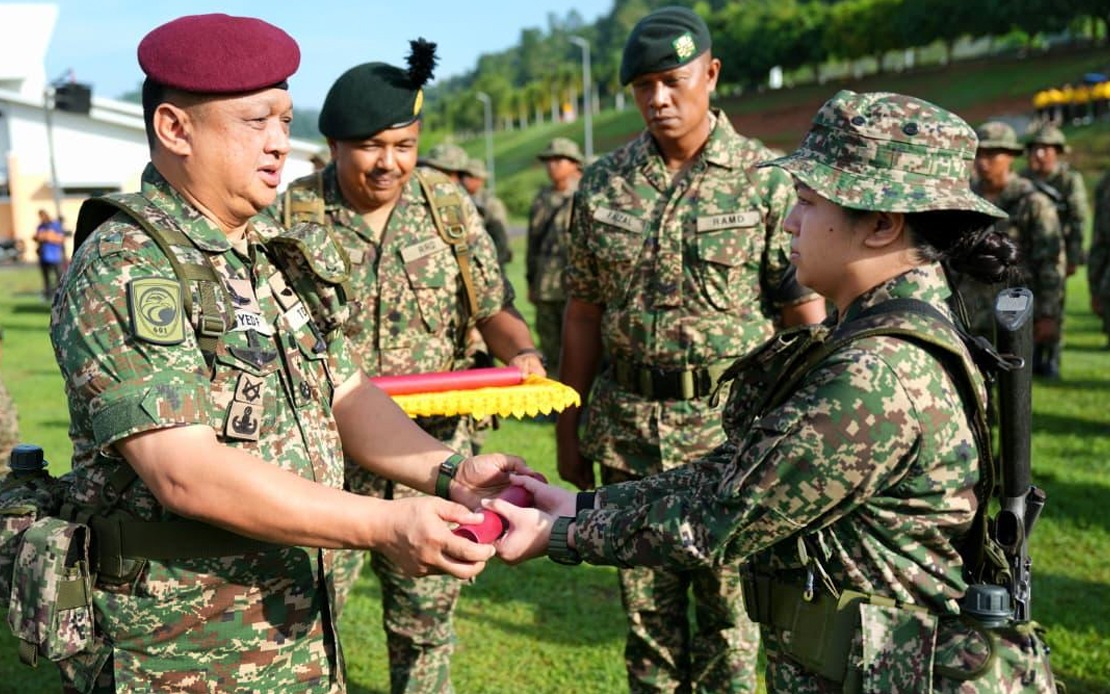
Hajah Sharifah Farah Adriana Jamalullail, the second daughter of the Raja Muda of Perlis and Raja Puan Muda of Perlis, has successfully completed the Malaysian Army's Voluntary Young Soldier Basic Course (APMS) conducted at Universiti Malaysia Perlis (UniMAP) over a two-week period ending June 21. The milestone represents more than a personal achievement for the 25-year-old; it signals a deliberate engagement by Perlis's royal household in demonstrating the nation's collective responsibility toward defence and security matters across all segments of Malaysian society.
The closing parade ceremony was presided over by the Raja Muda of Perlis, Tuanku Syed Faizuddin Putra Jamalullail, at the Boulevard Field on UniMAP's Pauh Putra Campus in Arau, with the Raja Puan Muda, Tuanku Dr Hajah Lailatul Shahreen Akashah Khalil, also present to witness the occasion. Through an official statement released by Istana Arau, the palace emphasised that the royal institution's direct participation in the military training programme underscores a foundational principle: that patriotism and national devotion must be cultivated and demonstrated throughout every stratum of society, not confined to any particular demographic or institution.
Hajah Sharifah Farah Adriana brings substantial educational credentials to her military training, having completed a Bachelor of Business (Management) degree from RMIT University in Australia and a Master of International Business degree from Monash University Malaysia. Her enrolment in the voluntary course demonstrates that even those with advanced qualifications and privileged backgrounds recognise the value and necessity of military foundational training. The palace characterised her successful completion of the programme as tangible proof that protecting national defence constitutes a shared duty requiring participation and commitment from citizens across all economic, educational, and social backgrounds.
Tuanku Syed Faizuddin Putra, who concurrently holds the appointment of Commander of the 504th Territorial Army Regiment, used the opportunity to articulate a strategic vision for strengthening Malaysia's Territorial Army capacity. He outlined plans to intensify recruitment and retention efforts aimed at drawing in physically capable young people who meet the stipulated standards for military service. The Raja Muda's statement stressed that the Territorial Army Regiment's foundational mission—encapsulated in the mandate to "Raise, Train and Maintain" personnel—requires sustained institutional focus and careful monitoring to ensure that Malaysia can effectively respond to emerging security challenges.
The "Raise" component, as explained by Tuanku Syed Faizuddin Putra, extends beyond merely swelling recruitment numbers; it encompasses the strategic selection and preparation of suitable human resources capable of meeting Malaysia's evolving defence requirements. This distinction underscores a quality-over-quantity approach that prioritises acquiring personnel with the right aptitude, discipline, and commitment rather than accepting candidates who fail to meet established benchmarks. The Raja Muda's emphasis on proper selection mechanisms reflects a broader recognition that military effectiveness hinges on the calibre of personnel enlisted.
The "Train" dimension demands the delivery of rigorous, standards-based instruction that enables Territorial Army personnel to operate seamlessly alongside the Regular Force in integrated operational contexts. This integration requirement becomes increasingly critical as Malaysia faces diverse security scenarios ranging from conventional threats to non-traditional security challenges including transnational crime, cyber operations, and maritime security issues. Training programmes must therefore equip soldiers with multi-domain capabilities and interoperability standards that mirror those of full-time military counterparts.
Maintaining operational readiness constitutes the third pillar of this framework, as articulated by Tuanku Syed Faizuddin Putra. The Territorial Army must preserve the preparedness of its personnel such that they remain available for mobilisation and augmentation duties whenever operational requirements demand rapid force enhancement. This aspect proves particularly significant for Malaysia, which must maintain defence capabilities across vast territorial waters and land borders while managing budgetary constraints that make reliance on reserve and territorial forces essential to national strategy.
The timing of the Raja Muda's public statements on Territorial Army strengthening reflects broader Malaysian defence policy preoccupations. As regional security dynamics evolve—marked by strategic competition, maritime tensions, and transnational security threats—Malaysia increasingly recognises that sustainable defence requires sustained investment in reserve forces and the cultivation of widespread military participation beyond professional soldiery. The Territorial Army functions as a critical bridge between civilian society and defence institutions, fostering civil-military understanding while enlarging Malaysia's security apparatus without proportional increases in defence expenditure.
The successful completion of the APMS course by a member of the royal family carries symbolic weight that extends beyond the individual achievement. Royal participation in military programmes traditionally signals institutional endorsement and can encourage broader societal engagement with defence initiatives. In Southeast Asia's Malaysian context, where public discourse on defence and security often remains confined to specialist communities, visible royal participation potentially elevates national consciousness regarding defence obligations and opportunities.
The APMS programme itself represents Malaysia's institutional commitment to professionalising reserve forces and expanding access to military training beyond full-time enlistment. By offering voluntary basic courses, the Malaysian Army creates pathways for civilians to acquire fundamental military competencies while maintaining their primary occupations and civilian pursuits. This model recognises that robust national defence requires cultivating defence consciousness and basic military capability across the broader population—a principle the palace statement explicitly endorsed through its characterisation of defence responsibility as fundamentally shared.
Looking forward, Tuanku Syed Faizuddin Putra's emphasis on continued intensification of Territorial Army development suggests that Perlis, and by extension Malaysia, will pursue sustained investment in these reserve structures. The presence of high-profile participants like Hajah Sharifah Farah Adriana may catalyse wider elite engagement with military programmes, potentially encouraging other influential families and prominent individuals to demonstrate similar commitment to defence training. Such cascading participation could gradually reshape societal perceptions regarding military service and defence engagement, particularly among educated, professional cohorts whose involvement has historically remained limited.
The broader implications for Malaysia's defence posture should not be underestimated. As the region confronts multifaceted security challenges requiring sustained vigilance and capable response mechanisms, the cultivation of informed, trained civilian participation in territorial defence becomes increasingly valuable. The Perlis royal household's demonstration of this principle, through direct participation and visible support for military training programmes, contributes to a cultural shift that elevates defence consciousness from peripheral concern to central national responsibility. For Malaysian policymakers and defence strategists, such developments suggest that building resilient, capable defence capacity depends not solely on professional military institutions but equally on fostering widespread public engagement with security imperatives that shape regional stability.

