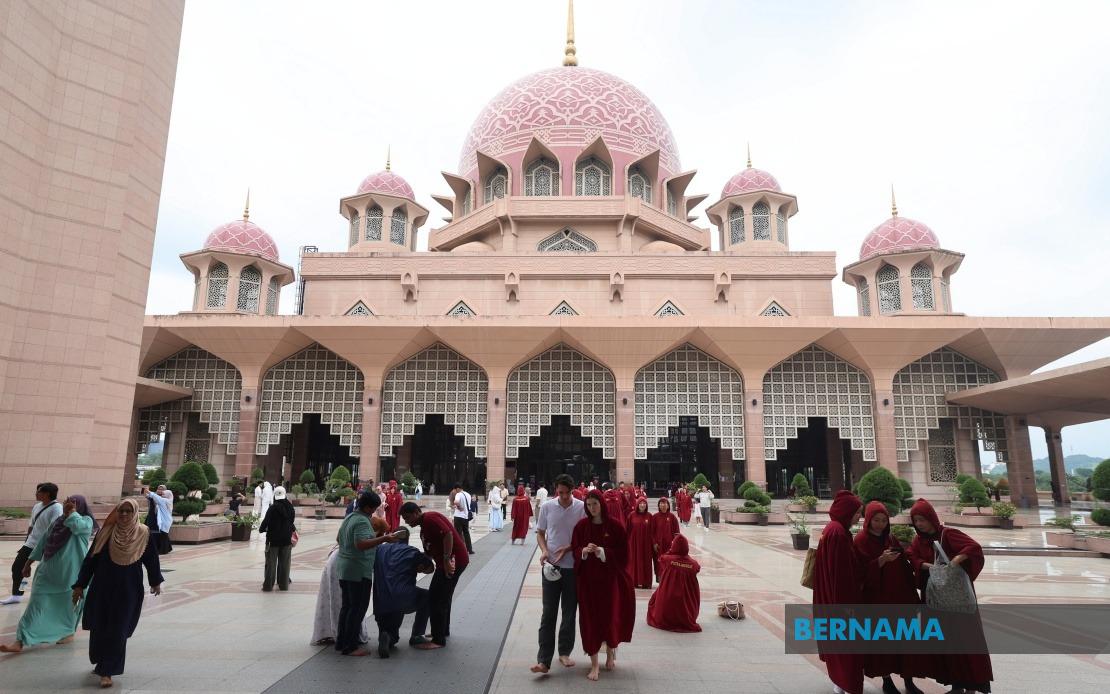
Malaysia's Islamic community will mark the beginning of the lunar year with a grand gathering at Putra Mosque in Putrajaya, where approximately 5,000 attendees from across the country and beyond are expected to participate in the National Maal Hijrah 1448H/2026M celebration. The event represents one of the year's significant religious observances, drawing high-level government participation and international representation to underscore the occasion's importance to Malaysia's multi-faith society and diplomatic standing.
Sultan Nazrin Shah, the Sultan of Perak, will serve as the principal dignitary, presiding over the ceremony and delivering a royal address that is anticipated to set the tone for the nation's reflection on the Islamic calendar's significance. The presence of top government officials, including Deputy Prime Ministers Datuk Seri Ahmad Zahid Hamidi and Datuk Seri Fadillah Yusof, alongside various Cabinet ministers and departmental heads, demonstrates the government's commitment to observing this important Islamic milestone. Foreign representatives will also be in attendance, reflecting Malaysia's position as a bridge-builder between diverse cultures and faith communities in Southeast Asia and beyond.
The ceremonial centrepiece involves the presentation of the National and International Tokoh Maal Hijrah Awards, accolades that recognise extraordinary individuals who have devoted themselves to advancing Islamic knowledge, practice, and civilisation. These individuals are selected based on rigorous criteria encompassing profound expertise within their professional domains, exemplary moral conduct, and substantial contributions to strengthening Islam's influence at both local and global scales. The awards carry considerable prestige, as they acknowledge those who embody the values and aspirations central to the Islamic community's intellectual and spiritual development.
Maal Hijrah carries deep historical resonance for Muslims worldwide, commemorating Prophet Muhammad's migration from Mecca to Medina in 622 CE—a pivotal moment that established the foundations of Islamic governance and community building. The Department of Islamic Development Malaysia (JAKIM) deliberately structured this year's theme to encourage contemporary believers to reconnect with the spiritual essence of that migration, viewing it not merely as a historical event but as a living principle of positive transformation and renewal. This framing invites Muslims to examine their own lives through the lens of purposeful change and steadfast commitment to their faith's core principles.
A novel addition to the celebration programme is the Tausiyyah @ Maal Hijrah initiative, a reflective session conducted at the mosque that encourages participants to engage deeply with Quranic teachings through contemplation and analysis. The programme paired Quranic recitations delivered by accomplished qari—specialists trained in the art of Quranic recitation—with interpretive guidance designed to help listeners extract practical wisdom applicable to contemporary challenges. This pedagogical approach bridges the gap between scriptural study and lived experience, enabling attendees to transform abstract religious knowledge into concrete behavioural and ethical frameworks that shape their daily interactions and decision-making.
The multi-day nature of the observance reflects Malaysian Islam's sophisticated approach to major religious events, combining spiritual reflection with intellectual discourse and community engagement. By scheduling complementary programmes across consecutive days, organisers create opportunities for different segments of the Muslim population to participate meaningfully, whether through physical presence at the central ceremony or engagement with satellite activities tailored to specific audiences. This structure also accommodates the practical constraints faced by working professionals, students, and others whose schedules might prevent attendance at a single concentrated event.
Following the main ceremony, the National and International Tokoh Maal Hijrah Lecture Series will convene at the Putrajaya Islamic Complex Auditorium, providing award recipients with a formal platform to disseminate their expertise and personal experiences. This knowledge-sharing component elevates the celebration beyond ceremonial recognition, transforming it into an educational forum where leading Islamic scholars, professionals, and community leaders can address audiences on topics spanning theology, ethics, social development, and contemporary Islamic thought. Such intellectual exchange proves invaluable for younger generations seeking guidance on integrating faith with professional ambition in an increasingly complex globalised world.
The scale and calibre of participation in this event underscore the strategic importance Malaysia attaches to articulating its Islamic identity on the international stage. As a Muslim-majority nation with significant Christian, Buddhist, Hindu, and indigenous communities, Malaysia's approach to celebrating Islamic occasions demonstrates how religious observance and inclusive governance can coexist. The inclusion of foreign representatives provides an opportunity for diplomatic engagement and showcases Malaysian Islam as progressive, intellectually vibrant, and deeply engaged with contemporary global concerns rather than isolated from them.
For Southeast Asia more broadly, Malaysia's hosting of such a prominent Maal Hijrah celebration carries subtle diplomatic messaging. The region contains substantial Muslim populations in Indonesia, Brunei, and significant minorities throughout Thailand, the Philippines, and Singapore. By elevating the celebration's profile and emphasising themes of unity, scholarly excellence, and constructive social contribution, Malaysia positions itself as a custodian of Islamic values that transcend narrow sectarianism or extremism. This soft power dimension complements more formal regional cooperation mechanisms and reinforces Malaysia's claim to leadership within both the Islamic world and the broader Southeast Asian community.
The awards programme particularly merits attention from observers seeking to understand how contemporary Islamic societies recognise and elevate their intellectual and moral exemplars. In contrast to some representations of Islam in Western media as primarily concerned with ritual observance or theological rigidity, these awards explicitly celebrate individuals whose contributions span academic scholarship, social entrepreneurship, interfaith dialogue, and scientific innovation. The decision to grant awards at both national and international levels indicates Malaysia's confidence in Muslim achievement globally and its aspiration to participate in shaping Islam's future trajectory across multiple domains of human endeavour.

