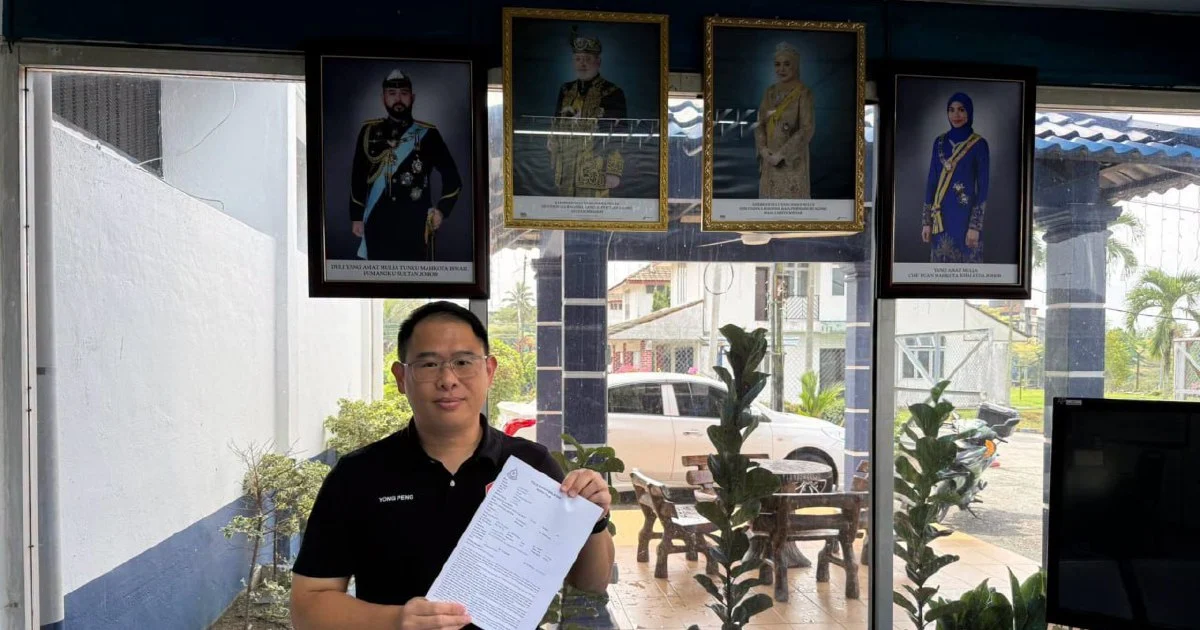
A police report has been formally lodged following allegations that implicated the Johor palace in the dissolution of the state assembly, marking another flashpoint in the state's ongoing political drama. The filing represents an intensification of disputes over constitutional authority and the respective roles of the monarchy and elected representatives in governance decisions that affect the peninsula's second-largest state.
The allegations in question centre on claims made by a political figure suggesting that the Johor palace played a role in the decision to dissolve the assembly. Such assertions carry significant weight in Malaysian constitutional discourse, where the relationship between state rulers and democratically elected institutions remains a sensitive and carefully balanced arrangement. The lodging of a police report indicates that parties involved view the statements as sufficiently serious to warrant formal investigation, either as potential breaches of law or as matters that deserve official clarification and scrutiny.
Johor's political landscape has been characterised by considerable turbulence in recent months, with various stakeholders engaging in disputes over legislative authority, executive decision-making, and the constitutional prerogatives of different institutions. The state assembly's dissolution would have represented a significant constitutional action with far-reaching implications for the state's governance and electoral timeline. Allegations linking such a momentous decision to royal intervention, if substantiated or formally addressed, could reshape public understanding of how key institutional decisions are made.
The Malaysian constitutional framework grants state rulers significant ceremonial and symbolic authority, yet the practical separation of powers between the monarchy and elected governments remains an area where interpretations can diverge. Claims that explicitly connect the palace to specific legislative decisions venture into contested constitutional territory, where historical precedent, written law, and political convention may offer varying guidance. The decision to lodge a police report suggests that relevant authorities have determined these allegations warrant formal investigation rather than simple political dismissal.
In the broader Southeast Asian context, Malaysia's constitutional arrangements around monarchical institutions present a unique model. Unlike neighbouring countries with elected heads of state or directly accountable monarchs, Malaysia's system distributes authority across multiple state rulers and a federal king, creating complex institutional dynamics. Johor, as the richest and historically most influential state, has always occupied a special place in these dynamics, and disputes within Johor consequently attract wider regional attention and scrutiny.
The timing of this police report reflects the current state of political competition in Johor, where rival coalitions and political parties have been engaged in sustained contest for electoral dominance and control of state institutions. Such disputes often become vehicles through which broader questions about institutional integrity, constitutional propriety, and democratic accountability are debated. By formalising complaints through official channels, political actors seek not merely to win rhetorical advantage but to establish authoritative records and potentially invoke legal or institutional remedies.
For Malaysian readers and observers, the implications of these allegations extend beyond Johor's borders. Johor's stability and governance structures influence investor confidence across the nation, as the state remains a major economic hub and source of federal revenue. Political disputes that raise questions about constitutional clarity and institutional predictability can create broader uncertainty affecting business planning and economic planning across the region. The state's role as a manufacturing and trading centre means that governance clarity in Johor has multiplicative effects on the wider Malaysian economy.
The police investigation process itself will be closely monitored by political observers, constitutional scholars, and media commentators. The question of whether police findings will support, refute, or remain ambiguous about the core allegations remains open. Malaysian police investigations involving political figures and institutions have historically attracted scrutiny regarding independence and impartiality, making this matter particularly sensitive from a public perception standpoint. How the investigation unfolds and what conclusions emerge could influence political behaviour and constitutional interpretation in Johor for years to come.
Moreover, the filing of this report establishes a formal record that may eventually inform broader discussions about constitutional convention and the boundaries of appropriate political speech regarding state institutions. In Malaysia's political culture, where respect for traditional institutions coexists with democratic expectations, allegations about palace involvement in specific decisions occupy an exceptionally delicate space. The police report's existence itself becomes a matter of political significance, regardless of ultimate investigative outcomes.
The Johor assembly dissolution, whether occurring in the near or distant future, will remain a constitutionally significant event that this dispute has already touched. Future analysts of Johor's governance during this period will necessarily grapple with these allegations and the formal investigation they prompted. The report thus becomes part of the documentary record of how state institutions functioned during a period of considerable political stress and competition, providing material for future constitutional and political analysis.
As Johor continues navigating these institutional and political challenges, the broader Malaysian political system faces questions about how such disputes are most constructively resolved. Whether through police investigation, parliamentary or assembly debate, legal proceedings, or through eventual clarification by affected institutions themselves, the resolution of these allegations will likely influence expectations and norms governing similar disputes in the future. The manner in which these issues are addressed ultimately shapes not just Johor's political trajectory but also contributes to Malaysian constitutional practice more broadly.

