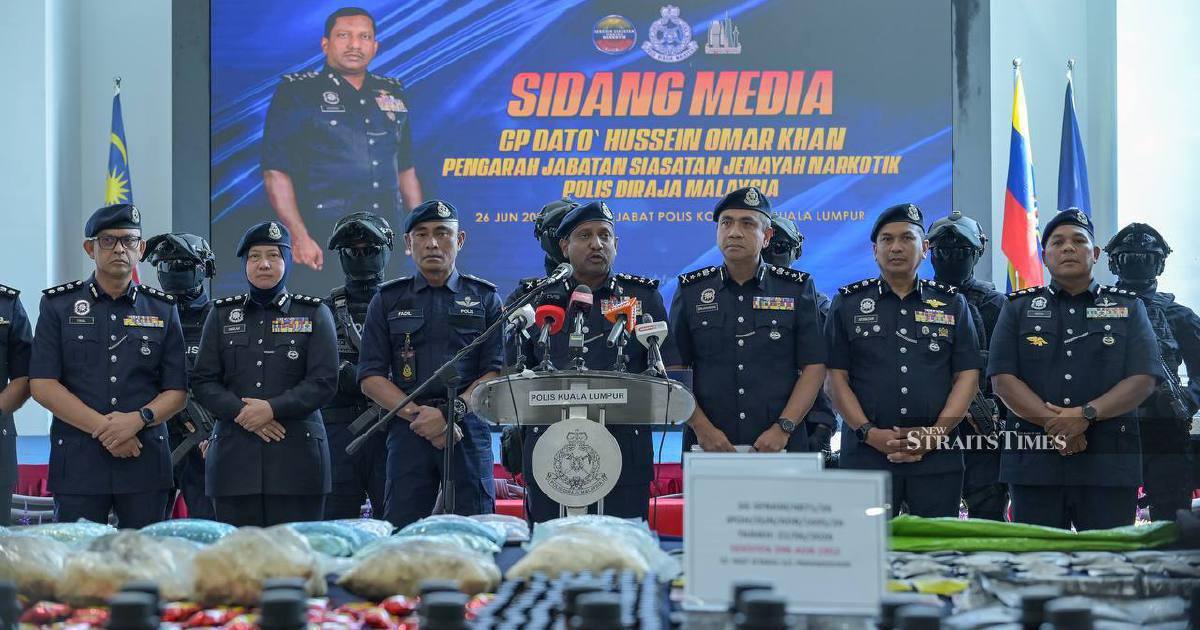
Malaysian authorities have executed a series of precision strikes against organised drug trafficking in Kuala Lumpur, impounding contraband substances estimated at RM135.63 million following simultaneous raids conducted in the Cheras district on June 20. The multi-pronged enforcement action culminated in the arrest of seven suspects, marking a significant victory in the country's ongoing war against narcotics distribution networks that have historically relied on urban warehousing operations to funnel illicit materials into communities across the peninsula.
The three coordinated raids represent the culmination of sustained intelligence gathering and surveillance work by law enforcement agencies, reflecting the increasing sophistication of police operations in targeting major supply chains. Rather than conducting isolated arrests, authorities opted for a synchronized approach designed to prevent suspects from warning associates or relocating stockpiles—a tactical shift that has proven increasingly effective in dismantling vertically integrated criminal enterprises. The timing and precision of such operations underscore the advancement in inter-agency coordination between different police units responsible for narcotics enforcement.
The sheer volume of the seized haul provides crucial insight into the scale of distribution networks operating within Malaysia's urban centres. A confiscation valued at RM135.63 million suggests authorities had intercepted materials destined for wholesale distribution rather than retail-level transactions, meaning the seizure likely prevented supply reaching hundreds of mid-level dealers who would have dispersed smaller quantities throughout neighbourhoods across Greater Kuala Lumpur and potentially neighbouring states. The financial impact on criminal syndicates can be severe, often representing months or years of operational profit.
Cheras, situated in the eastern corridor of Kuala Lumpur with established commercial and residential infrastructure, has emerged as a strategic location for criminal operations due to its accessibility to major transportation routes and proximity to distribution hubs. The district's mixed demographic composition and numerous commercial premises provide convenient cover for clandestine activities. Law enforcement agencies have increasingly focused resources on this area, recognising that disrupting operations at key geographical nodes can have ripple effects across broader networks.
The arrest of seven individuals raises critical questions about the hierarchical structure of the organisation involved. Criminal syndicates operating at this scale typically employ layered command structures with clearly delineated roles—handlers, warehouse managers, transporters, and street-level dealers. The identification of precisely how many individuals were apprehended suggests authorities have obtained actionable intelligence regarding the organisational composition of this particular network, potentially enabling further investigations into higher-level operatives who coordinate larger operations.
The stated objective of flooding local markets with these drugs represents an escalation pattern observed among trafficking organisations facing consolidation pressures. Rather than maintaining existing distribution channels, networks attempting to capture market share often deploy aggressive supply strategies designed to overwhelm existing competitors and establish dependency among users. Such tactics typically correlate with increased violence, territorial disputes, and destabilisation of communities, making this particular seizure's prevention of market flooding especially significant for public safety considerations.
For Malaysian society more broadly, the success of such operations provides tangible evidence that enforcement capabilities remain functional despite the persistent challenge of supply-side drug control. However, security experts emphasise that seizures, while impressive and important, represent only partial solutions within comprehensive drug policy frameworks. Each major interdiction typically prompts trafficking organisations to recalibrate routes, methods, and supply sources—often resulting in experimentation with more potent substances or refined smuggling techniques that create new enforcement challenges.
The economic dimensions merit careful examination. A RM135.63 million seizure translates to substantial loss for criminal enterprises, yet it simultaneously reflects the enormous profitability of drug trafficking that continues attracting new participants despite enforcement risks. Street-level markups on confiscated materials often exceed 300 to 500 percent, meaning the retail value of these drugs likely would have generated revenue several times the wholesale estimation, attracting perpetually renewed criminal investment regardless of individual operational failures.
Regional implications extend across Southeast Asia, where Malaysia functions as a critical transit point for narcotics moving between production zones in the Golden Triangle and consumer markets in Indonesia, Singapore, and Thailand. Disrupting distribution nodes in Malaysia can create temporary supply disruptions throughout the region, though organised trafficking groups maintain sufficient redundancy in their networks to quickly establish alternative routes. International cooperation remains essential, requiring Malaysian authorities to coordinate intelligence with counterparts across ASEAN member states.
The investigation following these arrests will likely prove as significant as the seizure itself. Interrogation of detained suspects may yield information regarding supplier networks, financial structures, and distribution relationships that extend investigation beyond the immediate Cheras location. Mobile phone records, financial transactions, and witness testimonies frequently expose connections to larger operations, enabling authorities to pursue cases against organisational leadership rather than merely incapacitating lower-level operatives.
Moving forward, the success of this operation demonstrates that intelligence-led policing focused on dismantling distribution infrastructure rather than pursuing isolated arrests can yield measurable results. However, sustained effectiveness requires continuous resource allocation, ongoing technological investment in surveillance capabilities, and persistent cultivation of community intelligence networks that provide early warning of emerging trafficking activities. The Cheras raids exemplify operational excellence, yet their true impact will manifest only if subsequent investigations generate prosecutions of organisational leadership and prevent reconstitution of disrupted networks.

