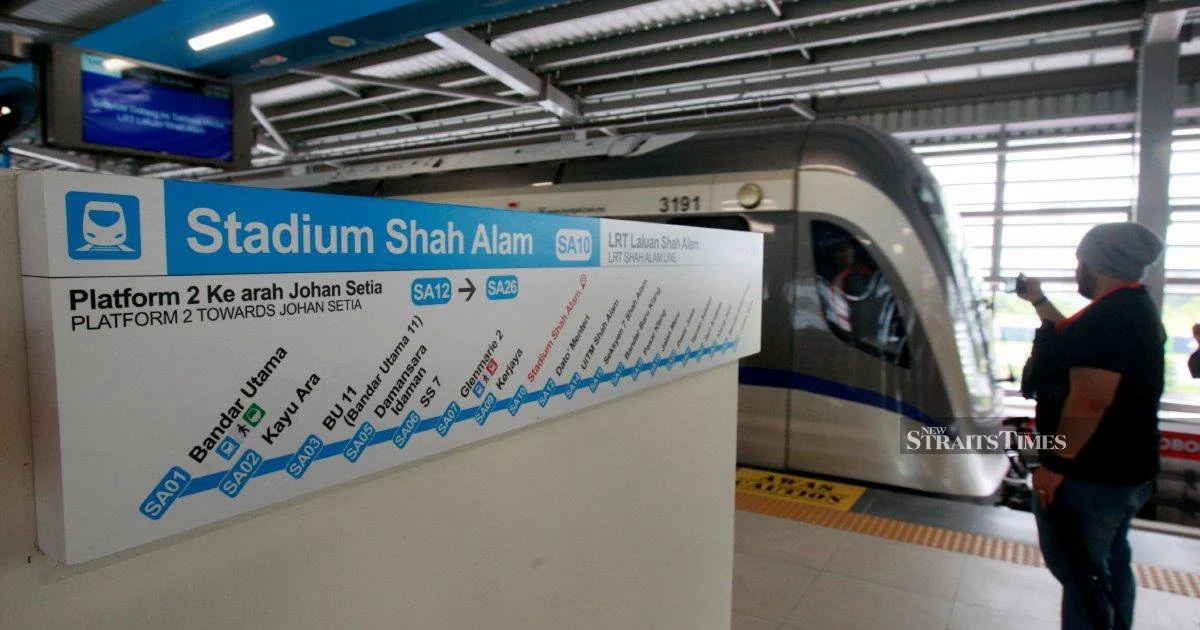
Prime Minister Datuk Seri Anwar Ibrahim is set to perform the official inauguration of the Light Rail Transit Line 3 Shah Alam extension on Sunday, marking a significant milestone in the nation's public transport infrastructure. The ceremonial launch will precede the commencement of regular passenger operations scheduled for Monday, formally bringing the line into full commercial service for commuters in the Selangor region.
The LRT3 Shah Alam line represents an important expansion of the Greater Kuala Lumpur transport network, extending connectivity to the industrial and residential areas west of the capital. This extension builds upon the existing LRT3 network, which has served the eastern corridor since its initial opening. The project reflects ongoing government commitment to developing integrated public transport systems across the Klang Valley, an area that accommodates millions of daily commuters and represents one of Malaysia's most economically vital regions.
Infrastructure development of this scale typically involves considerable coordination between multiple government agencies, transit authorities, and construction consortiums. The completion of this line represents the culmination of planning, engineering, and construction efforts spanning several years. The project's realisation demonstrates capacity within Malaysia's construction and project management sectors to deliver large-scale rail infrastructure, though such undertakings frequently encounter scheduling pressures and budget considerations that reflect broader challenges in managing complex public works.
The Shah Alam extension carries particular significance for residents and workers in areas that previously lacked direct rail connectivity to central Kuala Lumpur. Commuters in these zones previously relied predominantly on road-based transport options, contributing to traffic congestion during peak hours. Enhanced rail connectivity should encourage modal shift away from private vehicles, potentially alleviating pressure on major arterial roads serving the western Klang Valley corridor.
For the state of Selangor, which hosts significant manufacturing, commerce, and residential development, improved transit infrastructure addresses longstanding transportation constraints. The line's operational commencement will provide business districts, industrial parks, and residential communities with alternatives to car-dependent commuting patterns. This structural change in transport behaviour carries implications for urban planning, environmental quality, and economic productivity across the region.
The timing of the official launch reflects standard practice whereby government ministers perform ceremonial inaugurations ahead of public service commencement. This formal process allows for final safety verifications, system checks, and operational readiness assessments before welcoming regular passenger traffic. The weekend timing of the launch ceremony minimises disruption to the broader transport network while permitting appropriate media coverage and official documentation of the infrastructure's opening.
Regional transport dynamics throughout the Klang Valley have experienced gradual evolution as successive phases of the LRT network, monorail system, and bus rapid transit services have come online. The Shah Alam extension contributes to this expanding multimodal framework, though integrating different transit systems into seamless passenger journeys remains an ongoing challenge for authorities. Fare structures, scheduling coordination, and physical interchanges require continuous refinement to maximise the utility of diverse transport options.
Malaysian public transport development occurs within a context of increasing urbanisation and motorisation across the nation. While car ownership rates have risen substantially over recent decades, governments face pressure to invest in rail infrastructure as congestion management strategies. The LRT3 Shah Alam extension exemplifies this balance between accommodating growing transport demand and promoting sustainable urban mobility through rail-based alternatives to road travel.
The broader implications of this line's opening extend to property development patterns in the Shah Alam vicinity. Transit-oriented development typically flourishes around successful rail corridors, as residential and commercial projects position themselves to capture commuter demand. Property values near transit stations frequently experience uplift, incentivising investment and redevelopment within station catchment areas. These dynamics reshape urban geography and economic activity distribution across metropolitan regions.
Operational success of the LRT3 Shah Alam extension will depend significantly on factors including frequency of service, reliability of operations, integration with feeder bus networks, and acceptance among target commuter populations. Authorities will monitor ridership patterns, system performance metrics, and passenger feedback during initial operational phases. Challenges common to newly launched transit lines, including demand forecasting accuracy and operational procedures refinement, will likely emerge during early service delivery months.
For Malaysian policymakers, the Shah Alam line's completion provides evidence of continued capacity to deliver major infrastructure projects, alongside lessons regarding project execution, cost management, and scheduling. These experiences inform planning of future transit expansion schemes throughout the nation. Regional considerations also arise, as Selangor's development trajectory influences broader Klang Valley competitiveness and Malaysia's position within Southeast Asian urban hierarchies.
The official launch ceremony will generate significant public attention and media coverage, reinforcing government narratives regarding infrastructure development and public service provision. For residents gaining new rail access, the line's opening delivers tangible improvements to commuting options that accumulate across thousands of journeys daily. The extension exemplifies how infrastructure investment translates into practical changes in how millions navigate urban spaces and conduct their daily activities across Malaysia's premier metropolitan region.

