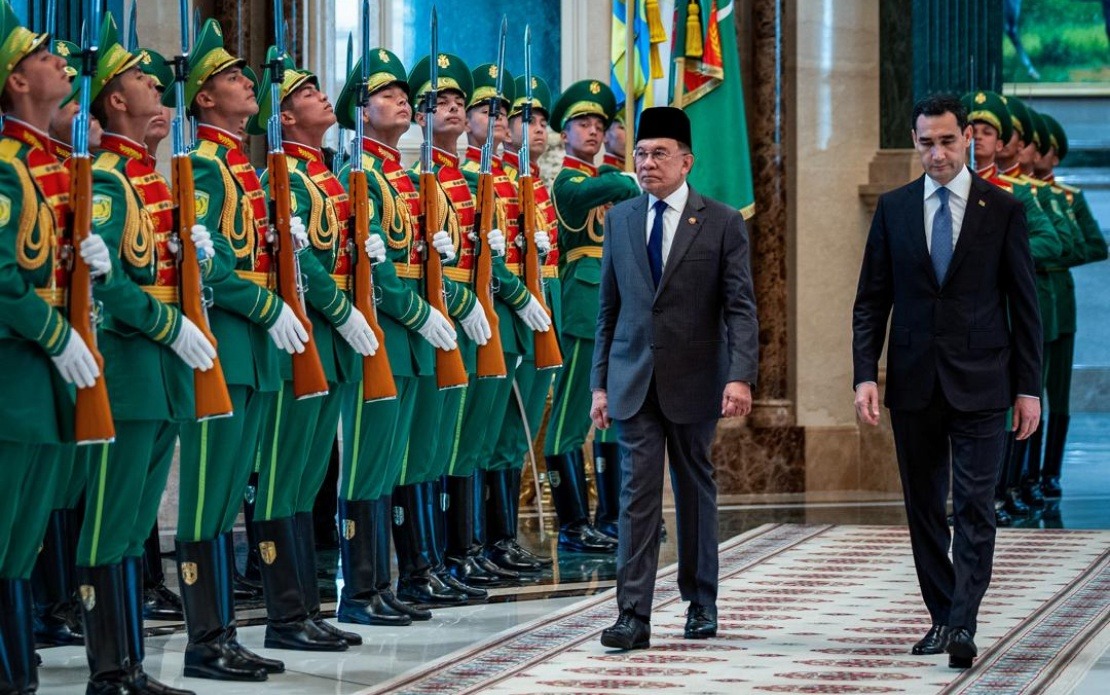
Prime Minister Datuk Seri Anwar Ibrahim was granted a full state reception at the Turkmenistan Presidential Palace on June 19, underscoring the significance Malaysia places on its relationship with the Central Asian nation. The ceremonial welcome, complete with military honours and national anthems, signals the government's commitment to expanding bilateral ties beyond Malaysia's traditional regional focus. This inaugural official visit since Anwar assumed office as Malaysia's 10th Prime Minister in November 2022 comes at the personal invitation of Turkmenistan President Serdar Berdimuhamedov, reflecting the mutual desire between both nations to strengthen diplomatic and economic partnerships.
The formal protocol observed during Anwar's arrival—including a full guard of honour and the playing of both nations' national anthems—reflects the ceremonial importance attached to the visit. Turkmenistan's President Berdimuhamedov personally received Malaysia's premier, a gesture that underscores Ashgabat's willingness to elevate relations with Kuala Lumpur. Beyond the ceremonial aspects, the reception included formal introductions between the Malaysian delegation and Turkmenistan's senior ministerial ranks, establishing the groundwork for substantive dialogue on shared interests. These introductions facilitate not only personal rapport among officials but also create pathways for functional cooperation across various government agencies.
Following the ceremonial reception, the two leaders engaged in private discussions before convening a full bilateral meeting. The confidential nature of initial talks between prime ministerial-level figures typically reserves sensitive matters or strategic discussions for this format, away from broader delegations. The subsequent bilateral meeting, conducted with full delegations present, allowed for comprehensive exploration of cooperation opportunities spanning trade, investment, cultural exchange, and diplomatic coordination. The structure of these engagements—progressing from intimate one-on-one discussions to broader bilateral forums—reflects established diplomatic protocol aimed at building personal connections before addressing substantive policy matters.
Malaysia's outreach to Turkmenistan represents a notable dimension of the country's foreign policy strategy under Anwar's leadership. Central Asia has historically remained peripheral to Southeast Asian diplomatic priorities, with most engagement concentrated within ASEAN and immediate regional neighbours. However, Turkmenistan's position as a resource-rich nation with significant energy reserves and its role as a gateway between Europe and Asia present compelling strategic and economic opportunities for Malaysian investors and policymakers. The nation's neutrality in international affairs and non-aligned status align with Malaysia's historical diplomatic approach, potentially creating common ground on multilateral issues and global governance questions.
Turkmenistan's economy, heavily dependent on natural gas and petrochemical exports, offers complementary opportunities for Malaysian corporations involved in energy trading, downstream petrochemical processing, and infrastructure development. Beyond energy sectors, Malaysian expertise in palm oil production, Islamic finance, and technology could find receptive markets in Turkmenistan and potentially throughout Central Asia. Conversely, Turkmenistan's manufacturing capabilities and transport links to European and Asian markets could benefit Malaysian exporters seeking alternative trade routes and market access. The timing of this inaugural visit suggests Anwar's administration views Central Asia as part of a broader diversification strategy in Malaysia's international economic engagement.
The two-day visit, which commenced on June 18, creates sufficient time for substantive discussions and potential announcement of cooperation frameworks or agreements. In contemporary diplomatic practice, visits of this calibre typically result in memoranda of understanding, trade agreements, or commitments to future institutional cooperation. Such outcomes would signal concrete achievements beyond ceremonial exchanges, providing tangible benefits to both nations' citizens and businesses. The duration also permits cultural and social engagements that humanise diplomatic relations and foster people-to-people connections, traditionally valued within Islamic diplomacy where Malaysia maintains particular cultural influence.
For Malaysia, engagement with Central Asia under Anwar's premiership reflects a more expansive global outlook than previous administrations. The region encompasses over 70 million people across five nations—Turkmenistan, Kazakhstan, Uzbekistan, Kyrgyzstan, and Tajikistan—representing substantial untapped markets and geopolitical actors of growing significance. As China and Russia intensify their Central Asian engagement and Western nations reassess their regional strategies, Malaysia's entrance into serious bilateral diplomacy positions the country as a non-threatening, commercially-oriented partner. This positioning could enhance Malaysia's influence in international forums and create leverage in regional disputes by establishing partnerships across diverse geopolitical blocs.
Turkmenistan, officially the Turkmen SSR during Soviet times and independent since 1991, has maintained a unique position of permanent neutrality recognised by the United Nations. This status shapes its foreign policy toward selective engagement rather than bloc alignment. The nation's substantial natural gas reserves—among the world's largest—combined with its position along ancient Silk Road routes make it strategically valuable for trade and transit corridors. Malaysia's engagement with Turkmenistan therefore carries implications extending beyond bilateral relations, potentially facilitating Malaysian access to Central Asian markets and positioning the country within emerging trade corridors that could reshape Asian commerce in coming decades.
Under Anwar's leadership, Malaysia has demonstrated renewed diplomatic activism across multiple continents and strategic regions. This Turkmenistan visit complements previous international engagement and reflects a deliberate effort to position Malaysia as a bridge between different regions and civilisations. The prime minister's travels and bilateral meetings contribute to Malaysia's soft power, cultural influence, and economic interests simultaneously. By establishing direct high-level relationships with Central Asian leadership, Malaysia increases its visibility among important geopolitical actors and creates platforms for advancing Malaysian interests in international organisations and regional forums where Central Asian states hold voting positions and institutional roles.

