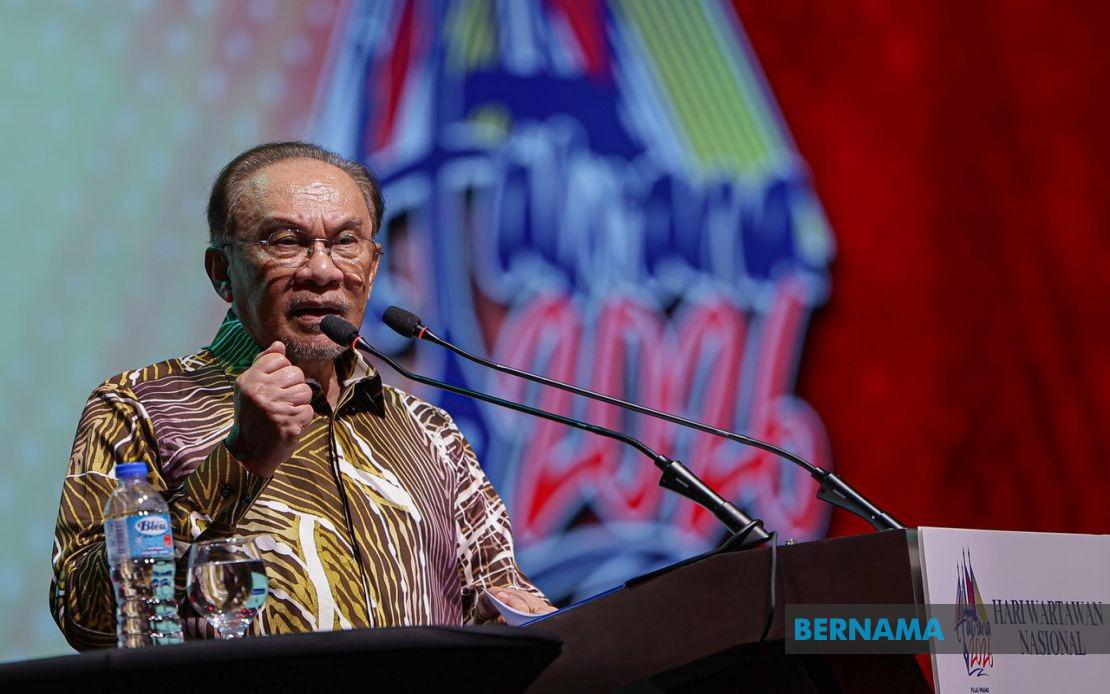
Prime Minister Datuk Seri Anwar Ibrahim has rallied behind the appointment of former Federal Court judge Tan Sri Nallini Pathmanathan to lead the Malaysian Media Council, describing the move as strategically designed to elevate the institution's public standing and restore credibility after years of scrutiny. Speaking at the National Journalists' Day (HAWANA) 2026 celebration in Butterworth on Thursday, Anwar underscored how Nallini's distinguished background in the judiciary would inject fresh legitimacy into an organisation tasked with self-regulation across Malaysia's diverse media landscape.
The Prime Minister's public backing carries particular weight given ongoing global conversations about media independence and the need for robust self-regulatory frameworks that command respect from both journalists and the public. By publicly endorsing Nallini during a high-profile event attended by senior communications officials and media leaders, Anwar signalled that the government views the Media Council's reformation as central to its broader vision for institutional integrity. His remarks went beyond ceremonial acknowledgment, directly attributing the appointment to meticulous evaluation of Nallini's judicial credentials, professional record, and personal integrity—factors he framed as essential to the council's institutional rebirth.
Nallini's selection represents a pivotal moment for the Malaysian Media Council, particularly following its statutory establishment under the Malaysian Media Council Act 2025. Unlike previous incarnations that operated without legislative foundation, the newly constituted MMC operates as a formal self-regulatory body enshrined in law, tasked with elevating journalistic standards across the industry. The council's mandate encompasses management of public complaints regarding media conduct, promotion of ethical journalism practices, and safeguarding press freedom as a foundational democratic principle. By appointing a former apex court judge, the government has signalled that it intends the council to function as an institution of genuine authority rather than a symbolic placeholder.
The unanimous endorsement from the MMC board on May 26 reflects broader consensus within the media establishment that Nallini commands the respect necessary to navigate the council's complex mandate. Her judicial tenure positioned her to adjudicate contentious matters and apply rigorous legal reasoning to ethical dilemmas—skills directly transferable to media regulation. In a region where media councils have occasionally faced accusations of political instrumentalisation or inadequate independence, Nallini's appointment sends a message that Malaysia intends to construct a credible institution capable of withstanding external pressure and maintaining professional standards without government micromanagement.
The event itself drew a constellation of high-ranking officials underscoring the government's institutional investment in media affairs. Penang Chief Minister Chow Kon Yeow's attendance connected the initiative to state-level governance, while Communications Minister Datuk Fahmi Fadzil's presence affirmed the portfolio's commitment to the Media Council's success. The gathering also included Communications Ministry leadership and representatives from Bernama, Malaysia's national news agency, indicating coordinated messaging across government communication structures. This orchestration suggests the administration views media regulation reform as integral to broader institutional modernisation efforts.
For Malaysian media professionals, Nallini's appointment addresses long-standing concerns about the legitimacy and effectiveness of industry self-regulation. A functioning, respected media council provides journalists with institutional protection against arbitrary complaints while maintaining standards that preserve public trust. By recruiting leadership from the bench rather than political circles or incumbent media figures, the government has attempted to bypass the perception problem that plagued previous arrangements. Nallini's judicial background insulates her appointment from accusations of political cronyism or media industry capture—two vulnerabilities that have undermined media councils across Southeast Asia.
The timing of this announcement reflects Malaysia's evolving relationship with media governance. As Southeast Asian democracies navigate tensions between press freedom and social media regulation, Malaysia's decision to strengthen its formal media council suggests deliberate positioning as a jurisdiction serious about industry self-governance rather than state censorship. This distinction carries implications for Malaysia's international standing and its influence within regional media networks. A well-functioning, credible media council can model best practices for other Southeast Asian economies grappling with similar regulatory challenges.
Nallini's mandate extends beyond managing complaints and disciplining errant outlets. The council must navigate the intersection of traditional media and digital platforms, a territory where regulatory clarity remains elusive across the region. Her judicial experience in interpreting legislation and weighing competing constitutional principles positions her to develop coherent frameworks addressing contemporary media ethics challenges. The former judge brings to the role a capacity for reasoned deliberation that distinguishes judicial temperament from political instinct—precisely what media self-regulation requires when balancing freedom with responsibility.
The formal establishment of the Malaysian Media Council under legislation, combined with Nallini's appointment, reflects a maturing institutional infrastructure around media governance. Rather than ad hoc regulatory responses or ministerial directives, Malaysia is constructing permanent, law-based frameworks designed to outlast particular administrations or political priorities. For Malaysian media operators, this provides greater certainty and predictability compared to discretionary regulation. Internationally, it positions Malaysia as a jurisdiction investing in institutional professionalism across media affairs.
Prime Minister Anwar's personal endorsement carries additional significance given his historical engagement with press freedom issues throughout his political career. His explicit framing of the appointment as enhancing public confidence—rather than merely technical administration—acknowledges that credible media regulation ultimately depends on social legitimacy rather than formal authority alone. By publicly championing Nallini's appointment and celebrating the council's reformulation, the Prime Minister has invested political capital in ensuring the institution succeeds, creating incentives across government for genuine cooperation with council initiatives.
The broader challenge confronting the newly reconstituted Malaysian Media Council involves proving that institutional independence and public credibility can coexist with government engagement. Nallini's judicial background provides moral authority, but operational success will depend on demonstrating that the council investigates complaints rigorously, disciplines media outlets evenhandedly, and advocates for press freedom when governmental pressure threatens journalistic independence. Her track record on the bench suggests she possesses the temperament for such demands, but implementation will ultimately determine whether this institutional reform translates into genuine improvements in media standards and industry credibility.

