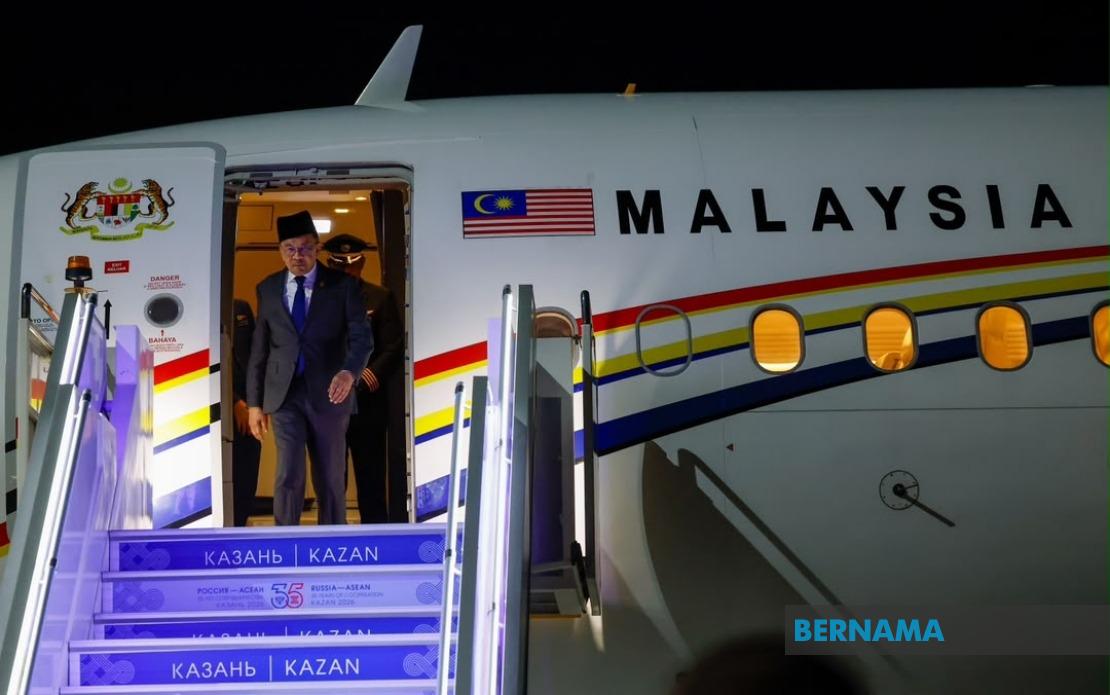
Prime Minister Datuk Seri Anwar Ibrahim landed in Kazan late on June 16, touching down at the city's international airport at 10.20 pm local time to begin a two-day working visit centred on the ASEAN-Russia Commemorative Summit. The arrival marks Malaysia's continued engagement with Russia at the highest levels, with the Prime Minister leading a substantial delegation that includes Minister of Investment, Trade and Industry Datuk Seri Johari Abdul Ghani and Minister of Economy Akmal Nasrullah Mohd Nasir alongside senior officials from both the Prime Minister's Office and the Foreign Ministry.
The timing of the visit underscores Malaysia's diplomatic priorities in what Wisma Putra characterised as an increasingly complex global environment. The summit itself, scheduled for June 17-18, carries particular significance as it commemorates three and a half decades of formal relations between the ten-member ASEAN bloc and the Russian Federation. Those ties first took root in Kuala Lumpur in 1991, representing a period when post-Cold War engagement was still finding its footing across the Asia-Pacific region.
Upon arrival, Anwar was received by Malaysia's Ambassador to Russia Datuk Cheong Loon Lai, while Russia's reception team was headed by Kazan's Mayor Ilsur Metshin alongside the Minister of Digital Development of Tatarstan Ilya Nachvin and State Protocol Department officials. The composition of the receiving delegation reflected both the diplomatic weight of the occasion and Russia's investment in bilateral and bloc-level relations with Southeast Asia.
The forthcoming summit is expected to function as more than ceremonial occasion. Officials have signalled that substantive discussions will span practical cooperation across multiple sectors, from traditional domains such as trade, investment and energy to emerging areas including digital economy development, science and technology collaboration, and cultural exchanges. Food security figures prominently in the agenda, reflecting shared regional concerns about supply chain stability and agricultural sustainability. Tourism and people-to-people linkages round out the scope, suggesting an intent to broaden the partnership beyond state-level transactions.
The summit is anticipated to produce four outcome documents that will structure cooperation through the remainder of this decade. The Kazan Declaration on the 35th Anniversary of ASEAN-Russia Relations will serve as the political cornerstone, while separate joint statements on energy cooperation and cultural cooperation will detail sector-specific commitments. Most substantively, the Comprehensive Plan of Action to Implement the ASEAN-Russia Strategic Partnership 2026-2030 will provide a detailed roadmap guiding the relationship's trajectory, establishing benchmarks and collaborative frameworks for the years ahead.
For Malaysia specifically, the visit represents a continuation of intensive engagement with Russia initiated since Anwar assumed office in November 2022. This marks his third journey to Russian territory in that period, following an September 2024 trip to Vladivostok for the Eastern Economic Forum and a May 2025 official visit to Moscow where he held substantive talks with President Vladimir Putin. Those earlier conversations had explored diverse cooperation domains including agricultural collaboration, aerospace technology, energy partnerships and educational exchanges, painting a picture of bilateral relations that extend well beyond political courtesies.
The summit agenda reflects Malaysian foreign policy objectives under Anwar's leadership. The government has positioned itself as an advocate for dialogue and peace in contexts of geopolitical tension, a stance particularly relevant given current great power dynamics. Malaysia simultaneously emphasises economic resilience at a time when global supply chains remain volatile, energy security amid transitions toward cleaner power sources, and food security given regional vulnerability to disruptions in agricultural trade. These positions resonate across ASEAN capitals and provide common ground for collective engagement with Moscow.
Anwar's scheduled bilateral meetings during the Kazan visit will extend beyond summit participation. Conversations with President Vladimir Putin will likely revisit the substance of their May 2025 Moscow discussions while exploring new collaborative opportunities. Discussions with the Rais of Tatarstan will touch on the republic's particular economic and developmental priorities. Parallel engagements with ASEAN counterparts attending the summit will enable Malaysia to coordinate positions on regional issues and bilateral concerns, reinforcing the consensus-seeking traditions of ASEAN diplomacy.
The broader context for this visit involves Malaysia's conscious effort to maintain balanced relations across the multipolar international system. By sustaining high-level dialogue with Russia through mechanisms like the ASEAN-Russia partnership, Malaysia preserves space for manoeuvre and influence in Asian geopolitics. The emphasis on ASEAN Centrality in Wisma Putra's framing reflects Kuala Lumpur's investment in the bloc as a platform for advancing Southeast Asian interests collectively, rather than exclusively through bilateral channels.
The summit's focus on energy cooperation holds particular relevance for Malaysia and the broader Southeast Asian region. Russia remains a significant supplier of refined petroleum products and liquefied natural gas to Asian markets, and formal mechanisms for energy dialogue can enhance supply security and price stability. Similarly, Russian technological expertise in digital economy development offers potential benefits for ASEAN nations seeking to accelerate digital transformation, particularly in areas like cybersecurity and digital infrastructure.
Cultural and educational cooperation frameworks emerging from Kazan may facilitate expanded people-to-people exchanges that strengthen mutual understanding between Russia and Southeast Asia. Enhanced academic partnerships, student mobility programmes and cultural initiatives can create lasting connections beyond governmental relationships, building constituencies within both societies that support constructive engagement. This people-centric dimension distinguishes contemporary diplomatic practice from Cold War-era state-only engagement.
The visit arrives at a moment when Southeast Asian nations are reassessing their foreign policy frameworks in light of shifting global alignments. Malaysia's participation in this summit, occurring at prime ministerial level with substantial delegation representation, signals that engagement with Russia remains integral to ASEAN's strategy despite broader geopolitical pressures. The outcome documents from Kazan will provide a foundation for that engagement through 2030, institutionalising cooperation across multiple domains and creating structured platforms for dialogue even during periods of international tension.
As Anwar prepares for summit participation and bilateral meetings in Kazan, the visit encapsulates Malaysia's approach to navigating great power competition while safeguarding Southeast Asian interests. Through mechanisms like the ASEAN-Russia Strategic Partnership, Malaysia seeks to ensure that the region remains a site of cooperation rather than confrontation, maintaining channels for dialogue and practical collaboration across diverse domains. The two-day visit will test whether that vision can yield tangible results in the form of substantive partnership frameworks and genuine advancement in shared objectives.

