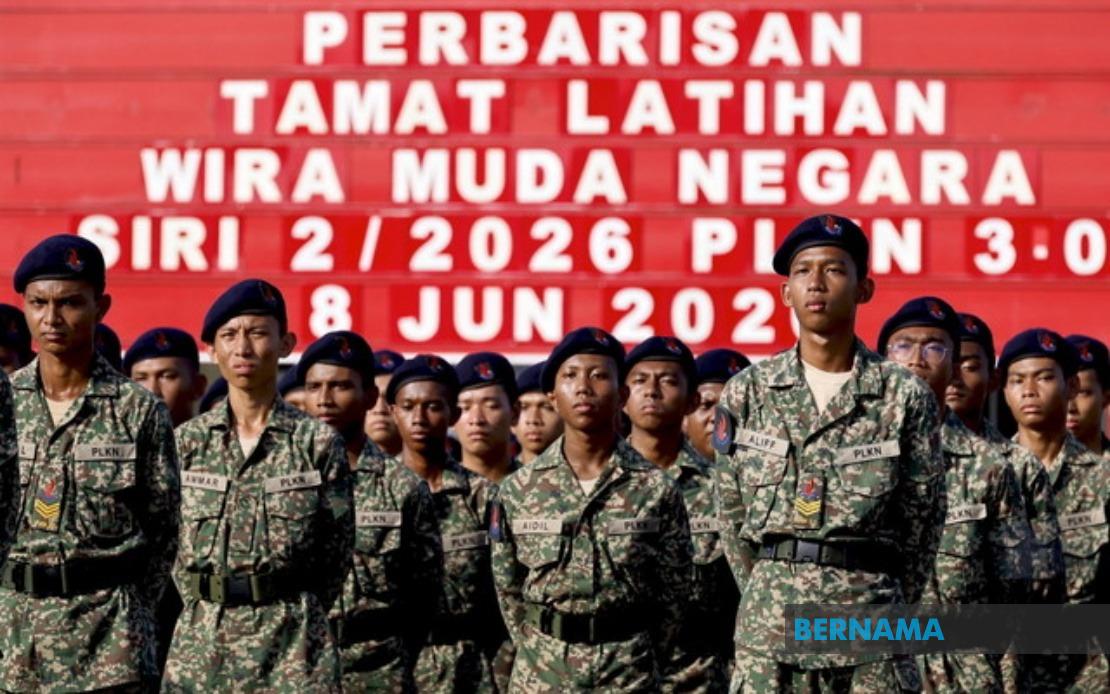
The National Service Training Programme, or PLKN 3.0, has successfully achieved every key performance indicator set for the initiative, with comprehensive impact assessments revealing substantial improvements across the six pillars of human capital development targeted by the training regimen. Deputy Defence Minister Adly Zahari disclosed these findings to Parliament on June 22, presenting evidence from formal studies conducted in collaboration with Universiti Malaysia Sabah and the National Defence University of Malaysia that tracked trainee progression both before and after completion of the programme.
Designed to foster national cohesion and personal development among young Malaysians, PLKN 3.0 established a challenging benchmark requiring participants to achieve at least 80 per cent proficiency across six distinct competency areas. These domains encompass patriotism and national identity, social unity and communal bonding, discipline coupled with personal transformation, psychological resilience and operational readiness, foundational military knowledge, and a commitment to voluntary service and civic engagement. The rigorous assessment framework reflects a deliberate strategy to measure tangible progress rather than rely on subjective impressions, with impact studies conducted before and after training to isolate the programme's actual contribution to participant development.
The statistical outcomes reveal particularly striking gains in military knowledge, where trainee competency surged dramatically from 56 per cent at programme entry to 84 per cent upon completion—a 28-percentage-point improvement that underscores the effectiveness of the technical curriculum. Volunteerism, already relatively strong at baseline, grew from 75 per cent to 83 per cent, indicating that the training environment successfully cultivates attitudes toward community service and social contribution. Patriotism demonstrated robust growth from 82 per cent to approximately 89 per cent, while social cohesion metrics expanded by nine percentage points overall. Perhaps most impressively, discipline and personal transformation capacity jumped from roughly 77 per cent to over 92 per cent—a near-16-point gain suggesting that the structured environment fundamentally reshapes trainee self-regulation and maturity. Mental resilience and psychological preparedness likewise strengthened substantially, climbing from 71 per cent to 83 per cent.
These findings assume particular significance for Malaysia's ongoing efforts to build social cohesion across its ethnically and religiously diverse population. By demonstrating measurable improvements in unity metrics among young people from varying backgrounds, the programme provides empirical support for structured national service as a mechanism for forging common identity and shared values. For policymakers evaluating the cost-benefit proposition of PLKN 3.0, the data offers concrete justification for continued expansion and resource allocation—a crucial consideration given competing budgetary priorities across government ministries.
While PLKN 3.0 explicitly avoids positioning itself as an employment scheme, the programme does offer tangible career advantages to graduates. Adly reported that five public sector recruiting authorities have agreed to award bonus merit points to eligible former trainees during hiring and interview evaluations, effectively translating programme participation into a competitive advantage for government employment. This arrangement creates a meaningful incentive structure without converting the initiative into a direct placement programme, preserving the training's focus on character and capability development while acknowledging its potential labour market value.
Access and inclusivity represent central design principles for the revamped programme, particularly given historical concerns about equitable participation across socioeconomic strata. PLKN 3.0 deliberately incorporates Technical and Vocational Education and Training elements into its modules, enabling meaningful participation from young people pursuing diverse educational pathways. This curricular integration reflects recognition that national service programmes must accommodate Malaysia's varied youth demographics and educational backgrounds to achieve genuine cross-sectional representation rather than skewing toward academically-tracked cohorts.
Participation figures demonstrate steady momentum, though remain modest relative to the youth population baseline. Through the second training series completed this year, PLKN 3.0 has enrolled 3,404 trainees total—comprising 1,202 participants during the inaugural year and 2,202 in the second series. This trajectory indicates growing awareness and uptake as the programme becomes established. The ministry targets 4,200 trainees by year-end utilising existing infrastructure across three operational camps, representing a measured scaling strategy rather than precipitous expansion that might compromise training quality.
Longer-term capacity projections reveal significantly more ambitious growth pathways. Nine additional training camps are in advanced preparation stages, with completion expected to boost annual capacity to 9,200 trainees. This near-tripling of throughput would represent a qualitatively different scale of national service delivery, substantially increasing the proportion of Malaysian youth experiencing structured military-civic training. For context, such expansion would enable coverage of growing age cohorts while gradually shifting PLKN from a selective to a more universal programme—a transformation comparable to how some developed nations approach mandatory or quasi-mandatory service systems.
Not all selected candidates successfully complete the programme, with Adly identifying health-related complications and ongoing educational commitments as primary reasons for non-reporting among selected trainees. This attrition pattern reflects the realistic tensions between military training demands and competing life obligations for young people. Understanding these barriers proves essential for programme refinement, suggesting potential need for flexible scheduling options, health screening protocols, or educational leave coordination mechanisms to improve completion rates without diluting training standards.
The parliamentary disclosure of PLKN 3.0's performance metrics occurs amid broader regional interest in national service programmes as tools for social integration and youth development. Malaysia's experience offers valuable evidence to neighbouring countries evaluating similar initiatives. Thailand's conscription system, Indonesia's military service tradition, and Singapore's mandatory national service all operate at substantially different scales and with varying objectives, yet all grapple with similar questions about efficacy, inclusivity, and societal return on investment. Malaysia's rigorous measurement approach and documented improvements provide a constructive model for evidence-based programme evaluation in the region.
The timing of these positive findings carries political significance as well. National service programmes frequently generate public debate regarding resource allocation, voluntariness, and relevance to contemporary youth concerns. By presenting quantified evidence of impact across measurable human capital dimensions, government officials can respond to sceptics with substantive data rather than assertion. This data-driven accountability approach strengthens institutional credibility and establishes baselines for future performance comparison, enabling continuous programme improvement rooted in objective evidence rather than anecdote or assumption.

