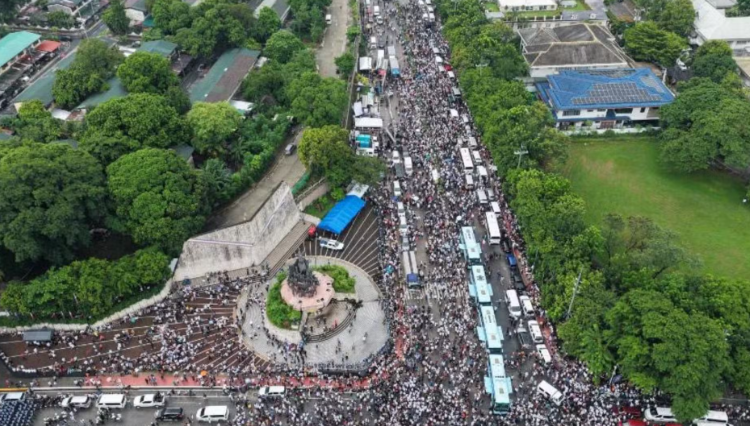
Thousands of devotees from one of the Philippines' most influential religious organisations descended on Manila's streets on Tuesday, bringing rush hour traffic to a standstill as they demonstrated against the impending legal troubles facing Senator Rodante Marcoleta. The demonstration by members of the Iglesia Ni Cristo (INC) stretched across kilometres of the capital's main thoroughfares, underscoring the sect's capacity to mobilise its membership on short notice—a reminder of its significant political clout in Philippine affairs.
The rally erupted just one day after authorities announced that Marcoleta, himself a senior INC member and steadfast ally of impeached Vice President Sara Duterte, would face graft charges centred on his failure to declare approximately 75 million pesos in residual campaign funds. The ombudsman's office, headed by Jesus Remulla, determined that the senator had violated disclosure obligations regarding his electoral contributions, a violation that could carry severe penalties under Philippine law.
What makes this particular case noteworthy extends beyond the narrow question of campaign finance irregularities. Marcoleta is widely viewed across Philippine political circles as virtually certain to vote against convicting Duterte when the Senate trial commences on July 6. With only 16 of the chamber's 24 members needed to remove the vice president from office and bar her from future elections, every vote carries substantial weight. The INC's visible backing of Marcoleta during this critical juncture suggests the church may be signalling its intention to protect a valued political asset.
On the ground in Manila, the situation created considerable disruption. Police reported initial crowd estimates of around 8,000 participants, with authorities bracing for further swelling as the day progressed. Regional police spokeswoman Hazel Asilo acknowledged that the congregation had paralysed commuter traffic, leaving only dedicated bus lanes operational while thousands of workers and students faced severe delays. The sheer scale of the gathering—accomplished with minimal advance notice—demonstrated the INC's formidable organisational infrastructure.
INC spokesman Edwil Zabala articulated the church's position in a Facebook video, framing the protest as a call for institutional transparency and fair treatment. He vowed that imprisonment of the senator would not silence the sect's demands for justice, declaring that selective enforcement of laws against their member constituted a fundamental injustice. Such rhetoric, while ostensibly focused on procedural fairness, effectively functioned as a show of strength on Marcoleta's behalf during a politically sensitive moment.
The INC's mobilisation on Marcoleta's behalf represents the latest chapter in a broader pattern of alliance between this powerful religious organisation and the Duterte political dynasty. The church commands loyalty among millions of Filipino devotees and possesses an unparalleled capacity to organise rapid, large-scale demonstrations. This institutional muscle has made the INC a perennial factor in Philippine electoral politics and high-stakes legislative proceedings.
Marcoleta's predicament arrives as part of a wider unravelling of the Duterte loyalist bloc in the Senate. Fellow Duterte partisan Senator Jose "Jinggoy" Estrada now faces charges stemming from his alleged involvement in a sprawling corruption scheme centred on fabricated flood control projects—a scandal that sparked public outrage and demands for accountability. Meanwhile, Senator Ronald "Bato" Dela Rosa, another Duterte associate, has evaded arrest authorities attempting to execute an International Criminal Court warrant linked to his participation in the former president's controversial drug war campaign.
The sequencing of these legal pressures against Duterte loyalists raises questions about whether prosecution efforts might be influencing political calculations within the Senate. The apparent timing—with major charges against multiple Duterte allies arriving just as the vice president faces trial—invites scrutiny regarding the tactical dimensions of these legal manoeuvres and their implications for legislative independence.
The INC itself has demonstrated its political engagement through several large-scale gatherings in recent months. Last November, the church mobilised an estimated crowd numbering in the hundreds of thousands to protest the flood control scandal, directing considerable criticism toward President Ferdinand Marcos despite the scandal's involvement of politicians across factional lines. In January 2025, the INC organised another massive rally opposing Duterte's initial impeachment, showcasing the depth of its institutional commitment to the former president's political interests.
Duterte's relationship with Marcos has deteriorated dramatically since their previous alliance, transforming the Philippine political landscape fundamentally. The current impeachment represents the second effort to remove Duterte from office within months, following a Supreme Court reversal of an earlier impeachment. Her conviction would require 16 affirmative Senate votes, a threshold that appears achievable but hardly inevitable given the fractious nature of Philippine legislative coalitions.
The timing of the INC demonstration appears calculated to reinforce Marcoleta's value to Duterte while simultaneously pressuring other senators to consider the political costs of opposing him. President Marcos cancelled a scheduled foreign press luncheon to monitor the unfolding situation, indicating the government's assessment that the protest warranted high-level attention. Such a response underscores the genuine political significance that institutional demonstrations can carry within the Philippine system.

