Puteri Mas Aishah Ramyusnali, a 24-year-old artist from Penang, has discovered that sunlight is far more than a daily convenience—it is her primary creative partner. Through cyanotype, an ancient photographic printing method that relies entirely on solar energy, she transforms ordinary paper into striking blue compositions that speak to the intricate relationship between human creativity and the natural world. Her journey into this distinctive artistic discipline over the past three years has fundamentally altered how she understands the environment's role in human expression.
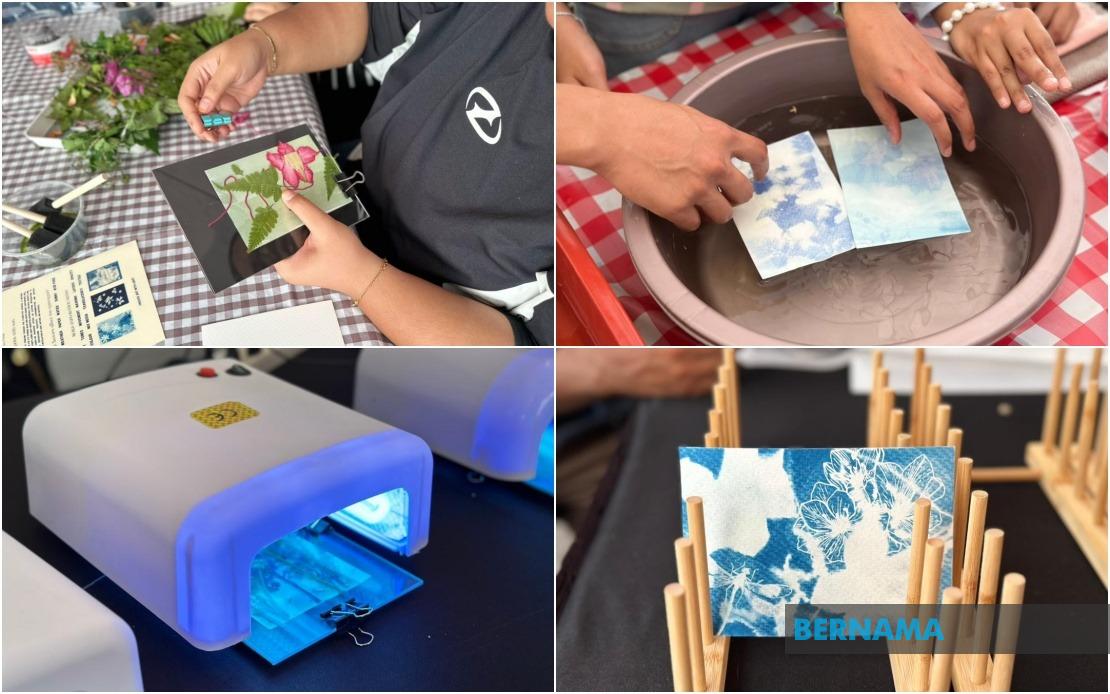
At its essence, cyanotype is elegantly simple yet profoundly dependent on natural forces. Puteri Mas Aishah describes the process with evident enthusiasm: artists first coat paper with a light-sensitive chemical solution, then arrange botanical specimens—leaves, flowers, twigs, or other natural objects—directly onto the prepared surface. The arrangement is then exposed to sunlight for 10 to 15 minutes, allowing ultraviolet rays to chemically alter the paper around the objects. Once the organic materials are removed, the paper undergoes washing in acidic and alkaline solutions, during which the characteristic deep cyan-blue image gradually emerges. What appears straightforward on the surface actually demands considerable attentiveness to environmental variables.
The unpredictability of weather and atmospheric conditions forms the artistic crux of cyanotype work. Unlike digital or traditional darkroom photography, where controlled lighting is engineered, cyanotype practitioners must engage directly with meteorological reality. Puteri Mas Aishah emphasises that tracking daily UV intensity and cloud cover is not peripheral to her practice—it is fundamental. Stronger ultraviolet exposure produces richer, more saturated blue tones, while overcast skies yield softer, more muted results. Water quality in the washing stages similarly influences the final appearance. This dependency on natural conditions forces artists to abandon the illusion of complete control and instead collaborate with atmospheric conditions as an active partner in creation.
Currently pursuing a Master of Fine Arts and Technology degree at Universiti Teknologi MARA, Puteri Mas Aishah stumbled upon cyanotype during industrial training when she was tasked with introducing the technique to the general public through practical workshops. Initial apprehension about guiding participants without direct supervision from her academic mentors quickly transformed into confidence and deeper commitment. That pivotal experience proved to be a turning point, catalysing her evolution from student practitioner into an active educator and workshop facilitator. She now regularly conducts cyanotype sessions across art studios and galleries in Shah Alam and the Selangor region, broadening access to a technique that remains relatively obscure in Malaysian artistic circles.
The broader significance of her work extends beyond technical mastery or aesthetic appeal. By introducing cyanotype through public workshops and collaborative gallery projects, Puteri Mas Aishah advocates for a reconceptualisation of art's societal function. She challenges the widespread perception that art represents an ornamental luxury disconnected from everyday concerns. In her view, artistic practice—particularly when grounded in natural processes—offers a tangible pathway for people to deepen their environmental awareness and reconsider their ecological relationship. Cyanotype workshops become spaces for contemplating weather, sunlight, water, and botanical life not as abstract environmental concepts but as immediate, tactile participants in creative work.
The RIUH Pi HAWANA Carnival at the PICCA Convention Centre in Butterworth provided a public platform for her vision, allowing workshop participants to experience firsthand how dependent artistic creation can be on natural phenomena. Such community engagement initiatives prove especially valuable in Malaysia, where art education often emphasises technical skill over philosophical engagement with environmental systems. By demystifying cyanotype and enabling ordinary visitors to produce compelling botanical prints, Puteri Mas Aishah chips away at the notion that meaningful artistic practice requires expensive equipment, sophisticated technology, or exclusionary expertise.
Her emphasis on engaging young people carries particular weight. Malaysia's younger generation navigates increasingly complex environmental challenges—from deforestation to climate shifts to water scarcity. Introducing art forms that inherently require awareness of weather, sunlight, and water quality can catalyse a different relationship with these elements. Rather than experiencing environmental factors as abstract data points or distant policy concerns, participants in cyanotype workshops encounter them as immediate, creative forces shaping their own artistic output. This embodied engagement potentially cultivates more nuanced environmental consciousness than conventional educational approaches.
The intersection of artistic practice and environmental awareness that cyanotype represents also resonates within broader Southeast Asian artistic and cultural contexts. The region's rich botanical heritage and diverse ecosystems provide abundant material for cyanotype work. Yet the technique remains relatively uncommon across Malaysia, Singapore, and neighbouring countries compared to its established presence in European and North American art communities. Puteri Mas Aishah's advocacy and teaching efforts contribute to expanding the technique's footprint regionally, potentially inspiring other artists to explore similar nature-dependent creative processes.
Her commitment to demonstrating art's relevance to contemporary life reflects a growing movement among emerging artists worldwide who reject the compartmentalisation of creative practice from social and environmental concerns. Rather than treating art as a rarefied pursuit isolated from quotidian existence, practitioners like Puteri Mas Aishah position their work within the texture of everyday environmental experience. The blue tones emerging on her cyanotype papers carry within them the particular weather of a specific day, the specific leaves or flowers that grew in specific soil, the specific water that washed the print. Each artwork becomes a record of material entanglement rather than a detached aesthetic object.
Looking forward, Puteri Mas Aishah's vision extends beyond her own artistic output to encompass a cultural shift in how society values and engages with creative practice. She aspires for young Malaysians to embrace art not as something separate from life but as an integrated dimension of human existence—a medium through which we actively negotiate our relationship with the living world. By grounding her artistic philosophy in cyanotype's necessary dependence on natural systems, she offers both a practical technique and a conceptual framework for rethinking art's social role. Her hope that art might be recognised as integral rather than trivial reflects not merely professional ambition but a conviction that creative practice can catalyse deeper environmental consciousness and more thoughtful inhabitation of the material world.

